Showing posts with label "On Tango". Show all posts

Tuesday, February 10, 2009

Tango is in trouble...

From ruddy...this is one of those "must reads" that rises to the surface periodically...interesting stuff...


Hola Naifas y Garabos,
this has been an interesting topic, albeit IMHO just
another round in the seemingly endless battle between
the conservative and liberal camps of the tango spectrum.

Coincidentally, a friend of mine who just came back from
Buenos Aires posted the following in a local tango list:


...
Tango is in trouble. Living in our own world of music and dance, we
are failing to see it. The milongas in Buenos Aires are full. And
when they are not, the practicas are (100-300 people). But in the
real world, outside of the milongas, the picture looks very different.

Argentines, essentially, are boycotting the tango. Many even hate
it. Out of 100 radio stations in Buenos Aires, only one plays tango
music. Argentine companies do not use tango music in their TV
commercials, preferring rock, foreign or national. And Argentine
people that love tango music are in despair. They no longer have
hope that the young Argentines will embrace the tango. Many also
have lost hope in the Europeans. But they have a lot of hope in the
Americans.

Many Argentine people that are involved with the music of tango, such
as tango historians and others, who may not even dance themselves,
feel that the Americans have a genuine interest and love for tango
music. It appears that many people from the US are buying a lot of
tango music, and not just the most obvious selections, but things
that are rare, and they know what they are buying because they have
been looking for it. These Argentine tango historians look at the
Amerian dancers and DJs with respect and hope. They believe that if
anyone can save the tango, it will be the Americans that love it.

There are many young people (18 +) in Buenos Aires, who dance
beautiful traditional tango with great style and energy, and they do
not dance "nuevo" or dance to electronic tango (both of which seem to
be the domain of dancers outside of Argentina). Instead, they love
to dance to Donato, Canaro, Lomuto, etc. But there are not enough of
them to keep tango from oblivion.

Traditionally, tango orchestras played at the milongas, sometimes as
many as four or five on the same night at the same milonga. There
was also recorded music. Each orchestra had its own unique sound,
and each orchestra's signature was their endings. After the WWII,
there were only two recording studios - Victor and Odeon. As a
result, many orchestras recorded either very little or not at
all. Those that recorded, left a legacy unmatched by anything else
from the more recent history of tango.

Why are the recordings of Pugliese, made in August of1945, have a
very special feel, something very haunting and beautiful that does
not appear in his later recordings? This was the first recording
that Pugliese did with his musicians as a full orchestra. Maybe we
feel that excitement in the music. It was a precious moment for
those musicians.

And what about Orquesta Tipica Victor? That was a special
time. Victor created a tango orchestra that never played in
public. They only recorded. But many, many musicians played with
them. That is why the sound of Donato and Carabelli powerfully
echoes OT Victor.

Because each orchestra had a different feel to their music, the
dancers became very selective regarding who they danced with to
particular music. The tandas maintained the feeling and the dancers
were never surprised by a sudden change. The lyrics of tango also
played an important part. The poetry of tango is beautiful,
memorable, and often painful. It was often written by very famous poets.
...


If, as my friend says, we Americans are the last hope for
tango, I think the tango will not last to celebrate its 200th
anniversary.

Best regards,
--
ruddy

Wednesday, December 31, 2008

Imagine :: Happy New Year

Imagine a happy, peaceful, healthy and prosperous New Year. Then dance it into existence.

Sunday, September 21, 2008

On Tango :: A Letter To My Friends

Some of you may have picked up on the fact that my thirty year high school reunion is this coming Saturday. I have reconnected with bunches of high school friends, and their curiosity has been piqued about tango - this dance that I seem to be obsessed with. I could write for hours on the subject, so it will be challenging to keep this brief. All of my blog friends, and others "in" tango understand about this - explaining to family and friends - "non" tango folks - explaining what tango is all about. It can be a difficult thing to convey.

Okay, here we go, off the top of my head.

First, I use the word "tango" to describe Argentine tango, which is not American/Ballroom/International Tango which is what you see on "Dances With The Stars".

Tango is chess. Salsa is checkers.

Tango is probably the most difficult "casual" "social" dance you can endeavor to learn - ballet would be harder.

There is no head snapping movement in tango. There are no roses in the teeth with tango. That's Flamenco, an entirely different dance - from Spain.

The fedora is an unfortunate stereotype from one particular aspect of tango in years past - the "dandy" character - which I won't go into. Real men do dance tango, but real men do not wear fedoras indoors at night in the presence of women.

Tango sprang forth from the cultural melting pot of Buenos Aires - from very early beginnings in the 1880's through the 1920's. The "Golden Age" of tango was in the 1930's and 1940's. Argentine tango was actually very popular in Europe in the 1910's and 1920's - before it became all the rage in Argentina. There have been changes - ebbs and flows - in the culture of tango in Buenos Aires over the years - mostly due to the military dictatorships in Argentina. Tango has enjoyed a resurgence in the U.S. and Europe since the late 1980's and early 1990's.

Tango is a feeling...that you dance.

Tango is all about the music, and the connection with your partner. The dance and the movement flow from the music, which we refer to as "musicality". It flows "from" the music, but to outside observers, it appears that the dancers are dancing "to" the music.

Tango is not about showy or flashy moves or figures. It is danced between two people, for their own mutual enjoyment and the social aspects of the dance. They don't dance for an audience, and there is no competition nor competitive events for Argentine tango.

However, there is "show" or "fantasia" or "stage" tango which is danced in the shows (on stage) in Buenos Aires and traveling tango shows around the world. There are varieties or styles of tango which include "salon" (dynamic embrace between open and close), "milonguero" (almost entirely unbroken close embrace), and "fantasia". Am I missing one?

Tango is purely improvisational, with no choreography or memorized steps. Many people migrate over from ballroom dances for this reason. There are "fundamentals" and "vocabulary", but each leader is interpreting the music in his own way. Prior to tango's emergence in the early part of the last century, partner dances required everyone to do the same exact steps at the same exact time. Tango was also the first partner dance to bring the leader and follower into close proximity/contact with each other.

Sometimes, the connection between two dancers can be so intense and intimate that evokes a strong psycho/meta/physical response. Some call it a "tango trance", some call it a "tangasm". A guy named Dan Boccia up in Alaska came up with the best definition of a "tango trance" that I have run across - "the state of being so completely immersed in the music and so profoundly connected to your partner that movement flows from within the partnership uninhibited by conscious thought..."

It can take one to two years or more for a leader to get to the level where he is dancing "uninhibited by conscious thought". There are leaders who have been dancing tango for six years and still don't get it, and some prodigies who "get it" after only six months.

The learning curve for followers is less steep - I would say in one or two months (of weekly classes) a follower will have the basics down enough to start dancing socially.

A social dance party/event is called a milonga. There is also music called "milonga" and the dance that you dance to that music is "milonga". So, you can dance milonga, to milonga music, at a milonga. Confusing, I know. Then there is "tango", and "vals" or waltz. Milonga, Candombe, and Canyengue are all precursors to tango - they existed before tango and tango evolved out of these dances.

The lead is all from the connection and the torso. There are no hand signals or use of the arms or verbal cues in the dance. The follower has to be very in tune with the leader - she has to "listen" to the lead - feel the lead - wait for the lead.

One of the most difficult aspects of tango for followers is the concept of "surrender". Not submission. Not subservience. Not passivity. She must surrender to be led. She must "give" herself to the leader to be led. I can feel it in the first three seconds of the embrace either she wants to be there with me, in that moment, and gives herself to me, or not. Brand new beginners can nail the surrender in the first embrace. Long time followers can have no clue of what it means to surrender. There is much debate about whether this can be taught/learned or not.

There is to be no backleading by the follower. I have been backled very rarely, and always only once with that follower, because I will never invite her to dance again.

Invitations are more verbal in the U.S., but in Buenos Aires there are "codigos" or guidelines that call for the use of "cabeceo", or non-verbal invitations by raising the eyebrows with a slight nod. If the woman accepts, she will meet the man's eyes and nod back. If she wishes to decline, she will avert her eyes.

Tango is a walking dance. The upper body is very still and level - "liso" or smooth. There is no hip action like in salsa dancing.

The leader should always walk the follower back to her table after the dance - if she was in a tango trance, she may not know where she is on the dance floor in relation to her table.

Tango music is played in groups of three or four songs called a "tanda", which are separated by a non-tango clip of a song 30 seconds long or so. These are called "cortinas" or curtains, and allow the dancers to change partners between tandas. Once you've invited a woman to dance, you've committed to the entire tanda. The parties say "thank you" at the end of the tanda. "Thank you" means "I'm done". If a woman says thank you after the first song, it means she is having a really unpleasant time and needs to end the dance immediately. This is rare.

Tango is all about the woman. Hold her in your embrace. Protecting her from other leaders bad navigation on the dance floor. You want her to feel safe and protected with you.

Tango typically is all about dancing with various partners. Some married couples dance only with each other, but even that is rare. Some women dance tango without their husbands - hubby is off fishing or hunting - and she is out dancing tango.

It's about the dance, the connection with another human being, the music, the socializing with friends - it's not about sex. Tango has a reputation of being sensual and intimate, which it can be - but there is a line that people generally do not cross. The sensuality and intimacy ends at the edge of the dance floor - it ends with the end of the three or four song tanda. The songs are roughly three minutes each - so the dance with a partner lasts 10-12 minutes.

Sometimes, I can feel a woman's heart fluttering against my chest.

All tango music is very old. Most of what we listen to is from the 1920's through the early 1950's. After that, the orchestras disbanded during the military junta and in general, never regrouped. There are newer orchestras and quartets and quintets, but they are just not able to duplicate that original sound and feeling. There is also newer electronic (and unplugged) music called "Nuevo" or "Alt" Tango.

Tango can be addictive. They say "you don't choose tango, tango chooses you...". Some people approach it as a hobby, take classes in other dances like swing and salsa and two step and may move away from tango over time.

Others, like me, know that they are addicted to this dance for life. I eat, sleep and breathe tango. I think about it all the time. I listen to tango music all the time - at least when I'm not listening to Jimi Hendrix, The Allman Brothers, Johnny Cash, etc. I started dancing tango about four years ago. I've been writing this blog for a year and a week.

Because, you see, it's not "just" a dance. It's a feeling. It's a culture. It's an art form. It's a social outlet and event. It can become a part of your life, or it can become your life.


Here are a bunch of sayings and quotes about tango I have collected over the past year...

"It's not so much that he led me, but more like he willed my movements..."

"Life is like Tango... sad, sensual, sexy, violent and quiet."

"Tango is like riding a bike, there are no standard memorized movements that you have to recall..."

"Tango is like a language - you learn the alphabet, the vocabulary, the definitions, the grammar, the style and usage - then you can write whatever you like...."

"Other music exists to heal wounds; but the tango when sung and played is for the purpose of opening them, for the purpose of sticking you finger in the wound and to tear them until they bleed."

"Tango is not a dance, it's a feeling. And how do you teach a feeling?"

"We dance tango because we have secrets." :: Marilyn Cole Lownes

"Great dancers are not great because of their technique; they are great because of their passion." :: Martha Graham 1894-1919, Dancer, Teacher and Choreographer

"I come to tango to relax - the music carries me and makes a dance for me. With other music, I have to make a dance myself"

"I believe that Tango has the potential to bring out the best in each of us, at least while in the embrace. We surrender our egos; leave prickly personality traits at the table; and cease to be CEOs, taxi drivers, engineers, unemployed. We replace all our externals with a purity of spirit, a generosity of kindness, splendid caring. And when these elements flow freely between partners, it is...the joy." (Johanna Siegmann)

"Tango is not about what is done, but how it is done"
(E. Santos Discepolo)

"Please, just for me, forget the steps...hold me, feel the music, and give me your soul. Then I can give you mine." [Sallycat]

Said by "El Flaco" Dany Garcia, subsequently interpreted by others - and now paraphrased here by me: "The music goes in my ears, is filtered through my heart, and comes out through my feet."

>The tango trance.
>
>Seek it, and it will elude you.
>Talk about it in too much detail.
>and it will haunt you evily.
>Live for it, and you will die many deaths
>
>Treasure it, but don't hold onto it.
>Dance with love and freedom.
>and it will embrace you.
>Be vulnerable, and feel it's power.
>
>Dan Boccia

"Tango can save your life, and it will break your heart." [Credit - Ms. Heartbreak Tango]

"I have tasted a lover's tears on my lips. But I have never felt his eyeballs moving inside their sockets." [Ms. Nuit of La Nuit Blanche - found by Ms. Heartbreak Tango]

“The tango can be debated, and we have debates over it,
but it still encloses, as does all that which is truthful, a secret.” [Jorge Luis Borges]

There is the now cliche'd one from the film "The Tango Lesson", Sally Potter asks Pablo Veron “How did you choose the tango?”, and he replies “I didn’t. The tango chose me.” So we now often hear the saying…”You don’t choose tango, tango chooses you…” [I suppose credit goes to Sally Potter, who I assume wrote the screenplay.]

“The follower feels the first half of the sentence [from my lead], and then she completes the second half of the sentence...” [Murat Erdemsel]

“Surrender Tango [a documentary], delves into the mystery of the tango connection--why sometimes you lose yourself in your partner's arms and other times three minutes seems like three hours. This thirty-minute film goes beyond tango as a dance to tango as a metaphor for relationships. The rules and roles of tango partnering reveal how giving space actually creates more intimacy. The film breaks down various aspects of the dance to see how a good embrace is about sharing; the lead is about clarity and commitment; the follow is about sensitivity and surrender. But surrender requires that the dancers be centered and independent of each other before they can truly give themselves to each other. Sensuality is the fusion that adds tension and excitement to the dance and music is the glue that holds the couple together.” [Film Commentary about the documentary film “Surrender Tango” – produced and directed by Tango dancer Marcia Rock]

A famous quote attributed to Enrique Santos Discepolo, a poet, journalist and philosopher, "Tango is a sad thought that is danced."


And some "general" dance quotes...

Movement never lies.
~ Martha Graham

Dancers are the athletes of God.
~Albert Einstein

A day I don't dance is a day I don't live.
~ Anonymous Tunisian dancer

Dancing is like dreaming with your feet!
~ Constanze

Only the wise can dance the rhythm of life.
~ Unknown

Nothing is more revealing than movement.
~ Martha Graham

Dance first. Think later. It's the natural order.
~ Samuel Beckett

Dancing is a relatively safe form of intoxication.
~ from Copeland & Cohen

Don't dance for the audience; dance for yourself.
~ Bob Fosse

Dance is not something to talk about. Dance is to dance.
~ Peter Saint James

Everyday I count wasted in which there has been no dancing.
~ Nitzsche

We're fools whether we dance or not, so might as well dance.
~Japanese Proverb

There are short-cuts to happiness, and dancing is one of them.
~ Vicki Baum

Will you, won'te you, will you, won't you, will you join the dance?
~ Lewis Caroll

It is impossible for a man to learn what he thinks he already knows.
~ Epictetus


There are tango communities in most major cities and smaller towns across the U.S. and around the globe.

I'll post some YouTube videos tomorrow...this is enough to digest for now...so much for brevity...

To sum this all up, tango has changed my life. Four years ago I was a rhythmic retard and was always uncomfortable/inhibited about getting up there and dancing. To sum up, if you've been thinking about taking up dancing - do it - whatever the dance may be. Just do it.

Lastly, here are a couple of links:

Some of my tango photos on flickr ::

http://www.flickr.com/photos/tangofuego/sets/72157601479609026/

My favorites on my YouTube Channel :: (you will have to glean through some non-tango stuff)

http://www.youtube.com/profile_favorites?user=zgman

Saturday, July 26, 2008

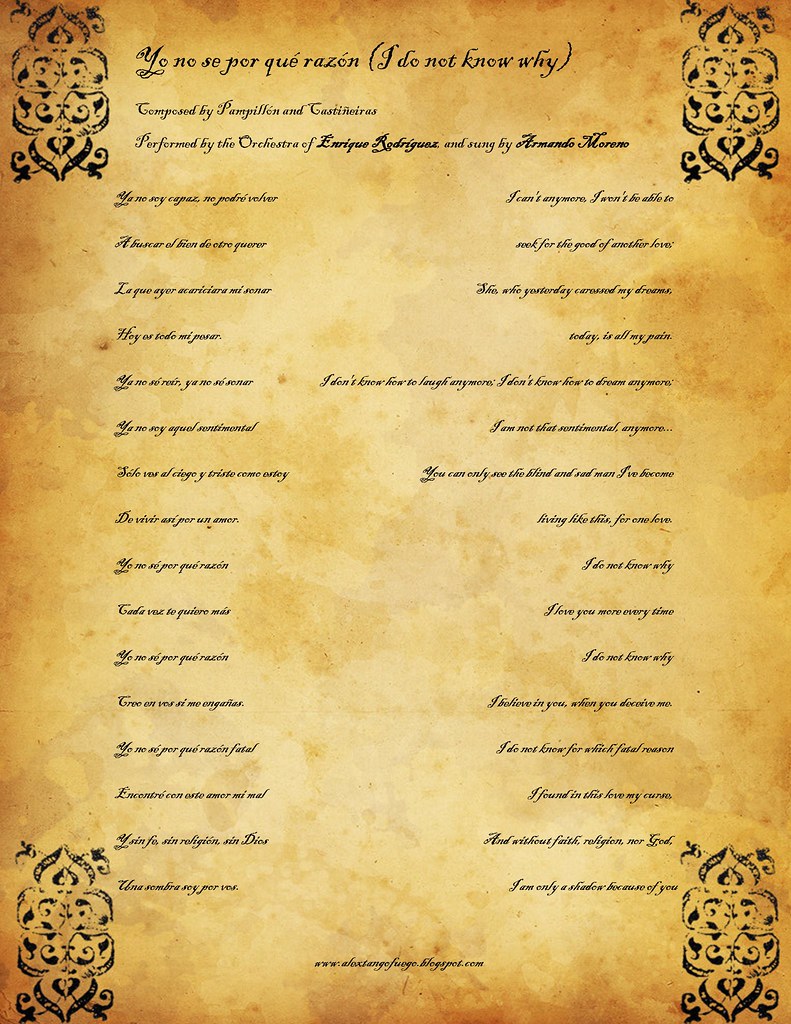
Yo no sé por qué razón

For the song, the lyrics, not the dancing...although the dancing ain't too shabby...

Sticking with my "no judgement"...and policy of Nondiscrimination on the Basis of Race, Sex, Color, National Origin, Disability, Religion, Age, Sexual Orientation, Status as a Parent, Politics, Carbon Footprint and Tango Orientation...here are two versions...

I love this song, but alas, it does not find itself in my collection...anyone willing to help me with that?

Kinda nuevo-ey...Claudio y Diana


Most definitely nuevo...Gaston y Mariela


Yo no se por que razon

Sunday, July 13, 2008

Three Women of Tango :: by Terence Clarke

I ran across this here.

Three Women of Tango, by Terence Clarke

1.

There is a tango entitled "Tengo Miedo", written in 1929.

Tu cariño me enloquece.
Tu pasión me da la vida.
Sinembargo tengo miedo,
tengo miedo de quererte.
(Your affection drives me crazy.
Your passion gives me life.
But just the same I'm afraid,
I'm afraid to love you.)

In New York some years ago, I danced occasionally with Julietta, a woman who had had three husbands, two of whom she had left. The third was named William, a retired American investment banker who was a tall and quiet New England Protestant who'd attended Choate and Harvard. He was quite well-spoken despite his shyness, gray-haired and usually clothed in New England tweed, a blue dress shirt and an old-school tie, and he treated Julietta with extraordinary kindliness. He was many years older than she. They lived on Sutton Place and were of such polished elegance that they seemed simply out of place dancing Argentine tango.

She was of Paraguayan extraction, very dark with extremely dark eyes, who was known among the tango people in New York as one who kept to herself. She spoke no Spanish, having been raised in East Side Manhattan on Fifth Avenue. Julietta and William had a great deal of money, and had traveled the world, staying in the most remarkable hotels anyone could imagine. They received an expensive gift every Christmas, for example, from the general manager of the Danieli in Venice, where they would stay for a month each year. A hand-written letter as well from that same general manager.

Julietta was a fine tango dancer. One afternoon, I danced with her to "Tengo miedo", recorded by Ada Falcón with the orchestra of Francisco Canaro. This tango is no longer well known, but Falcón sings it in such a way that I feel it is an undiscovered treasure. The lyrics tell of a woman afraid to love her lover. The irony of the performance is that, when Falcón declares her fear, she does so with a smile in her voice.

I asked Julietta if she knew the lyrics to this tango. When she replied that she did not, I translated them for her as we danced.

Tengo miedo ... A pause, in which you can feel Falcon's search for the correct words, which she delivers with considerable intensity, as though she's looking up at her lover and saying, with a smile, "Yes. Yes, I will." Tengo miedo ... de quererte.

Toward the end of the tango, I sensed that the emotional state in which we had begun dancing had changed. For one thing, the front of my shirt was damp. The music came to an end, and as I released Julietta from the embrace I saw that she was in tears.

"It's just that ... that translation ... it reminded me of my father," she explained. "I ... I loved him so."

"What did he do?" I asked.

"He died!"

"No, I mean what did he do for a living?"

"Oh..." Julietta shrugged. "He was unusual for someone from Paraguay. He was in shipping. He owned ships." She put the fingers of her right hand to her lips as she surveyed the dance floor. She was wearing a ring of black jade. "I stopped seeing him after I finished school. Sarah Lawrence. He wanted to see me. But I refused. And then ... then he died."

"What happened?" I asked.

"Well, I think ... I think he died of sadness." She sighed, looking for a moment at the ring, caressing it with her fingers. "Sadness for me."

Julietta and William once took me to a cloth and button store on lower Broadway in Manhattan that was staffed by elderly orthodox Jews, men who knew where each remnant was located in this store — a store filled with thousands of such remnants — where each bolt of cloth was, each button, each sequin. The store was long, very narrow, and very dusty. There was a broad window in front, but the daylight coming in from outside was for the most part cut off by piled up bolts of cloth.

Julietta shopped there for embroidery and brocade, cloth that reminded her, she said, of her mother, who had died long ago in Paraguay. The three of us had coffee afterwards in their apartment, and Julietta told me about the messages she had received from her mother, when she had been a little girl.

Her mother and father had been divorced, and her father had basically stolen the two-year-old and brought her to New York. He'd forbidden his former wife to visit them or to talk to Julietta on the phone. So the mother had sent letters to Julietta that she had sewed into remnants of embroidered lace and brocaded silk. The letters were secret. All her father knew was that his ex-wife was sending Julietta the sewn gifts, and he allowed the girl to receive them. Julietta suspected that his doing so absolved him of the guilt he must have felt being so cruel to his daughter. Each letter was a soulfully made present to a little girl far away, and each one of them had made her suffer terribly.

She showed me several of them that day. She had catalogued them by date and had stored them, singly, in protective manila envelopes. The letters themselves contained bits of family news and were written in very simple Spanish. Each was framed in cloth, pink, green, light blue, made playful by the lace that her mother had sewn to the cloth, by the colored thread that held the lace to the paper, by little tassels, cloth buttons, quilted little squares of velvet, gold brocade, bright cotton and silk, silver and white.

"The maid had to read them to me," Julietta told me, an admission that caused her mood to darken. "Because I couldn't understand the Spanish."

"Why haven't you ever learned Spanish?" I asked.

"I couldn't stand it! Spanish was my father's language, even though he spoke English to me. He spoke Spanish on the phone every day, doing business. It was like a gun or something. He was always so formally dressed, shirt and tie. Perfect. His hair combed, so handsome. And everything he said on the phone sounded so disapproving."

I read a few of the letters, translating out loud into English the news about the new bishop at the cathedral, about her mother's servant Locala, a Bolivian Indian woman who made such wonderful coffee, and Locala's sister Marisol who had six little children, all of whom prayed every Sunday for Julietta's soul.

Julietta nodded, joyful in her memories. When I looked up at her, she was seated in the sunlight coming in the window, in a chair for which she had done the needlepoint work on the chair back herself, a pair of dark red roses on an ebony background. William sat across from her, a saucer and cup of tea in his hands. He had heard this story many times before, it was obvious. But he listened in silence nonetheless, allowing Julietta her sorrow.

Earlier, she had handed the man at the Jewish remnant shop a twenty dollar bill, to pay for a selection of colorful remnants, a few pearlescent buttons, some red velvet tassels and a quite frayed but nonetheless somberly beautiful piece of blue Chinese silk. The man was in his seventies, wearing a wrinkled white shirt and black pants. His white beard was stained below his mouth with yellow. He wore a black yarmulke and he counted out the change from a drawer in the counter in a hurried manner. He had had to interrupt his cutting of a large piece of cloth with a pair of heavy scissors, and he appeared to resent the distraction. He put the items that Julietta had bought into a white plastic sack and handed it to her with her change, thanking her without looking at her.

The three of us passed back into the noisy flow of Broadway.

"What do you do with the remnants you buy?" I asked as we stood before the shop awaiting a taxi. The remnants showed through the plastic, as though shrouded by a cold fog.

For a moment, Julietta remained silent.

"I donate them to the Catholic girls' school in my neighborhood, for the girls' art classes."

She put on her sunglasses, and looked back over her shoulder at the shop window, the view through which was almost fully blocked by the ends of the bolts of cloth.

"I like their selection here. Their prices. They've got everything."

Her eyes were hidden by the glasses.

"But mostly," she murmured, "I come here to weep."


2.

An Argentine couple I knew in New York had had an on-again/off-again relationship for many years. Federico was about fifty, short, squat, and had a terrific sense of the rhythms of tango and its related dance, the milonga. Lucia, known as La India, was rather tall, with long black hair that seemed to command the space around her upper body. You had to arrange your right hand carefully when you took her into your embrace, so that the hand would not pull her hair or ensnare it any painful way. She danced very slowly, and always appeared to be savoring this moment of masculine intensity.

India was the number one woman I knew for shopping at used clothing stores or "seconds" shops. Many of the tangueras in New York would not go shopping for dance clothing without her. I associated the sound of clothing stores — the tight click-click of hangers moving from or being replaced upon the racks — with her. The sound was a major part of India's personality. It was the sound of commerce being done in the name of artistic necessity.

She did not buy conservatively. For tango she dressed in the mode of a 1950s screen beauty. So there were a lot of sequins and tight dresses, very high heels, remarkable makeup. Film noir severity, with dark sunglasses, tight sweaters and long black skirts. A form of dress very often sought after by the older New York tangueras, say those over forty. The younger women don't much care for any of that, and appear at the practicas in Levis and baggy shirts, in keeping with the contemporary fashion of the streets. Basically they dress in hip-hop clothes, K-Mart style. The older Argentines cluck at this, certain that this kind of sloppy informality is an offense against tango itself, and will result in sloppy tango.

India, though, was sympathetic to the simpler mode of dress, even though she was well into her forties. I once asked her why, even in Buenos Aires, one sees so few women who take the trouble to dress for tango the way she did. She nodded and sighed.

"It's the economic situation in my country. It's always bad. The government. Corruption. So women there don't have the money to dress up like a two-bit tart." She smiled and lay a hand on my shoulder. "The way I do," she said.

India was five inches taller than Federico in her stocking feet. So, with heels she was seven or sometimes eight inches taller than he. She did not slouch when she danced with him. They looked like a pine tree dancing with a shrub. She appeared to love Federico as though there were no other lover in the world.

One evening I was cadging some cheese from the kitchen of a milonga in New York, sneaking around in the refrigerator. I'd found a little bread, some gouda, and a knife, and I was happy.

As I turned to return to the milonga, I saw India leaning in the kitchen doorway crying. She resembled - this evening - Ida Lupino in sunglasses

"India," I said. "¿Qué pasó?"

She looked up at me and I could see tears running down her face, melting pearls covering her cheeks with silvery light.

"Oh, it's just that ..."

She looked away. I found a roll of industrial paper tissue on the sink.

Tearing off a square of it, I approached her.

"It's just that Honey Bun doesn't love me any more," India said, taking the tissue from me.

"Who?"

"Federico."

I would not have equated Federico with the notion of being a honey bun. Glancing out to the dance floor, I saw that Federico was dancing with a portly blonde woman. Ada Falcón's voice floated through the kitchen. Tu cariño me enloquece. Driven mad by affection. The middle finger of the blonde's left hand was caressing the back of Federico's neck.

India sat down on a wooden chair and leaned forward, her elbows on her knees, her lower legs splayed out to the sides. She placed a hand on the back of her neck and grimaced. I felt she was on the verge of explaining some sort of secret to me, an internal solitude of some kind that would explain how she could give herself over so completely to such sadness.

"She wouldn't leave him alone. I asked him not to dance with her," India muttered, "but he went and did it."

There was nothing else. Silence. Tears. She daubed at them with the industrial tissue.

I had never seen such a display from India, and a few days later I was speaking with a mutual friend, a woman who knew her well. I worried out loud about the state of India's emotions.

"So this is the first time you've seen this act that Federico does?" my acquaintance asked.

"Yes."

"It happens once every few months," she said. "It sends India into some dark unhappiness that ..."

"That must be terrible for her," I muttered

"She loves it!"

"But who'd want anything like that?"

My friend shook her head.

"She says it makes her feel like a woman. A true woman. She lives for it."


3.

Ada Falcón herself was a child star in Argentina, making her stage debut in 1910 at the age of five. Known then as La joyita argentina (The Little Argentine Jewel) she was an immediate hit as a singer during interludes between acts in Buenos Aires stage productions. At the age of thirteen, Ada made her first film and became an immediate star.

Her voice was mezzo-soprano, and so has a profundity not shared by the more usual sopranos. When she sings, there is nonetheless a kind of playfulness in her voice that seems to make fun of the possibilities for betrayal and desperation that fill so many of the tango lyrics. When she is singing of the disappointment life can bring — when she's seen how the love she's given away has then been thrown away — now that she's given up what she had in such abundance as a child: innocence, trust, laughter — now that the only thing she has left from that time is the memory of the madreselva, the honeysuckle that grew up a wall, to the flowers of which she confided her closest secrets, when there's nothing left at all, Ada still sings with a smile in her voice, fresh and genuine, and with a suggestion of jaded desire for the person to whom she is singing.

She is a Judy Garland-like figure. Evidently she did not attend school. Rather she had personal teachers who worked with her when she was not making movies or singing or making records. She was also quite remarkably beautiful, notably so. By the time she was in her twenties, she was driving around Buenos Aires in a fast, red luxury convertible, she owned a fabulous three-story home in the Recoleta neighborhood, and she was appearing in public wrapped in fur and glittering with jewels. In the early thirties, she made approximately fifteen recordings a month. She was a superstar, and when you listen to her recordings you understand why. There are few singers in any genre who approach their songs with as much casual authority, yet fine artistic judgment, as Ada Falcón.

She was not as successful in matters of love.

She fell for Francisco Canaro, who was himself one of the most successful tango orchestra leaders of the twenties and thirties. This man's music is extremely popular to this day. Many of Falcón's greatest recordings were made with Canaro, including "Tengo miedo". I have listened to most of them, and wondered how much of the passion that is so evident in her voice came about because Canaro himself was standing near her as she sang, behind her, watching her and marveling at the feeling with which she gave him back the songs that he had given her.

In 1943, at the age of thirty-eight, at the peak of her career, Falcón abandoned it. Her retirement was sudden, completely unexpected and extremely strange. She began to appear on the streets of Buenos Aires in disguise, it seemed, her head swathed in scarves, shawls hanging about her shoulders, her considerably lovely eyes hidden behind slab-like sunglasses. She stopped recording. There were reports in the newspapers about strange nighttime peregrinations, about her odd dress, her raving. What was more unexpected was that she abruptly left Buenos Aires one day in the company of her mother, traveled to Cordoba, Argentina and there entered the Molinari Convent of Franciscan nuns.

There is a great deal of speculation about her decision to leave show business, the life she had known almost since birth, and to enter the contemplative life under vows of poverty, chastity, and obedience. Most center upon her love for Canaro. Because Canaro had a wife.

Evidently Falcón had been very guilt-ridden about her affair with a married man, yet overwhelmed by the love she felt for him. She had pleaded with Canaro to divorce his wife so that she could marry him. Canaro had agreed, but did not actually go through with the divorce action. He kept Falcón on one hand and his wife on the other, for years. There were family reasons. The Church, you see. We just have to wait for a while, he said, to keep it respectable. We have careers. We have obligations. Falcón waited, until the day on which Canaro admitted to her that he would never leave his wife under any circumstances.

Falcón, the theory says, went mad. She went to the streets, wandered the streets, swathed in craziness. Shortly thereafter, her mother took her away and she entered the convent.

Ada Falcón died in 2002, at niney-six, in the convent in Cordoba. She seldom left the convent, she never recorded another song, and it's my guess that she never recovered her heart.

Tuesday, June 24, 2008

Everybody knows this, right?


here i am
Originally uploaded by leone.


I was talking to a friend the other day and she was telling me about a guy who is teaching now with his partner. I used to call him "Rico Suave", but that was before I knew him. He's actually a really nice guy - a kid really.

My friend had danced with him at a milonga and was talking about the lack of connection with him. She attributed it to the fact that his dancing is all about him. His steps, his sequences, his embellishments, the way he looks. She can feel that he is focused on himself and his dancing and not her. He's dancing with himself.

It struck me after our conversation that everyone (leaders - especially beginners) might not know this - that this will screw with your tango - it's the me/ego mindset.

Tango is all about the woman. It's about making her feel good and safe and making her feel beautiful and special in those nine minutes on the floor. Leaders have to focus on the "her" and the "now". Her. Now. This moment. This connection. This dance. This tanda.

Focus your thoughts and energy on her. Think about her feet, not yours. Think about what you want her feet to do. Beginners have the disadvantage of having to think about steps and sequences and weight transfers and the minutiae. Being able to think about her will come, in time. Try it some time though, even if just for a minute of one song. Focus your thoughts and energy on her. See how it feels.

For me, when I realized this a couple of years ago, and when I was able to manifest this all the time in my dance, it was a breakthrough. A defining moment. An epiphany.

Sometimes we forget about the basic, underlying principles, and just have to be reminded.

Monday, November 19, 2007

Tango::Men are Pigs

Story #1::
Tango dancer (follower) of eight or ten years....very beautiful and sexy woman...very good dancer....talking about the 2006 Fandango de Tango...at which she sat for 3 hours without being asked to dance...her friend, from Washington, D.C., who came with her to watch...and had never danced one minute of tango....danced all night long...

Story #2::
Woman from Spain at a practica last night....she took two tango classes three years ago...and is a better dancer/follower than many women with much more dancing time (avoiding the word "experience" - "dancing time" and "experience" can be two different things...)...she too came with a friend to watch...but she danced all night...mostly with me.....while many others sat...the Woman from Spain happened to be beautiful/sexy/intelligent/Spanish/exotic...and married...so many women...so many married women...

I am a man...

I am a pig...