By Robert Reich, Thursday, April 5, 2012...
Imagine a country in which the very richest people get all the economic gains. They eventually accumulate so much of the nation’s total income and wealth that the middle class no longer has the purchasing power to keep the economy going full speed. Most of the middle class’s wages keep falling and their major asset – their home – keeps shrinking in value.
Imagine that the richest people in this country use some of their vast wealth to routinely bribe politicians. They get the politicians to cut their taxes so low there’s no money to finance important public investments that the middle class depends on – such as schools and roads, or safety nets such as health care for the elderly and poor.
Imagine further that among the richest of these rich are financiers. These financiers have so much power over the rest of the economy they get average taxpayers to bail them out when their bets in the casino called the stock market go bad. They have so much power they even shred regulations intended to limit their power.
These financiers have so much power they force businesses to lay off millions of workers and to reduce the wages and benefits of millions of others, in order to maximize profits and raise share prices – all of which make the financiers even richer, because they own so many of shares of stock and run the casino.
Now, imagine that among the richest of these financiers are people called private-equity managers who buy up companies in order to squeeze even more money out of them by loading them up with debt and firing even more of their employees, and then selling the companies for a fat profit.
Although these private-equity managers don’t even risk their own money – they round up investors to buy the target companies – they nonetheless pocket 20 percent of those fat profits.
And because of a loophole in the tax laws, which they created with their political bribes, these private equity managers are allowed to treat their whopping earnings as capital gains, taxed at only 15 percent – even though they themselves made no investment and didn’t risk a dime.
Finally, imagine there is a presidential election. One party, called the Republican Party, nominates as its candidate a private-equity manager who has raked in more than $20 million a year and paid only 13.9 percent in taxes – a lower tax rate than many in the middle class.
Yes, I know it sounds far-fetched. But bear with me because the fable gets even wilder. Imagine this candidate and his party come up with a plan to cut the taxes of the rich even more – so millionaires save another $150,000 a year. And their plan cuts everything else the middle class and the poor depend on – Medicare, Medicaid, education, job-training, food stamps, Pell grants, child nutrition, even law enforcement.
What happens next?
There are two endings to this fable. You have to decide which it’s to be.
In one ending the private-equity manager candidate gets all his friends and everyone in the Wall Street casino and everyone in every executive suite of big corporations to contribute the largest wad of campaign money ever assembled – beyond your imagination.
The candidate uses the money to run continuous advertisements telling the same big lies over and over, such as “don’t tax the wealthy because they create the jobs” and “don’t tax corporations or they’ll go abroad” and “government is your enemy” and “the other party wants to turn America into a socialist state.”
And because big lies told repeatedly start sounding like the truth, the citizens of the country begin to believe them, and they elect the private equity manager president. Then he and his friends turn the country into a plutocracy (which it was starting to become anyway).
But there’s another ending. In this one, the candidacy of the private equity manager (and all the money he and his friends use to try to sell their lies) has the opposite effect. It awakens the citizens of the country to what is happening to their economy and their democracy. It ignites a movement among the citizens to take it all back.
The citizens repudiate the private equity manager and everything he stands for, and the party that nominated him. And they begin to recreate an economy that works for everyone and a democracy that’s responsive to everyone.
Just a fable, of course. But the ending is up to you.

Showing posts with label "On Economics". Show all posts
Showing posts with label "On Economics". Show all posts
Sunday, April 8, 2012


Friday, August 26, 2011
The Deficit Tango or, The Federal Budget Put in Simpler Terms
(Note: the best part of this post is all the way down at the bottom...)

Sorry folks, but no, this is not my post about how much my tango has cost me over the past seven years. Or is it eight? I dunno. Some day I may get around to writing that post. It would be an interesting one, especially when you factor in lost opportunity costs and loss of profit. I get this nagging retro rearview don't want to look at it was it all a dream feeling that my tango came at great cost to me. HUGE investment. The return on that investment? Hmm. You'll have to stay tuned whilst I ponder and cipher on that one. And I'm not talking about greenbacks. Well, maybe kindasorta that too. Whatever. But I digress. (grin)
This one is about Warren Buffet's op-ed in the New York Times about the super-wealthy getting preferential treatment by Congress and not paying enough taxes. I haven't actually read it yet, but I wanted to post it before I get too far down the road and forget.
Here's the link: http://www.nytimes.com/2011/08/15/opinion/stop-coddling-the-super-rich.html
And then there's this little tidbit from Warren - thanks to La Reina for sending it to me:
The Federal Budget put in simpler terms...
The U.S. Congress sets a federal budget every year in the trillions of dollars. Few people know how much money that is, so we created a breakdown of federal spending in simple terms. Let's put the 2011 federal budget into perspective:
• U.S. income: $2,170,000,000,000
• Federal budget: $3,820,000,000,000
• New debt: $ 1,650,000,000,000
• National debt: $14,271,000,000,000
• Recent budget cut: $ 38,500,000,000 (about 1 percent of the budget)
It helps to think about these numbers in terms that we can relate to. Therefore, let's remove eight zeros from these numbers and pretend this is the household budget for the fictitious Jones family.
• Total annual income for the Jones family: $21,700
• Amount of money the Jones family spent: $38,200
• Amount of new debt added to the credit card: $16,500
• Outstanding balance on the credit card: $142,710
• Amount cut from the budget: $385
Sorry folks, but no, this is not my post about how much my tango has cost me over the past seven years. Or is it eight? I dunno. Some day I may get around to writing that post. It would be an interesting one, especially when you factor in lost opportunity costs and loss of profit. I get this nagging retro rearview don't want to look at it was it all a dream feeling that my tango came at great cost to me. HUGE investment. The return on that investment? Hmm. You'll have to stay tuned whilst I ponder and cipher on that one. And I'm not talking about greenbacks. Well, maybe kindasorta that too. Whatever. But I digress. (grin)
This one is about Warren Buffet's op-ed in the New York Times about the super-wealthy getting preferential treatment by Congress and not paying enough taxes. I haven't actually read it yet, but I wanted to post it before I get too far down the road and forget.
Here's the link: http://www.nytimes.com/2011/08/15/opinion/stop-coddling-the-super-rich.html
And then there's this little tidbit from Warren - thanks to La Reina for sending it to me:
The Federal Budget put in simpler terms...
The U.S. Congress sets a federal budget every year in the trillions of dollars. Few people know how much money that is, so we created a breakdown of federal spending in simple terms. Let's put the 2011 federal budget into perspective:
• U.S. income: $2,170,000,000,000
• Federal budget: $3,820,000,000,000
• New debt: $ 1,650,000,000,000
• National debt: $14,271,000,000,000
• Recent budget cut: $ 38,500,000,000 (about 1 percent of the budget)
It helps to think about these numbers in terms that we can relate to. Therefore, let's remove eight zeros from these numbers and pretend this is the household budget for the fictitious Jones family.
• Total annual income for the Jones family: $21,700
• Amount of money the Jones family spent: $38,200
• Amount of new debt added to the credit card: $16,500
• Outstanding balance on the credit card: $142,710
• Amount cut from the budget: $385
Saturday, June 18, 2011
The Truth about the Economy
Robert Reich explains it all in 5 bullet points in 2 minutes. Down there. At the bottom of my insipid ramblings.
Back in the early 1990's, I remember having a very strong gut feeling about an undercurrent redistribution of wealth. We were a family of three living in Flower Mound, Texas - I was a project manager/estimator for a construction company, wifey was a dental assistant/office manager, daughter in public school.
We we living a modest lifestyle within our means - a $95k garden home, an Isuzu Trooper, a Nissan Sentra - no boat, no jet ski, no motor cycle, no lavish vacations, no debt besides mortgage and car notes. Hell, we only budgeted "movie night" (with dinner out) once a month. Our vacations were to Colorado and northern New Mexico - camping out in the National Forest - with a night in a cheap motel every third night or so.
The problem was that this modest lifestyle was eating up essentially 100% of our net income. We didn't have much in the way of savings. No investments. I think I had a 401k. Sundays were my budgeting/bill paying/expense projection days. I tried and tried to figure out where to cut back. Sure, we could have cancelled our cable and saved $25 or perhaps $35 a month. There were no cell phones back then so we had to have a land line. I'm remembering now that I had a company car - so the gasoline bills were low, too.
I remembered looking back to our first car after we were married - a Toyota Corolla for $1,200. And looking at my Isuzu Trooper at $12,000 - my college graduation-gift-to-myself. And then Sentra six years later at $16,000 - used. I remember projecting my weekly take-home pay week after week, month after month, and nothing ever accumulating.
I'm sitting here now acknowledging that we could have shopped for clothes at Wal-Mart instead of Dillard's. We bought our furniture - what little we owned - at Haverty's and Dillards and Foley's. I remember going from a full-size bed to a queen size and thinking/feeling how indulgent and luxurious it seemed.
I remember wondering how we could be working so hard, making good money, living within our means - managing at just above the frugal level. I remember wondering why we were basically just breaking even. I remember wondering why all our neighbors had boats and jet skis and motor cycles and were taking Disney and European Vacations. Most of that was credit cards and HELOC (home equity line of credit), if that credit/default/redistribution of wealth device even existed then.
What I remember most is the feeling that someone, somewhere, was getting rich - accumulating wealth off the backs of the hard working common folks - the "middle class" - and that someone damn sure wasn't me (us).
Those memories are fading into the distant past now - my recollection is vague - but I remember it being very strong back then. A very powerful gut feeling of injustice happening out there in the world. Ah. It's still there, that feeling.
Oh well.
Whatever.
I think I'll make myself a tequila sunrise and go bake myself outside in the shade.
Back in the early 1990's, I remember having a very strong gut feeling about an undercurrent redistribution of wealth. We were a family of three living in Flower Mound, Texas - I was a project manager/estimator for a construction company, wifey was a dental assistant/office manager, daughter in public school.
We we living a modest lifestyle within our means - a $95k garden home, an Isuzu Trooper, a Nissan Sentra - no boat, no jet ski, no motor cycle, no lavish vacations, no debt besides mortgage and car notes. Hell, we only budgeted "movie night" (with dinner out) once a month. Our vacations were to Colorado and northern New Mexico - camping out in the National Forest - with a night in a cheap motel every third night or so.
The problem was that this modest lifestyle was eating up essentially 100% of our net income. We didn't have much in the way of savings. No investments. I think I had a 401k. Sundays were my budgeting/bill paying/expense projection days. I tried and tried to figure out where to cut back. Sure, we could have cancelled our cable and saved $25 or perhaps $35 a month. There were no cell phones back then so we had to have a land line. I'm remembering now that I had a company car - so the gasoline bills were low, too.
I remembered looking back to our first car after we were married - a Toyota Corolla for $1,200. And looking at my Isuzu Trooper at $12,000 - my college graduation-gift-to-myself. And then Sentra six years later at $16,000 - used. I remember projecting my weekly take-home pay week after week, month after month, and nothing ever accumulating.
I'm sitting here now acknowledging that we could have shopped for clothes at Wal-Mart instead of Dillard's. We bought our furniture - what little we owned - at Haverty's and Dillards and Foley's. I remember going from a full-size bed to a queen size and thinking/feeling how indulgent and luxurious it seemed.
I remember wondering how we could be working so hard, making good money, living within our means - managing at just above the frugal level. I remember wondering why we were basically just breaking even. I remember wondering why all our neighbors had boats and jet skis and motor cycles and were taking Disney and European Vacations. Most of that was credit cards and HELOC (home equity line of credit), if that credit/default/redistribution of wealth device even existed then.
What I remember most is the feeling that someone, somewhere, was getting rich - accumulating wealth off the backs of the hard working common folks - the "middle class" - and that someone damn sure wasn't me (us).
Those memories are fading into the distant past now - my recollection is vague - but I remember it being very strong back then. A very powerful gut feeling of injustice happening out there in the world. Ah. It's still there, that feeling.
Oh well.
Whatever.
I think I'll make myself a tequila sunrise and go bake myself outside in the shade.
Sunday, November 14, 2010
The Quantitative Easement Tango, with cool flow charts
First, my apologies for unleashing this on you so early on a Sunday morning. There's a great deal of informational drivel in this post. Get coffee first...and start that grin 'a crackin' at the crack of dawn...
My first title to this post was "We're Being Quantitatively Eased and We Don't Even Know It", which seemed wordy and nebulous. You guys know how I like to, tongue in cheek, try to come up with some kind of sensationalist headline tying back to tango. Just for fun. For this one the tie-back is much more difficult - obviously it doesn't make sense.
I tried to think of a relationship between printing more money and tango. $600,000,000,000 aka six hundred billion dollars are being printed up (the first $105 billion this coming week) over the next eight months. I'm not completely clear on the whole thing, but they are saying "We're not printing money", and are emphasizing that they are buying government bonds.
So a guy spends a lot of money on his tango, but nothing happens...?
As in the "All hat and no cattle" concept?
So a guy spends a lot of money on his tango, his ego gets inflated (inflation), and his tango gets weaker (deflation)...?
So a guy spends a lot of money on his tango, learns some half-assed kickass highboleo moves, leading to ego inflation, and destabilization of the milonga...?
So a guy spends a lot of money on his tango, leading to ego inflation, and takes a trip to Buenos Aires aka TangoMecca for further lessons and a world stage to show off his half-assed kickass highboleo moves, which leads to destabilization of an international milonga, and finds that the women aren't impressed by his ego nor his tango, which leads to ego deflation, and tango stagnation...?
So a guy spends a lot of money on his tango, leading to ego inflation, decides to manifest himself into a tango a teacher and teach his HAKAHB to others, (begins to troll the milongas across the globe for a suitable potranca rusa/SYT/teaching partner), leading them to invest more of their hard-earned short-supplied greenbacks into their tango, which in turn leads to further tango deflation and destabilization of the milongas, resulting in dissatisfied women, who stay home to watch "Dances with the Stars", yielding a gender imbalance, stimulating the lamentations of the menfolk to yield even higher investment into tango investment bonds, which of course, the guy benefits from as a direct result...? (Guy and SYT move to Spain or Isla de Pantelleria to open a Tango bar using the windfall tango profits and live happily ever after)
Or, finally, in desperation, confusion and frustration, the guy decides to just give his tango greenbacks to the tango dealers (in "support", without actually attending any classes), and hopes that somehow it will get infused back into his tango, somehow, someday, somewhere...?
Probably not.
Who knows? I don't completely understand it - on the downstream end anyway - in terms of how this will benefit the global economy, or not. Methinks someone, somewhere, somehow, some day soon, will be stuffing their pockets and teabags with at least some of the aforementioned $600 billion.
My gut tells me we are in for a wild ride over the next 30 years aka "the rest of my life". Maybe by then I will be a highly leveraged milonguero wannabe/blacksmith.
Stay tuned for my upcoming articles - "The Qualitative Easement Tango" and "Tango Derivatives Demystified"!
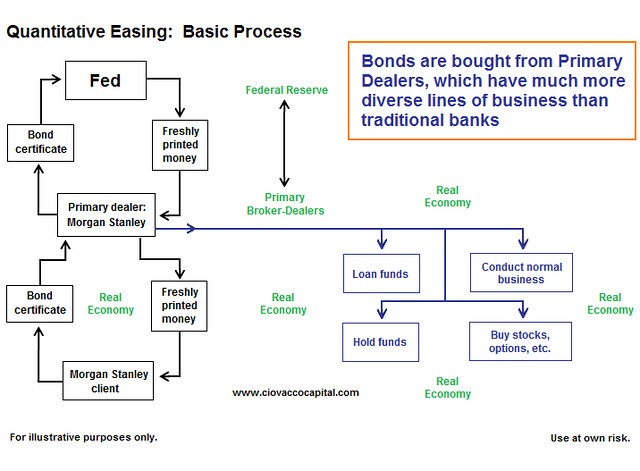
Here is the first (1 in 5) article in a series explaining QE2 - that appears to be pretty good, albeit technical/economicspeak, with a flowchart and all. Cool!
"Common sense tells us money printing is probably not the path to long-term prosperity and low unemployment, but common sense also tells us after a possible QE disappointment pullback, newly printed U.S. dollars will be finding their way into the global stock, commodity, and currency markets. The big questions are (a) how much QE is coming in terms of a dollar amount, and (b) how much of that money will find its way into the financial markets."
And here is the corresponding Quantitative Easement for Tango flow chart:
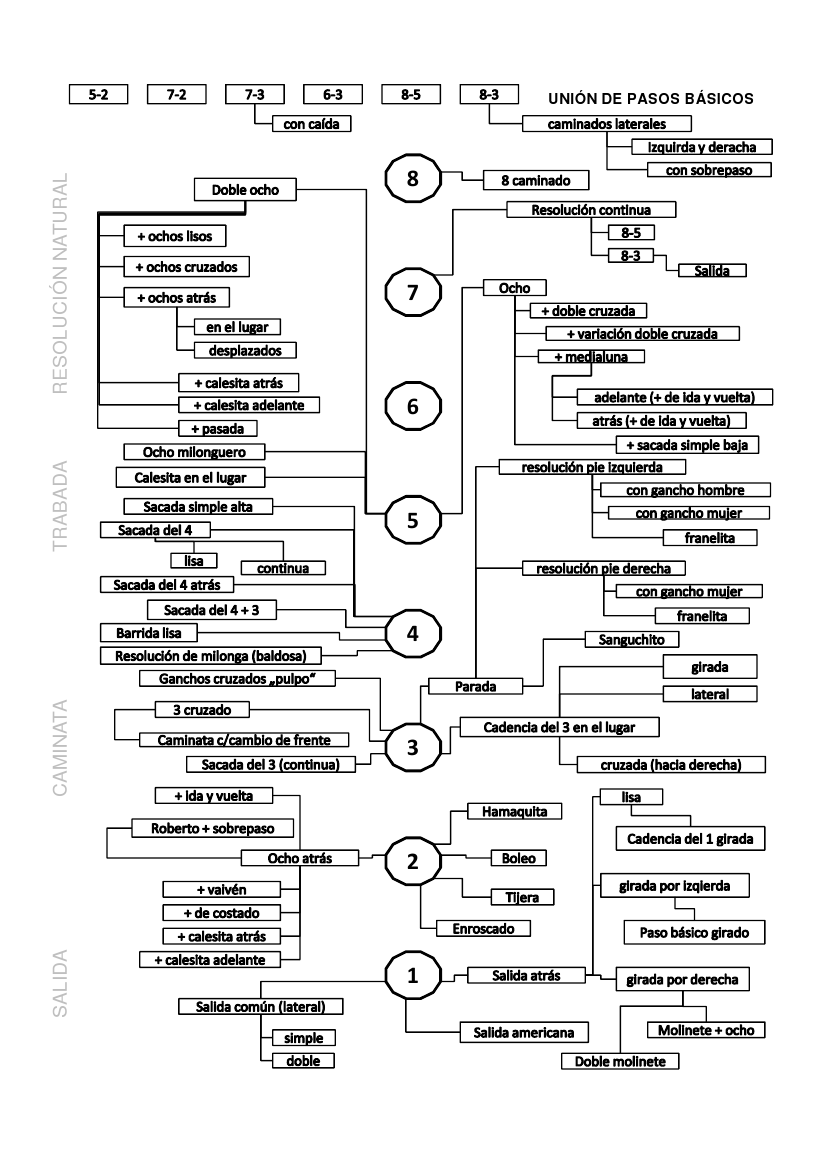
You *know* they always say that Tango is THE most complicated investment a human being can make. This is why monkeys don't dance tango or make investments or try to influence the global economy to the upside.
Here's a tiny blurb I found on the topic on MSNBC: (although I didn't look very hard)
By JEANNINE AVERSA
The Associated Press
updated 11/10/2010 3:24:54 PM ET 2010-11-10T20:24:54
WASHINGTON — The Federal Reserve says it will buy a total of $105 billion worth of government bonds starting later this week as it launches a new program to invigorate the economy.
The bonds will be purchased through a series of 18 operations that start on Friday and end on Dec. 9. The purchases are the first since the Fed announced last week that it will buy a total of $600 billion worth of Treasury bonds over the next eight months.
The Fed will buy $75 billion of government debt as part of the new program. And, it will buy another $30 billion, using the proceeds from its vast mortgage portfolio.
That totals $105 billion for the first phase of the Fed's government bond buying. The Fed last week said it anticipates buying on average $110 billion a month.
And finally, the genesis for this post, from Dieudonne's comment on my Jon Stewart post...thanks D!
Actually, having written/blogarreah'd this self-amusing piece of BS, I have arrived at that tie-back (there is a word for this) that I was looking for - the true essence of the quantitative easement of global tango - in the vein of too much of a good thing. But I'm out of time. I have to get to work now.
And coffee...I need my coffee.
My first title to this post was "We're Being Quantitatively Eased and We Don't Even Know It", which seemed wordy and nebulous. You guys know how I like to, tongue in cheek, try to come up with some kind of sensationalist headline tying back to tango. Just for fun. For this one the tie-back is much more difficult - obviously it doesn't make sense.
I tried to think of a relationship between printing more money and tango. $600,000,000,000 aka six hundred billion dollars are being printed up (the first $105 billion this coming week) over the next eight months. I'm not completely clear on the whole thing, but they are saying "We're not printing money", and are emphasizing that they are buying government bonds.
So a guy spends a lot of money on his tango, but nothing happens...?
As in the "All hat and no cattle" concept?
So a guy spends a lot of money on his tango, his ego gets inflated (inflation), and his tango gets weaker (deflation)...?
So a guy spends a lot of money on his tango, learns some half-assed kickass highboleo moves, leading to ego inflation, and destabilization of the milonga...?
So a guy spends a lot of money on his tango, leading to ego inflation, and takes a trip to Buenos Aires aka TangoMecca for further lessons and a world stage to show off his half-assed kickass highboleo moves, which leads to destabilization of an international milonga, and finds that the women aren't impressed by his ego nor his tango, which leads to ego deflation, and tango stagnation...?
So a guy spends a lot of money on his tango, leading to ego inflation, decides to manifest himself into a tango a teacher and teach his HAKAHB to others, (begins to troll the milongas across the globe for a suitable potranca rusa/SYT/teaching partner), leading them to invest more of their hard-earned short-supplied greenbacks into their tango, which in turn leads to further tango deflation and destabilization of the milongas, resulting in dissatisfied women, who stay home to watch "Dances with the Stars", yielding a gender imbalance, stimulating the lamentations of the menfolk to yield even higher investment into tango investment bonds, which of course, the guy benefits from as a direct result...? (Guy and SYT move to Spain or Isla de Pantelleria to open a Tango bar using the windfall tango profits and live happily ever after)
Or, finally, in desperation, confusion and frustration, the guy decides to just give his tango greenbacks to the tango dealers (in "support", without actually attending any classes), and hopes that somehow it will get infused back into his tango, somehow, someday, somewhere...?
Probably not.
Who knows? I don't completely understand it - on the downstream end anyway - in terms of how this will benefit the global economy, or not. Methinks someone, somewhere, somehow, some day soon, will be stuffing their pockets and teabags with at least some of the aforementioned $600 billion.
My gut tells me we are in for a wild ride over the next 30 years aka "the rest of my life". Maybe by then I will be a highly leveraged milonguero wannabe/blacksmith.
Stay tuned for my upcoming articles - "The Qualitative Easement Tango" and "Tango Derivatives Demystified"!
Here is the first (1 in 5) article in a series explaining QE2 - that appears to be pretty good, albeit technical/economicspeak, with a flowchart and all. Cool!
"Common sense tells us money printing is probably not the path to long-term prosperity and low unemployment, but common sense also tells us after a possible QE disappointment pullback, newly printed U.S. dollars will be finding their way into the global stock, commodity, and currency markets. The big questions are (a) how much QE is coming in terms of a dollar amount, and (b) how much of that money will find its way into the financial markets."
And here is the corresponding Quantitative Easement for Tango flow chart:
You *know* they always say that Tango is THE most complicated investment a human being can make. This is why monkeys don't dance tango or make investments or try to influence the global economy to the upside.
Here's a tiny blurb I found on the topic on MSNBC: (although I didn't look very hard)
By JEANNINE AVERSA
The Associated Press
updated 11/10/2010 3:24:54 PM ET 2010-11-10T20:24:54
WASHINGTON — The Federal Reserve says it will buy a total of $105 billion worth of government bonds starting later this week as it launches a new program to invigorate the economy.
The bonds will be purchased through a series of 18 operations that start on Friday and end on Dec. 9. The purchases are the first since the Fed announced last week that it will buy a total of $600 billion worth of Treasury bonds over the next eight months.
The Fed will buy $75 billion of government debt as part of the new program. And, it will buy another $30 billion, using the proceeds from its vast mortgage portfolio.
That totals $105 billion for the first phase of the Fed's government bond buying. The Fed last week said it anticipates buying on average $110 billion a month.
And finally, the genesis for this post, from Dieudonne's comment on my Jon Stewart post...thanks D!
Actually, having written/blogarreah'd this self-amusing piece of BS, I have arrived at that tie-back (there is a word for this) that I was looking for - the true essence of the quantitative easement of global tango - in the vein of too much of a good thing. But I'm out of time. I have to get to work now.
And coffee...I need my coffee.
Friday, October 22, 2010
The best way to rob a bank is to own one
Y'all know there is no love loss between little 'ol AlexTangoFuego and the bankers and investment bankers and financiers of the world. I never did much like those guys when I encountered them whilst enjoying a single malt nightcap at the Caribou Club. I think back on that now and wonder whatever the fuck was I thinking to become a member of that "members only" bastion of conspicuous consumption and everything/one that is wrong with this world. I do remember why - thinking that it was good for business - to mingle and bullshit with potential clients. I did meet a few genuine and nice people there. A few. And far between.
The money pimps were mostly assholes. Par excellence. In a French accent. Driving through town in Lamborghini's and Ferrari's and Bentley's (apostrophes for visual effect) on Sunday morning to get donuts and coffee and the Sunday Times. Overcompensating and overconfident with regard to the bulge in their Prada jeans. That would be in the back pocket, in the "billfold" as they call it in west Texas. Too much money will make a man into an arrogant God-prick and a woman into a marquisetta whore to the highest bidder. It's sad, really, to see the people who sell their souls to the Almighty God-Dollar. Empty, sad souls set for life (in theory) in mega-big and not-so-big houses alike wondering where they took the wrong turn. Longing for love and life and music and dance and art and poetry. And love, one more time for good measure.
I like to think and believe that I was an undercover radical-leftist-hippie-socialist-commie-enviro-green-fundamentalist spy/recon guy collecting intel on how to bring it all down with a little C4 or a UHaul moving van full of fermented bullshit pumped down the red carpeted stairs under the caribou horn chandeliers. Or maybe I was collecting some sort of twisted CC experience for a screenplay, or a book, or a poem, or just a memory or two. Or maybe I was just trying to get laid. (grin)
Anyway, it's a small part of my life experience, that Aspen/Caribou Club experience is. Was. A very small part of me, but definitely nothing to do with who I have always been at my core. Thank God. Thank Gawd as Madeleine Murray O'Hair would say. I'm glad that time in my life is behind me - although I miss my true friends there - my tango friends. I miss them dearly.
I am happy to be getting back to my hippie roots these days, long hair and all. But that, my friends, is another story.
So, as usual, I digressed. Here's what I wanted to post, crossposted from The Huffington Post via NiemanWatchdog.org - written by Dan Froomkin.
http://www.huffingtonpost.com/2010/10/20/nine-stories-the-media-is_n_769620.html
If it wasn't already blindingly obvious that pervasive fraud was at the heart of the financial crisis and the ensuing foreclosure catastrophe, you would think that the latest news -- that banks have routinely been lying their heads off in the rush to kick homeowners off the properties they fraudulently induced them to buy in the first place -- would pretty much clinch it.
And yet the mainstream media still by and large hasn't connected the dots.
What we are seeing all around us are the continued effects of a vast criminal enterprise that has never been brought to account, employing a process that, as University of Texas economist James Galbraith explains, involved the equivalent of counterfeiting, laundering and fencing.
So the person with the right expertise to lead us here is a criminologist -- in particular William K. Black, one of the few effective regulators in recent history (during the savings and loan crisis of the late 1980s), a notorious knocker of heads and currently professor at the University of Missouri-Kansas City and author of the book, "The Best Way to Rob a Bank Is to Own One".
I first interviewed Black in April, and recently checked back in and asked him about this ongoing problem of the mainstream media's inability to properly cover this story. He responded with this breathless and breathtaking list of failings (slightly edited for publication):
The things I think are critical and badly under-reported are:
1. The astonishing amount of mortgage fraud (literally, millions of cases annually) and how it hyperinflated the bubble and led to the Great Recession.
2. The fact that these mortgage frauds were overwhelmingly due to consciously fraudulent lending practices in which the CEOs of seemingly legitimate entities used accounting tricks as their “weapon of choice" to report higher profits and get bigger bonuses. (George A. Akerlof and Paul R. Romer got it right in the title to their 1993 article: Looting: The Economic Underworld of Bankruptcy for Profit.)
3. The disgraceful lack of prosecutions which has resulted from regulators virtually ending the practice of making criminal referrals and the pathetic March 2007 "partnership" that the FBI entered into with the Mortgage Bankers Association (the trade association of the "perps") that led the FBI and the Department of Justice to (implicitly) define out of existence fraud by the lenders (and to conceive of them as the "victim" -- which they are, but only of their controlling officers). Bush administration attorney general Michael Mukasey in June 2008 notoriously refused to create a national task force against mortgage fraud based on his claim that mortgage fraud was analogous to "white collar street crime."
4. The "echo" epidemics of fraud set off by the primary epidemic of accounting “control fraud". The fraud designed by CEOs in turn kicked off an epidemic of fraud among loan brokers and appraisers. Reporters should explore the concept of the Gresham's-style dynamic in which bad ethics were a competitive advantage and drove good ethics out of the marketplace.
5. The massive foreclosure fraud we are seeing now as another "echo" epidemic. To optimize their accounting control fraud, lenders gutted underwriting. That led to "fraud in the inducement" (vis a vis borrowers), endemic documentation problems, and an extraordinary numbers of defaults. The process required tens of thousands of real estate financing personnel to commit fraud on a daily basis as their core function. Some of these people are unemployed, but many are in the industry and are presently engaged in loan servicing. Now that their job is to foreclose on properties, there is no reason to expect that they would suddenly become honest, and they haven't.
6. The ongoing massive cover up of losses on bad assets, particularly by the “too big to fail” institutions, which I call “systemically dangerous institutions” (SDIs). Those institutions, along with Federal Reserve Board Chairman Ben Bernanke and Congress (at the behest of the Chamber of Commerce and with no opposition from the Obama administration) in April 2009 forced the Financial Accounting Standards Board (FASB) to change the rules so that the banks do not have to recognize their losses unless and until they sell the bad assets. The implications of this cover up are large (and rarely reported). At the very least, it means that Treasury Secretary Timothy Geithner's propaganda campaign about TARP saving the world at virtually no cost (perhaps even a "profit") is nonsense -- despite its success in influencing the Washington Post and Los Angeles Times. Consider:
A) The repayment of TARP funds does not mean the banks are healthy. Their asset values are often grossly inflated, which means their net worth is grossly inflated. That means that the claims that we have increased net worth requirements (and that Basel III will further increase net worth requirements) are false. Net worth requirements have meaning only if the accounting is honest
B) The repayment of TARP funds does mean that the banks are freed from any meaningful restraint on senior officer compensation. Note that absent the accounting lies the banks would often be reporting losses (and failure to meet required capital requirements, or outright insolvency) and could not pay their senior officers bonuses and would be subject to mandatory closure under the Prompt Corrective Action (PCA) law.
C) No commercial entity would have ever signed the TARP deals on the terms that the U.S. drafted for itself. The U.S. provided not only fresh money but an unlimited de facto guarantee (along with permitting phony accounting). If the U.S. had negotiated competently it would have owned virtually all the shares of every TARP recipient (which, of course, was a political impossibility).
D) The accounting lies are stalling the recovery. Markets cannot clear promptly when one creates an incentive to hold massively overvalued assets for years.
E) The losses are still there, but the taxpayers are on the hook via Fannie and Freddie and the Fed (which has taken over a trillion dollars in toxic collateral at grossly inflated values).
7. The continued absence of effective regulation. It should be scandalous that President Obama left in charge, or even promoted, the anti-regulators who permitted the Great Recession. The (failed) anti-regulator of Fannie and Freddie, for example, remains FHFA's acting director. This is significantly insane as a matter of both economics and politics. (The administration doesn't even seem to realize the issue of integrity.)
8. The crises of state and local government and the lack of a rational basis for Republican and Blue Dog opposition to the proposed revenue sharing component of the stimulus bill. The compounding insanity of the administration failing to fight for its concept and failing to make explicit how badly its removal would harm the recovery, employment, and vital government services.
9. The insanity of accepting mass, long-term unemployment rather than having the government provide productive jobs for everyone willing to work (as the employer of last resort).
I have nothing to add.
Crossposted from NiemanWatchdog.org.
*************************
Dan Froomkin is senior Washington correspondent for the Huffington Post.
And here's to the good bankers and financial folks of the world. I know it's never good to over-generalize - they are not all bad. Most of the folks out there have noble intent and are doing the right thing - trying to help people in the financial maze/ artifice of the world. I thank you for all of the rest of us. You know who you are.
The money pimps were mostly assholes. Par excellence. In a French accent. Driving through town in Lamborghini's and Ferrari's and Bentley's (apostrophes for visual effect) on Sunday morning to get donuts and coffee and the Sunday Times. Overcompensating and overconfident with regard to the bulge in their Prada jeans. That would be in the back pocket, in the "billfold" as they call it in west Texas. Too much money will make a man into an arrogant God-prick and a woman into a marquisetta whore to the highest bidder. It's sad, really, to see the people who sell their souls to the Almighty God-Dollar. Empty, sad souls set for life (in theory) in mega-big and not-so-big houses alike wondering where they took the wrong turn. Longing for love and life and music and dance and art and poetry. And love, one more time for good measure.
I like to think and believe that I was an undercover radical-leftist-hippie-socialist-commie-enviro-green-fundamentalist spy/recon guy collecting intel on how to bring it all down with a little C4 or a UHaul moving van full of fermented bullshit pumped down the red carpeted stairs under the caribou horn chandeliers. Or maybe I was collecting some sort of twisted CC experience for a screenplay, or a book, or a poem, or just a memory or two. Or maybe I was just trying to get laid. (grin)
Anyway, it's a small part of my life experience, that Aspen/Caribou Club experience is. Was. A very small part of me, but definitely nothing to do with who I have always been at my core. Thank God. Thank Gawd as Madeleine Murray O'Hair would say. I'm glad that time in my life is behind me - although I miss my true friends there - my tango friends. I miss them dearly.
I am happy to be getting back to my hippie roots these days, long hair and all. But that, my friends, is another story.
So, as usual, I digressed. Here's what I wanted to post, crossposted from The Huffington Post via NiemanWatchdog.org - written by Dan Froomkin.
http://www.huffingtonpost.com/2010/10/20/nine-stories-the-media-is_n_769620.html
If it wasn't already blindingly obvious that pervasive fraud was at the heart of the financial crisis and the ensuing foreclosure catastrophe, you would think that the latest news -- that banks have routinely been lying their heads off in the rush to kick homeowners off the properties they fraudulently induced them to buy in the first place -- would pretty much clinch it.
And yet the mainstream media still by and large hasn't connected the dots.
What we are seeing all around us are the continued effects of a vast criminal enterprise that has never been brought to account, employing a process that, as University of Texas economist James Galbraith explains, involved the equivalent of counterfeiting, laundering and fencing.
So the person with the right expertise to lead us here is a criminologist -- in particular William K. Black, one of the few effective regulators in recent history (during the savings and loan crisis of the late 1980s), a notorious knocker of heads and currently professor at the University of Missouri-Kansas City and author of the book, "The Best Way to Rob a Bank Is to Own One".
I first interviewed Black in April, and recently checked back in and asked him about this ongoing problem of the mainstream media's inability to properly cover this story. He responded with this breathless and breathtaking list of failings (slightly edited for publication):
The things I think are critical and badly under-reported are:
1. The astonishing amount of mortgage fraud (literally, millions of cases annually) and how it hyperinflated the bubble and led to the Great Recession.
2. The fact that these mortgage frauds were overwhelmingly due to consciously fraudulent lending practices in which the CEOs of seemingly legitimate entities used accounting tricks as their “weapon of choice" to report higher profits and get bigger bonuses. (George A. Akerlof and Paul R. Romer got it right in the title to their 1993 article: Looting: The Economic Underworld of Bankruptcy for Profit.)
3. The disgraceful lack of prosecutions which has resulted from regulators virtually ending the practice of making criminal referrals and the pathetic March 2007 "partnership" that the FBI entered into with the Mortgage Bankers Association (the trade association of the "perps") that led the FBI and the Department of Justice to (implicitly) define out of existence fraud by the lenders (and to conceive of them as the "victim" -- which they are, but only of their controlling officers). Bush administration attorney general Michael Mukasey in June 2008 notoriously refused to create a national task force against mortgage fraud based on his claim that mortgage fraud was analogous to "white collar street crime."
4. The "echo" epidemics of fraud set off by the primary epidemic of accounting “control fraud". The fraud designed by CEOs in turn kicked off an epidemic of fraud among loan brokers and appraisers. Reporters should explore the concept of the Gresham's-style dynamic in which bad ethics were a competitive advantage and drove good ethics out of the marketplace.
5. The massive foreclosure fraud we are seeing now as another "echo" epidemic. To optimize their accounting control fraud, lenders gutted underwriting. That led to "fraud in the inducement" (vis a vis borrowers), endemic documentation problems, and an extraordinary numbers of defaults. The process required tens of thousands of real estate financing personnel to commit fraud on a daily basis as their core function. Some of these people are unemployed, but many are in the industry and are presently engaged in loan servicing. Now that their job is to foreclose on properties, there is no reason to expect that they would suddenly become honest, and they haven't.
6. The ongoing massive cover up of losses on bad assets, particularly by the “too big to fail” institutions, which I call “systemically dangerous institutions” (SDIs). Those institutions, along with Federal Reserve Board Chairman Ben Bernanke and Congress (at the behest of the Chamber of Commerce and with no opposition from the Obama administration) in April 2009 forced the Financial Accounting Standards Board (FASB) to change the rules so that the banks do not have to recognize their losses unless and until they sell the bad assets. The implications of this cover up are large (and rarely reported). At the very least, it means that Treasury Secretary Timothy Geithner's propaganda campaign about TARP saving the world at virtually no cost (perhaps even a "profit") is nonsense -- despite its success in influencing the Washington Post and Los Angeles Times. Consider:
A) The repayment of TARP funds does not mean the banks are healthy. Their asset values are often grossly inflated, which means their net worth is grossly inflated. That means that the claims that we have increased net worth requirements (and that Basel III will further increase net worth requirements) are false. Net worth requirements have meaning only if the accounting is honest
B) The repayment of TARP funds does mean that the banks are freed from any meaningful restraint on senior officer compensation. Note that absent the accounting lies the banks would often be reporting losses (and failure to meet required capital requirements, or outright insolvency) and could not pay their senior officers bonuses and would be subject to mandatory closure under the Prompt Corrective Action (PCA) law.
C) No commercial entity would have ever signed the TARP deals on the terms that the U.S. drafted for itself. The U.S. provided not only fresh money but an unlimited de facto guarantee (along with permitting phony accounting). If the U.S. had negotiated competently it would have owned virtually all the shares of every TARP recipient (which, of course, was a political impossibility).
D) The accounting lies are stalling the recovery. Markets cannot clear promptly when one creates an incentive to hold massively overvalued assets for years.
E) The losses are still there, but the taxpayers are on the hook via Fannie and Freddie and the Fed (which has taken over a trillion dollars in toxic collateral at grossly inflated values).
7. The continued absence of effective regulation. It should be scandalous that President Obama left in charge, or even promoted, the anti-regulators who permitted the Great Recession. The (failed) anti-regulator of Fannie and Freddie, for example, remains FHFA's acting director. This is significantly insane as a matter of both economics and politics. (The administration doesn't even seem to realize the issue of integrity.)
8. The crises of state and local government and the lack of a rational basis for Republican and Blue Dog opposition to the proposed revenue sharing component of the stimulus bill. The compounding insanity of the administration failing to fight for its concept and failing to make explicit how badly its removal would harm the recovery, employment, and vital government services.
9. The insanity of accepting mass, long-term unemployment rather than having the government provide productive jobs for everyone willing to work (as the employer of last resort).
I have nothing to add.
Crossposted from NiemanWatchdog.org.
*************************
Dan Froomkin is senior Washington correspondent for the Huffington Post.
And here's to the good bankers and financial folks of the world. I know it's never good to over-generalize - they are not all bad. Most of the folks out there have noble intent and are doing the right thing - trying to help people in the financial maze/ artifice of the world. I thank you for all of the rest of us. You know who you are.
Friday, February 27, 2009
On Fiscal Destabilization :: The Nut Crushing Truth
I just heard this on NPR, and could not have said it more succinctly myself...paraphrasing....
The problem is not the banks, the problem is not toxic assets, the problem is not Wall Street, the problem is not the housing debacle. The problem is us, we the people. We have been living an ever increasingly high (luxurious) standard of living for the past 25 years. Here is the kicker. We have been paying for it using BORROWED money.
We. We, the people are the ones responsible for where we are.
Have a nice day.
The problem is not the banks, the problem is not toxic assets, the problem is not Wall Street, the problem is not the housing debacle. The problem is us, we the people. We have been living an ever increasingly high (luxurious) standard of living for the past 25 years. Here is the kicker. We have been paying for it using BORROWED money.
We. We, the people are the ones responsible for where we are.
Have a nice day.
Tuesday, January 27, 2009
If less is more, then more must be less...
I'm sorry, but I can't feel sorry for the folks who invested with the latest investment fund aka ponzi scheme charlatan. He was promising returns of 80% per year.
If you give your life savings to a guy like this expecting to make 80% returns, you are just plain greedy.
If it sounds too good to be true, it is a scam!
Any idiot can skim 30% per year on real estate in Aspen. That's about the highest legitimate return I've ever heard of. Beyond that, you'd better be doing your homework, and be practicing your baseball bat swing, low, like at kneecap level. And be prepared to lose it all, just like in Vegas.
A coffee can and a shovel might be the best investment these days.
P.S. You can do a 200% home run in Aspen, too. $12,500,000 in the lot, hard construction costs, engineering, architecture, soft costs...sales price $24.9 mil...that's pretty much 200% right?...except in that realm, the owner probably really only took $5.0 mil out of his own pocket, if even that much...the math tells us that's right around $2,000 per square foot on the sales price...yup...I'm not exaggerating...
If you give your life savings to a guy like this expecting to make 80% returns, you are just plain greedy.
If it sounds too good to be true, it is a scam!
Any idiot can skim 30% per year on real estate in Aspen. That's about the highest legitimate return I've ever heard of. Beyond that, you'd better be doing your homework, and be practicing your baseball bat swing, low, like at kneecap level. And be prepared to lose it all, just like in Vegas.
A coffee can and a shovel might be the best investment these days.
P.S. You can do a 200% home run in Aspen, too. $12,500,000 in the lot, hard construction costs, engineering, architecture, soft costs...sales price $24.9 mil...that's pretty much 200% right?...except in that realm, the owner probably really only took $5.0 mil out of his own pocket, if even that much...the math tells us that's right around $2,000 per square foot on the sales price...yup...I'm not exaggerating...
Wednesday, December 17, 2008
I toldya so...
The $300 billion housing bailout (passed by Congress this past summer) to supposedly help hundreds of thousands (+/-400,000) of homeowners avoid foreclosure has failed miserably.
Only 312 homeowners have filled out the application paperwork.
Of those 312 who applied - guess the number who have been able to forestall foreclosure and stay in their homes - ZERO.
Sad, but true, and I am not surprised in the least. This is our own federal government of the United States of America. It's time we admit that it is fundamentally impossible for them to do anything effectively, efficiently, or that actually results in the desired/planned/needed outcome.
It just ain't gonna happen.
Now here's my question...where's our $300 billion?
Here's the link to the video on NBC.
By the way, $300,000,000,000 divided by 400,000 equals $750,000 per homeowner. Something's wrong with our government's math.
Only 312 homeowners have filled out the application paperwork.
Of those 312 who applied - guess the number who have been able to forestall foreclosure and stay in their homes - ZERO.
Sad, but true, and I am not surprised in the least. This is our own federal government of the United States of America. It's time we admit that it is fundamentally impossible for them to do anything effectively, efficiently, or that actually results in the desired/planned/needed outcome.
It just ain't gonna happen.
Now here's my question...where's our $300 billion?
Here's the link to the video on NBC.
By the way, $300,000,000,000 divided by 400,000 equals $750,000 per homeowner. Something's wrong with our government's math.
Tuesday, December 9, 2008
Constituent Response from Senator Kay Bailey Hutchison
Regarding my letter requesting that she *not* support the automotive industry bailout.
[Here's the letter from my Congressman - Lloyd Doggett)
It's important to note (in the kind Senator's letter) that before all this jumped to the forefront in the news media, Congress had already appropriated $25 billion in "loans". The $25-50 billion they are requesting now is on top of that figure.
Tuesday, December 2, 2008
Dear Mr. Tango.Fuego:
Thank you for contacting me regarding the financial state of the U.S. automobile industry. I welcome your thoughts and comments on this issue.
Our economy is facing dramatic challenges. Financial conditions are rapidly deteriorating, creating volatility and uncertainty for businesses, small and large, across the country.
As Texans, we have learned to take responsibility for our actions and being asked to pay for the mistakes of others is something many, including myself, find deeply troubling. While I am a firm believer of free market principles, I also believe that our economy is facing new challenges that if unaddressed, may produce serious unwarranted costs.
On September 30, 2008, the President signed into law H.R. 2638, the Consolidated Security, Disaster Assistance, and Continuing Appropriations Act of 2009. This legislation included, among many items, funding to support a $25 billion loan program for U.S. automakers. The loans, which will be repaid with interest, are intended for long-term business restructuring to promote innovative technologies and new fuel efficient products. The Department of Energy, which is administering the loan program, has indicated that the loans are scheduled to be released in 12 to 18 months.
Several weeks after H.R. 2638 was signed into law, executives of the three major U.S. automakers requested Congress provide an additional $25 billion to $50 billion from the Treasury’s Troubled Asset Relief Program (TARP) to support their short-term funding needs. The CEOs of the largest U.S. automakers testified before Congress that their companies are facing a liquidity crisis, and without an immediate injection of capital, their businesses may fail, creating massive job losses across the country.
The domestic auto industry has failed to meet foreign competition, and I do not think taxpayers should have to provide additional money from the TARP to the auto industry. Instead, I have proposed restructuring and expediting the $25 billion Department of Energy loan program to help the American auto industry weather the financial storm and retain their employees across the country. Requiring these prior funds, which are required to be paid back with interest, to be used on long-term expenditures is not the best use of federal resources when these companies are struggling to stay operational. Rather, these funds should be utilized for short-term needs first. I also believe that any government plan to aid the auto industry must include significant taxpayer protections, including restrictions on executive compensation, concessions from the unions, and assurances that each recipient of federal loans is financially viable.
As Congress returns to debate this issue, you may be certain I will keep your views in mind.
I appreciate hearing from you. I hope you will not hesitate to contact me on any issue of concern to you.
Sincerely,
Kay Bailey Hutchison
United States Senator
284 Russell Senate Office Building
Washington, DC 20510
202-224-5922 (tel)
202-224-0776 (fax)
http://hutchison.senate.gov
[Here's the letter from my Congressman - Lloyd Doggett)
It's important to note (in the kind Senator's letter) that before all this jumped to the forefront in the news media, Congress had already appropriated $25 billion in "loans". The $25-50 billion they are requesting now is on top of that figure.
Tuesday, December 2, 2008
Dear Mr. Tango.Fuego:
Thank you for contacting me regarding the financial state of the U.S. automobile industry. I welcome your thoughts and comments on this issue.
Our economy is facing dramatic challenges. Financial conditions are rapidly deteriorating, creating volatility and uncertainty for businesses, small and large, across the country.
As Texans, we have learned to take responsibility for our actions and being asked to pay for the mistakes of others is something many, including myself, find deeply troubling. While I am a firm believer of free market principles, I also believe that our economy is facing new challenges that if unaddressed, may produce serious unwarranted costs.
On September 30, 2008, the President signed into law H.R. 2638, the Consolidated Security, Disaster Assistance, and Continuing Appropriations Act of 2009. This legislation included, among many items, funding to support a $25 billion loan program for U.S. automakers. The loans, which will be repaid with interest, are intended for long-term business restructuring to promote innovative technologies and new fuel efficient products. The Department of Energy, which is administering the loan program, has indicated that the loans are scheduled to be released in 12 to 18 months.
Several weeks after H.R. 2638 was signed into law, executives of the three major U.S. automakers requested Congress provide an additional $25 billion to $50 billion from the Treasury’s Troubled Asset Relief Program (TARP) to support their short-term funding needs. The CEOs of the largest U.S. automakers testified before Congress that their companies are facing a liquidity crisis, and without an immediate injection of capital, their businesses may fail, creating massive job losses across the country.
The domestic auto industry has failed to meet foreign competition, and I do not think taxpayers should have to provide additional money from the TARP to the auto industry. Instead, I have proposed restructuring and expediting the $25 billion Department of Energy loan program to help the American auto industry weather the financial storm and retain their employees across the country. Requiring these prior funds, which are required to be paid back with interest, to be used on long-term expenditures is not the best use of federal resources when these companies are struggling to stay operational. Rather, these funds should be utilized for short-term needs first. I also believe that any government plan to aid the auto industry must include significant taxpayer protections, including restrictions on executive compensation, concessions from the unions, and assurances that each recipient of federal loans is financially viable.
As Congress returns to debate this issue, you may be certain I will keep your views in mind.
I appreciate hearing from you. I hope you will not hesitate to contact me on any issue of concern to you.
Sincerely,
Kay Bailey Hutchison
United States Senator
284 Russell Senate Office Building
Washington, DC 20510
202-224-5922 (tel)
202-224-0776 (fax)
http://hutchison.senate.gov
Tuesday, November 25, 2008
Oh great. Just what we want to hear.
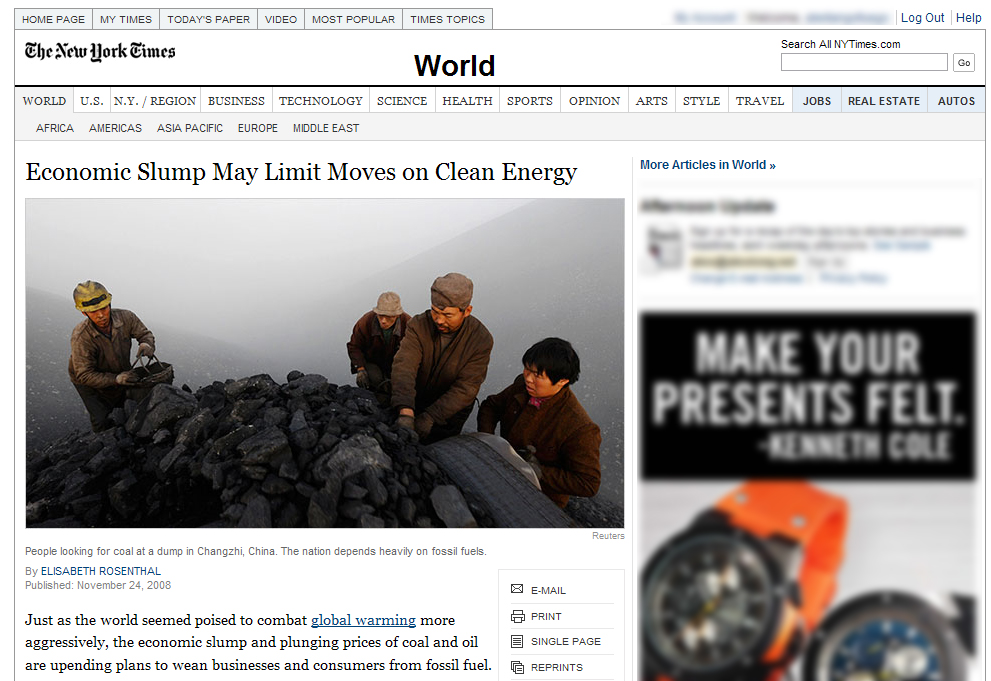
I've been thinking how this economic morass could be solved with new investment in alternative energy and mass transit, although the time frame to 'flip the switch' from fossil fuels to other alternatives is likely decades, not years, and especially not fiscal quarters or months.
If you read the article, everyone is saying that with low fossil fuel prices, we can't "afford" to invest in alternative energy (and mass transit, which is inextricably tied).
So let me get this straight. We can't "afford" to invest, to focus, to expand our views and thinking (and our hearts), to think outside our capitalist box, to change directions in technologies (and lifestyles) which will ensure the future of humanity for at least another couple of hundred years. We should actually be looking at a five hundred year window, when the capitalists typically look at a five year payback. There's a huge disconnect for ya. Electrical pun intended.
But we CAN afford to invest, to blindly follow, to bury our collective cabezas in the sand, to keep paying our utility bills like good little citizens, to keep enriching the wealthy, and the stockholders of energy/utility companies and automobile manufacturers, to be "safe and sound" with more of the same, worsening our environment each day, raping our Mother Earth and its future generations in our indifference, ensuring the demise of humanity on this earth. I see, YES WE CAN!
Maybe this means Circuit City doesn't have to go bankrupt. If we're not going to invest in ALT Energy Inc., then maybe we can go ahead and buy that 175 foot yacht I've been wanting.
"Hey Steve, hey good morning, it's Alex. I hope I'm not calling you too early. Hey do me a favor. Will you start working on consolidating some liquid assets for me. I need $100 million for this yacht I've been looking at. Actually just 25 for now. I'm pretty sure the salesman said that was the amount of the deposit. I can take possession with 25. I want to take the little lady for a cruise around the Med as a Christmas gift. Can you pull it together in three weeks? Pirates? There are pirates in the Med? I thought they were only around the bend in the Gulf. Oh. Better make it 30. I'll need some operating funds anyway. You know anyone over at Blackwater? No? I'll call Cheney, he'll know someone. Alright. Thanks. Talk later. [click] Hey Dick! Good morning to ya...this is Alex..."
No, I'm not that naive. I know that's not how it works. I know people can't consider investment in things that don't return that investment, plus a little something we call return on investment. ROI. Perhaps that is the ultimate question...okay, not the ultimate, but pretty high up there. Would you give money away, knowing you would never see it again, to ensure the future of humanity on the earth? Would you give money away to ensure the starving of the world could eat and be nourished? Would you give money away to develop alternate energies and mass transit? Would you give money away to ensure clean water, clean air, a safe food supply, healthy topsoil, a clean and sober society, healthy people through preventative medicine, smart(er) people through better education, more justice in the justice system, and on and on and on.
That's essentially what taxes are. We give our money away never to see it again. But for me, I see that as an investment. I want to see a return on that investment. We should all want to see a return on that investment. Huge funding, HUGE return. I don't want to see it go into the black hole of government, only to be pulled out of someone's pocket next month to pay their utility bill.
I'm headin' off to work. Got bills to pay.
Monday, November 24, 2008
Dear Alex
November 24, 2008
Dear Alex:
I received your request, indicating your disapproval of a bailout for Chrysler, General Motors and Ford. As you know, I voted against the earlier Wall Street bailout because it did not have enough limitations on Wall Street or protections for taxpayers. Even though there was no vote on any new bailout, last week, I introduced legislation to stop guidance secretly issued by the Treasury Department that gives away billions of dollars to banks.
I am attaching excerpts from a recent Washington Post article that describes how Treasury quietly issued this guidance that would create a $140 billion loophole in the tax code. It is fundamentally wrong that while aid for struggling families and other important national priorities must survive a long and difficult legislative process, $140 billion is handed out Treasury's backdoor to subsidize banks.
Be assured I will continue my hard work combating special interests and closing tax loopholes like these, which only increase the burden on families and small businesses.
I would also appreciate your thoughts on other issues that may be considered in Congress. If you have not done so already, please take a moment to visit my website at www.house.gov/doggett where you can complete a survey online.
A Quiet Windfall For U.S. Banks
With Attention on Bailout Debate, Treasury Made Change to Tax Policy
By Amit R. Paley
Washington Post Staff Writer
Monday, November 10, 2008; A01
The financial world was fixated on Capitol Hill as Congress battled over the Bush administration's request for a $700 billion bailout of the banking industry. In the midst of this late-September drama, the Treasury Department issued a five-sentence notice that attracted almost no public attention.
But corporate tax lawyers quickly realized the enormous implications of the document: Administration officials had just given American banks a windfall of as much as $140 billion.
The sweeping change to two decades of tax policy escaped the notice of lawmakers for several days, as they remained consumed with the controversial bailout bill. When they found out, some legislators were furious. Some congressional staff members have privately concluded that the notice was illegal. But they have worried that saying so publicly could unravel several recent bank mergers made possible by the change and send the economy into an even deeper tailspin.
"Did the Treasury Department have the authority to do this? I think almost every tax expert would agree that the answer is no," said George K. Yin, the former chief of staff of the Joint Committee on Taxation, the nonpartisan congressional authority on taxes. "They basically repealed a 22-year-old law that Congress passed as a backdoor way of providing aid to banks."
The story of the obscure provision underscores what critics in Congress, academia and the legal profession warn are the dangers of the broad authority being exercised by Treasury Secretary Henry M. Paulson Jr. in addressing the financial crisis. Lawmakers are now looking at whether the new notice was introduced to benefit specific banks, as well as whether it inappropriately accelerated bank takeovers.
The change to Section 382 of the tax code -- a provision that limited a kind of tax shelter arising in corporate mergers -- came after a two-decade effort by conservative economists and Republican administration officials to eliminate or overhaul the law, which is so little-known that even influential tax experts sometimes draw a blank at its mention. Until the financial meltdown, its opponents thought it would be nearly impossible to revamp the section because this would look like a corporate giveaway, according to lobbyists.
Andrew C. DeSouza, a Treasury spokesman, said the administration had the legal authority to issue the notice as part of its power to interpret the tax code and provide legal guidance to companies. He described the Sept. 30 notice, which allows some banks to keep more money by lowering their taxes, as a way to help financial institutions during a time of economic crisis. "This is part of our overall effort to provide relief," he said.
The Treasury itself did not estimate how much the tax change would cost, DeSouza said.
A Tax Law 'Shock'
The guidance issued from the IRS caught even some of the closest followers of tax law off guard because it seemed to come out of the blue when Treasury's work seemed focused almost exclusively on the bailout.
"It was a shock to most of the tax law community. It was one of those things where it pops up on your screen and your jaw drops," said Candace A. Ridgway, a partner at Jones Day, a law firm that represents banks that could benefit from the notice. "I've been in tax law for 20 years, and I've never seen anything like this."
More than a dozen tax lawyers interviewed for this story -- including several representing banks that stand to reap billions from the change -- said the Treasury had no authority to issue the notice.
Several other tax lawyers, all of whom represent banks, said the change was legal. Like DeSouza, they said the legal authority came from Section 382 itself, which says the secretary can write regulations to "carry out the purposes of this section."
Section 382 of the tax code was created by Congress in 1986 to end what it considered an abuse of the tax system: companies sheltering their profits from taxation by acquiring shell companies whose only real value was the losses on their books. The firms would then use the acquired company's losses to offset their gains and avoid paying taxes.
Lawmakers decried the tax shelters as a scam and created a formula to strictly limit the use of those purchased losses for tax purposes.
[.]
The notice was released on a momentous day in the banking industry. It not only came 24 hours after the House of Representatives initially defeated the bailout bill, but also one day after Wachovia agreed to be acquired by Citigroup in a government-brokered deal.
The Treasury notice suddenly made it much more attractive to acquire distressed banks, and Wells Fargo, which had been an earlier suitor for Wachovia, made a new and ultimately successful play to take it over.
The Jones Day law firm said the tax change, which some analysts soon dubbed "the Wells Fargo Ruling," could be worth about $25 billion for Wells Fargo. Wells Fargo declined to comment for this article.
The tax world, meanwhile, was rushing to figure out the full impact of the notice and who was responsible for the change.
Jones Day released a widely circulated commentary that concluded that the change could cost taxpayers about $140 billion. Robert L. Willens, a prominent corporate tax expert in New York City, said the price is more likely to be $105 billion to $110 billion.
Over the next month, two more bank mergers took place with the benefit of the new tax guidance. PNC, which took over National City, saved about $5.1 billion from the modification, about the total amount that it spent to acquire the bank, Willens said. Banco Santander which took over Sovereign Bancorp, netted an extra $2 billion because of the change, he said. A spokesman for PNC said Willens's estimate was too high but declined to provide an alternate one; Santander declined to comment.
Attorneys representing banks celebrated the notice. The week after it was issued, former Treasury officials now in private practice met with Solomon, the department's top tax policy official. They asked him to relax the limitations on banks even further, so that foreign banks could benefit from the tax break, too.
Congress Looks for Answers
No one in the Treasury informed the tax-writing committees of Congress about this move, which could reduce revenue by tens of billions of dollars. Legislators learned about the notice only days later.
DeSouza, the Treasury spokesman, said Congress is not normally consulted about administrative guidance.
Sen. Charles E. Grassley (R-Iowa), ranking member on the Finance Committee, was particularly outraged and had his staff push for an explanation from the Bush administration, according to congressional aides.
In an off-the-record conference call on Oct. 7, nearly a dozen Capitol Hill staffers demanded answers from Solomon for about an hour. Several of the participants left the call even more convinced that the administration had overstepped its authority, according to people familiar with the conversation.
[.]
Lawmakers are considering legislation to undo the change. According to tax attorneys, no one would have legal standing to file a lawsuit challenging the Treasury notice, so only Congress or Treasury could reverse it. Such action could undo the notice going forward or make it clear that it was never legal, a move that experts say would be unlikely.
But several aides said they were still torn between their belief that the change is illegal and fear of further destabilizing the economy.
"None of us wants to be blamed for ruining these mergers and creating a new Great Depression," one said.
Some legal experts said these under-the-radar objections mirror the objections to the congressional resolution authorizing the war in Iraq.
"It's just like after September 11. Back then no one wanted to be seen as not patriotic, and now no one wants to be seen as not doing all they can to save the financial system," said Lee A. Sheppard, a tax attorney who is a contributing editor at the trade publication Tax Analysts. "We're left now with congressional Democrats that have spines like overcooked spaghetti. So who is going to stop the Treasury secretary from doing whatever he wants?"
Sincerely,
Lloyd Doggett
Congressman
U.S. House of Representatives
25th District of Texas
Dear Alex:
I received your request, indicating your disapproval of a bailout for Chrysler, General Motors and Ford. As you know, I voted against the earlier Wall Street bailout because it did not have enough limitations on Wall Street or protections for taxpayers. Even though there was no vote on any new bailout, last week, I introduced legislation to stop guidance secretly issued by the Treasury Department that gives away billions of dollars to banks.
I am attaching excerpts from a recent Washington Post article that describes how Treasury quietly issued this guidance that would create a $140 billion loophole in the tax code. It is fundamentally wrong that while aid for struggling families and other important national priorities must survive a long and difficult legislative process, $140 billion is handed out Treasury's backdoor to subsidize banks.
Be assured I will continue my hard work combating special interests and closing tax loopholes like these, which only increase the burden on families and small businesses.
I would also appreciate your thoughts on other issues that may be considered in Congress. If you have not done so already, please take a moment to visit my website at www.house.gov/doggett where you can complete a survey online.
A Quiet Windfall For U.S. Banks
With Attention on Bailout Debate, Treasury Made Change to Tax Policy
By Amit R. Paley
Washington Post Staff Writer
Monday, November 10, 2008; A01
The financial world was fixated on Capitol Hill as Congress battled over the Bush administration's request for a $700 billion bailout of the banking industry. In the midst of this late-September drama, the Treasury Department issued a five-sentence notice that attracted almost no public attention.
But corporate tax lawyers quickly realized the enormous implications of the document: Administration officials had just given American banks a windfall of as much as $140 billion.
The sweeping change to two decades of tax policy escaped the notice of lawmakers for several days, as they remained consumed with the controversial bailout bill. When they found out, some legislators were furious. Some congressional staff members have privately concluded that the notice was illegal. But they have worried that saying so publicly could unravel several recent bank mergers made possible by the change and send the economy into an even deeper tailspin.
"Did the Treasury Department have the authority to do this? I think almost every tax expert would agree that the answer is no," said George K. Yin, the former chief of staff of the Joint Committee on Taxation, the nonpartisan congressional authority on taxes. "They basically repealed a 22-year-old law that Congress passed as a backdoor way of providing aid to banks."
The story of the obscure provision underscores what critics in Congress, academia and the legal profession warn are the dangers of the broad authority being exercised by Treasury Secretary Henry M. Paulson Jr. in addressing the financial crisis. Lawmakers are now looking at whether the new notice was introduced to benefit specific banks, as well as whether it inappropriately accelerated bank takeovers.
The change to Section 382 of the tax code -- a provision that limited a kind of tax shelter arising in corporate mergers -- came after a two-decade effort by conservative economists and Republican administration officials to eliminate or overhaul the law, which is so little-known that even influential tax experts sometimes draw a blank at its mention. Until the financial meltdown, its opponents thought it would be nearly impossible to revamp the section because this would look like a corporate giveaway, according to lobbyists.
Andrew C. DeSouza, a Treasury spokesman, said the administration had the legal authority to issue the notice as part of its power to interpret the tax code and provide legal guidance to companies. He described the Sept. 30 notice, which allows some banks to keep more money by lowering their taxes, as a way to help financial institutions during a time of economic crisis. "This is part of our overall effort to provide relief," he said.
The Treasury itself did not estimate how much the tax change would cost, DeSouza said.
A Tax Law 'Shock'
The guidance issued from the IRS caught even some of the closest followers of tax law off guard because it seemed to come out of the blue when Treasury's work seemed focused almost exclusively on the bailout.
"It was a shock to most of the tax law community. It was one of those things where it pops up on your screen and your jaw drops," said Candace A. Ridgway, a partner at Jones Day, a law firm that represents banks that could benefit from the notice. "I've been in tax law for 20 years, and I've never seen anything like this."
More than a dozen tax lawyers interviewed for this story -- including several representing banks that stand to reap billions from the change -- said the Treasury had no authority to issue the notice.
Several other tax lawyers, all of whom represent banks, said the change was legal. Like DeSouza, they said the legal authority came from Section 382 itself, which says the secretary can write regulations to "carry out the purposes of this section."
Section 382 of the tax code was created by Congress in 1986 to end what it considered an abuse of the tax system: companies sheltering their profits from taxation by acquiring shell companies whose only real value was the losses on their books. The firms would then use the acquired company's losses to offset their gains and avoid paying taxes.
Lawmakers decried the tax shelters as a scam and created a formula to strictly limit the use of those purchased losses for tax purposes.
[.]
The notice was released on a momentous day in the banking industry. It not only came 24 hours after the House of Representatives initially defeated the bailout bill, but also one day after Wachovia agreed to be acquired by Citigroup in a government-brokered deal.
The Treasury notice suddenly made it much more attractive to acquire distressed banks, and Wells Fargo, which had been an earlier suitor for Wachovia, made a new and ultimately successful play to take it over.
The Jones Day law firm said the tax change, which some analysts soon dubbed "the Wells Fargo Ruling," could be worth about $25 billion for Wells Fargo. Wells Fargo declined to comment for this article.
The tax world, meanwhile, was rushing to figure out the full impact of the notice and who was responsible for the change.
Jones Day released a widely circulated commentary that concluded that the change could cost taxpayers about $140 billion. Robert L. Willens, a prominent corporate tax expert in New York City, said the price is more likely to be $105 billion to $110 billion.
Over the next month, two more bank mergers took place with the benefit of the new tax guidance. PNC, which took over National City, saved about $5.1 billion from the modification, about the total amount that it spent to acquire the bank, Willens said. Banco Santander which took over Sovereign Bancorp, netted an extra $2 billion because of the change, he said. A spokesman for PNC said Willens's estimate was too high but declined to provide an alternate one; Santander declined to comment.
Attorneys representing banks celebrated the notice. The week after it was issued, former Treasury officials now in private practice met with Solomon, the department's top tax policy official. They asked him to relax the limitations on banks even further, so that foreign banks could benefit from the tax break, too.
Congress Looks for Answers
No one in the Treasury informed the tax-writing committees of Congress about this move, which could reduce revenue by tens of billions of dollars. Legislators learned about the notice only days later.
DeSouza, the Treasury spokesman, said Congress is not normally consulted about administrative guidance.
Sen. Charles E. Grassley (R-Iowa), ranking member on the Finance Committee, was particularly outraged and had his staff push for an explanation from the Bush administration, according to congressional aides.
In an off-the-record conference call on Oct. 7, nearly a dozen Capitol Hill staffers demanded answers from Solomon for about an hour. Several of the participants left the call even more convinced that the administration had overstepped its authority, according to people familiar with the conversation.
[.]
Lawmakers are considering legislation to undo the change. According to tax attorneys, no one would have legal standing to file a lawsuit challenging the Treasury notice, so only Congress or Treasury could reverse it. Such action could undo the notice going forward or make it clear that it was never legal, a move that experts say would be unlikely.
But several aides said they were still torn between their belief that the change is illegal and fear of further destabilizing the economy.
"None of us wants to be blamed for ruining these mergers and creating a new Great Depression," one said.
Some legal experts said these under-the-radar objections mirror the objections to the congressional resolution authorizing the war in Iraq.
"It's just like after September 11. Back then no one wanted to be seen as not patriotic, and now no one wants to be seen as not doing all they can to save the financial system," said Lee A. Sheppard, a tax attorney who is a contributing editor at the trade publication Tax Analysts. "We're left now with congressional Democrats that have spines like overcooked spaghetti. So who is going to stop the Treasury secretary from doing whatever he wants?"
Sincerely,
Lloyd Doggett
Congressman
U.S. House of Representatives
25th District of Texas
Sunday, November 23, 2008
The Big Three Bailout
Who knows if we will bail out GM, Ford and Chrysler? The best thing we can do is "not" buy one of their cars, which is what everyone seems to be doing anyway. That's the beauty and ugliness of capitalism. Companies fail when they produce products people don't want to buy.
If three million people are rendered unemployed in the process, then put them to work building light rail, mag-lev, and bullet train cars, and the rail infrastructure we will need when gas goes back up to $5/gallon, and then $10/gallon, and then runs out.
We mustn't delude ourselves that suddenly because gas prices are reasonable again, that we can ignore the problem. We are running out of crude oil. Plain. Simple. Painful. Very, very painful.
If three million people are rendered unemployed in the process, then put them to work building light rail, mag-lev, and bullet train cars, and the rail infrastructure we will need when gas goes back up to $5/gallon, and then $10/gallon, and then runs out.
We mustn't delude ourselves that suddenly because gas prices are reasonable again, that we can ignore the problem. We are running out of crude oil. Plain. Simple. Painful. Very, very painful.
Saturday, September 13, 2008
The Wrecking Crew
On NPR today, I heard an interview with Thomas Frank, the author of "The Wrecking Crew". He made a convincing argument that deficits have evolved into a weapons against the left. I'm probably oversimplifying here, but check out the link below to the New York Times review of the book. I plan to buy it as soon as I win the lottery.
It dawned on me in listening to the author, that when there are tax cuts, that the people who don't receive the cuts are paying for those who do receive the cuts, either now, or into the future. Either way, it sucks. We are being bent over and Enron'd in the ass. On a daily basis. I don't like it. Not one little bit.

Here is the link to The New York Times book review by Michael Lind.
Here is the NPR link.
Here is the NPR radio interview.
Saturday, September 6, 2008
No. 2 Pencils

Photo by Alex
Today was the start of the tutoring program that I volunteer for. Believe it or not, I'm the high school level (and 8th grade) Algebra tutor. I spent about thirty minutes sharpening pencils, tons of dull pencils. One of the first things that struck me was the crappy, weak, electric pencil sharpener made available for the job. It would shudder and shake, overheat and seize up - and that was with me going very easy on it, not trying to shove the pencil down it's throat in the least. Anyway, I was thinking "Whatever happened to the old silver hand cranked models?". Those worked just fine. Heavy duty industrial all metal parts. Now we get half plastic crap from China.
I was also struck by the fact that 9 out of 10 pencils, besides being dull leaded, were in fine shape. Full length, almost brand new shiny yellow No. 2 pencils. But, and there always is a but, the erasers were rubbed down to nothing on more than half of them. A pretty, almost brand new pencil, but with the eraser gone in the first few uses of its life.
I wonder what this means? What can this tell us about a school, or a weekend tutoring program, or even the state of our educational system nation-wide? What can it tell us about an economic demographic in a particular area of a city when the erasers are all rubbed to a nub.
I wonder.
Subscribe to:
Posts (Atom)