
Showing posts with label Tango Orchestras. Show all posts
Showing posts with label Tango Orchestras. Show all posts
Tuesday, April 14, 2026


Sunday, September 15, 2019
1960 Interview with Biagi
Here's the original interview from todotango.com - in Spanish: http://www.todotango.com/historias/cronica/286/Biagi-Entrevista-a-Rodolfo-Biagi-en-1960/
Translation to English:
Biagi - Interview with Rodolfo Biagi in 1960
Odolfo Biagi was born in San Telmo, in a house located meters from the intersection of Chacabuco and the United States. His childhood did not differ at all from that of other kids, the common games and the rag ball in the wasteland of the corner that is no longer there.
«Notice that the school where I did first grade is still standing and in good condition. It is in Sáenz Peña between Venezuela and Belgrano. There I was until fourth, then I went to Mariano Acosta and continued until I finished high school and received me as a teacher. But for the sake of the teaching profession I never exercised the profession. The music threw me, fellow student was Roberto Gil, who devoted himself to the lyrics and, half seriously jokingly, wrote his observations of everyday life and invented that of "Corrientes Street, the street that never sleeps."
«I started to study music when the little bug stung me, my parents couldn't do anything, they didn't understand that incurable hobby since there was no background in my family.
«Well, here is something else that many people don't know, because my first steps were with the violin. I cried so much, I insisted and begged, that my parents preferred to stop the whim before there was a tragedy. They bought it for me and enrolled me at the La Prensa music conservatory, which was directed by Mrs. María Rosa Farcy de Montal.
«My teacher was Professor Francisco Rivara, who soon discovered that my true inclination was the piano. Because every time he walked away for a moment, I ran to the piano and rehearsed octaves and arpeggios and even the occasion of tango.
«And then I start over, with the fear of my parents that that was not the instrument that awaited me, but it was. To the point that at the age of thirteen I debuted in public, it was at the Cine Colón, on Entre Ríos Street, where he entertained the entreacts and also, he played music during the screening of silent films creating the necessary climate.
«By chance or because someone told him, one day Juan Maglio appeared at the cinema, he moved closer to lean on the piano. When I finished, it produced an unknown emotion for me, put a hand on my shoulder and said: "Pibe, do you want to come with me to the National?"
«It was the cathedral of tango, it was approaching popularity. I was fifteen, I don't know how I did not faint from fright on debut day. He was Pacho's pianist.
«He supported me at all times. "Go on kid," he encouraged me when I was already out. I spent two years with him at El Nacional, then we went to the Dominguez Bar, in Corrientes between Paraná and Montevideo, on the north side. There, from the box I saw parade all the faces of our Buenos Aires life.
«Then I changed the orchestra and the street, I went to Miguel Orlando who played in the Maipú Pigall. There I alternated with Elvino Vardaro , with Cayetano Puglisi , with Juan Bautista Guido and met Carlos Gardel .
«I could not say that I became his friend, although de Gardel had said many contradictory things about the way he knew how to give himself in friendship. I admired him as an artist and my greatest pride was having an artistic relationship with him.

«He went to that place a lot and one night José Razzano came to see me in his name, it was the year 1927, he let me know his interest in joining me for his accompaniment for the recordings, until then they had only been with guitars. But I was looking forward to something else. We reached an agreement and a group was formed with Antonio Rodio , the guitars of Ángel Domingo Riverol , José María Aguilar , Carlos Cabral , Julio Vivas and me on the piano.
«We recorded in the studios of Max Glücksmann, where the Grand Splandid, Sante Fe cinema is now located a few meters from Callao. Memories I have many, but I keep one that for me had great significance, because it showed me its spiritual greatness and generosity. I was not doing well financially, so I talked to Razzano in case he could give me an advance, he had no problem and he gave it to me. So I could get out of some trouble. They passed the rehearsals, the changes of opinions, the coexistence gave me more guidelines to value Gardel and finally we recorded. When Razzano paid us, there was my discount. I commented in front of Carlos and went to return the money, then Carlos jumped: «It doesn't matter kid, your work is worth it and you have earned it in good law». That gesture forever compromised my gratitude and recognition.
«A few weeks later, Gardel went to Spain and offered to take me. I felt very young for that adventure, I was twenty years old. I thanked him for the confidence and chose to stay. Juan Guido had offered me to integrate his set. We debuted at the Real Cinema, which was the first to present an entire orchestra in one of its boxes to encourage film projections. There we alternated with the classical music orchestra conducted by maestro Fontova and jazz Verona, where Lucio Demare was at the piano. Then, we go to the Suipacha Cinema that was inaugurated.
“The public was different from the cabaret, there was a fundamental difference. The one who went to the cinema was a little disconnected from the music, absorbed by what was happening on the screen. In the other places there was a direct relationship, a communion, that feeling was a great attraction and that was the reason why I returned to the Pigall that had already changed its name, had become the Casanova, I became part of the orchestra of Juan Canaro
«I debuted in Radio Cultura with Maglio. Then, with Juan Canaro, we encouraged the great radioteatral shows at the Cine París, which were broadcast on the radio of the same name. The address was Claudio Martínez Payva and the cast included the jazz of Rudy Ayala, Tita Merello , Fernando Ochoa , the Desmond sisters, Juan Carlos Thorry . With Thorry I composed one of the most successful tangos, " Indifference ", which integrated the repertoires of the most popular orchestras and was taken to the album by Juan D'Arienzo , Hugo del Carril, Francisco Lomuto , Francisco Canaro . A little later we got back together and made a country song: "Your promise".
«My first trip was in 1935 with Juan Canaro to Rio Grande do Sul, in Brazil. There he already liked tango a lot.
«When I returned, I left Canaro and spent some time idling, although I did not miss the tango atmosphere. I was used to the Chantecler where Juan D'Arienzo acted and with whom I had friendship. His pianist was then Luis Visca . And I was invited to replace it several times since Luis always had a health problem. When his condition deteriorated him further, it was normal for me to be his replacement and he began a decisive stage in my career.
«Regarding my style, I always had concerns in placing the piano on a different plane than the one used in the typical orchestras, exclusively for accompaniment. And when I arrived at D'Arienzo I could materialize it. I was with him from December 1935 until June 1938.
«In 1938, when I formed my own orchestra to debut at Radio Belgrano, the advertising director of the Palmolive firm, Mr. Juan Carlos Bergeroc, baptized me Manos Brujas. I debuted on September 16 in El Marabú and after fifteen days in Radio Belgrano, I was there for 20 years. There was a short season in Radio Splendid in the middle.
«My first singer was Teófilo Ibáñez , who succeeded with a song of mine and Francisco Gorrindo:" Golgotha ". Then Andrés Falgás , another success with “ Scars ”. Also, Jorge Ortiz , Alberto Amor , Carlos Saavedra and, in the last nine years, Hugo Duval .
"Now I'm recording on the Columbia label."
To the singers mentioned must be added Carlos Heredia , Alberto Lago and Carlos Almagro , their last vocalist. He began recording in 1927, were two solo piano for the Victor label: "Cruz diablo", tango of his authorship and "El carretón". Already with his orchestra, from 1938, he registered 186 titles. They belong, in addition to the so-called "Devil's Cross", " Humiliation ", " Love and Waltz ", " As in a story ", " Golgotha ", " Magdala ", " For having a heart ", " Field outside ", "For la güella ”,“ Oh my mother! ”,“ Leave the world as it is ”and“ Indifference ”.
Thursday, March 8, 2018
Ignacio Varchausky :: Estilos Fundamentales de Tango Seminarios
I ran across this on YouTube and created a playlist - somewhere in the neighborhood of 20 or 22 hours of lectures by Ignacio Varchausky on the "fundamental styles of tango". All in Spanish, but no worries for those of us whose Spanish sucks. Click the little gear icon at the lower right of the video screen and turn on the auto-generated Spanish subtitles, let them populate, then click on "auto-translate" and pick your language. It will hesitate for a moment while it's queuing up. Thank God for Google.
Also note that Ignacio is the founder of TangoVia - a non-profit and website which aims at preserving, spreading and developing tango culture throughout the world. Be sure to check out their Tango CD collections, although the Spanish version website is better for this. Looks like you could find them on Amazon, but there are no direct purchase links.
There are also a dozen or so playlists on the Parkinson TeVe YouTube Channel, or click on "Videos" to see everything listed individually. Lots of stuff to watch and listen and ponder and learn here, including various live orchestra performances.
Here are the titles of the videos in the playlist I've created (above):
Pugliese
D'Arienzo
Piazzolla
La Milonga
Laurenz
El o Los Choclos
Calo
Fresedo
Francini-Pontier
De Caro
Elementos Basicos
Gobbi
Salgan
Friday, March 2, 2018
Duendes del dos por cuatro :: Illustrations by Héctor Palacios
Click on each image to be brought to the La Gaceta website and the journalistic notes (in Spanish) by Roberto Espinosa for each image/individual...in a new window...click on the La Gaceta website link to go the the website and scroll through the images yourself...
“Duendes del dos por cuatro”, se denomina la exposición que reúne notas periodísticas de Roberto Espinosa e ilustraciones de Héctor Palacios, que se inauguró en el Centro Cultural Virla de la Universidad Nacional de Tucumán, el 11 de diciembre de 2015, en adhesión al Día Nacional del Tango. La muestra reúne crónicas periodísticas publicadas en el diario La Gaceta de Tucumán, entre 1988 y 2015, que evocan a intérpretes y creadores del tango, como Carlos Gardel, Osvaldo Pugliese, Aníbal Troilo, Astor Piazzolla, Edmundo Rivero, Enrique Santos Discépolo, Julio Sosa, Mariano Mores, Enrique Cadícamo, José Luis Padula, Napoleón Escobar, Eduardo Podazza, Rubén Juárez, Miguelito Ruiz, el Polaco Goyeneche, entre otros.
"Spirits of two by four", is called the exhibition that brings together journalistic notes by Roberto Espinosa and illustrations by Héctor Palacios, which opened at the Centro Cultural Virla of the National University of Tucumán, on December 11, 2015, in adherence to the day National Tango. The exhibition includes journalistic chronicles published in the newspaper La Gaceta de Tucumán, between 1988 and 2015, which evoke interpreters and creators of Tango, such as Carlos Gardel, Osvaldo Pugliese, Aníbal Troilo, Astor Piazzolla, Edmundo Rivero, Enrique Santos Discépolo, Julio Sosa, Mariano mores, Enrique Cadícamo, José Luis Padula, Napoleon Escobar, Eduardo Podazza, Rubén Juárez, Miguelito Ruiz, the Polish Goyeneche, among others.
Anibal Troilo

Astor Piazzolla

Astor Piazzolla

Carlos Gardel

Edmundo Rivero

Eduardo Podazza

Enrique Cadicamo

Horacio Ferrer

Jose Luis Padula

Julo Sosa

Leopoldo Federico

Mariano Mores

Miguel Ruiz

Napoleon Escobar

Osvaldo Pugliese

Roberto Goyeneche

Rodolfo Mederos

Ruben Juarez

Enrique Santos Discepolo

http://www.lagaceta.com.ar/imagenes/galeria/3093/duendes-dos-cuatro.html
“Duendes del dos por cuatro”, se denomina la exposición que reúne notas periodísticas de Roberto Espinosa e ilustraciones de Héctor Palacios, que se inauguró en el Centro Cultural Virla de la Universidad Nacional de Tucumán, el 11 de diciembre de 2015, en adhesión al Día Nacional del Tango. La muestra reúne crónicas periodísticas publicadas en el diario La Gaceta de Tucumán, entre 1988 y 2015, que evocan a intérpretes y creadores del tango, como Carlos Gardel, Osvaldo Pugliese, Aníbal Troilo, Astor Piazzolla, Edmundo Rivero, Enrique Santos Discépolo, Julio Sosa, Mariano Mores, Enrique Cadícamo, José Luis Padula, Napoleón Escobar, Eduardo Podazza, Rubén Juárez, Miguelito Ruiz, el Polaco Goyeneche, entre otros.
"Spirits of two by four", is called the exhibition that brings together journalistic notes by Roberto Espinosa and illustrations by Héctor Palacios, which opened at the Centro Cultural Virla of the National University of Tucumán, on December 11, 2015, in adherence to the day National Tango. The exhibition includes journalistic chronicles published in the newspaper La Gaceta de Tucumán, between 1988 and 2015, which evoke interpreters and creators of Tango, such as Carlos Gardel, Osvaldo Pugliese, Aníbal Troilo, Astor Piazzolla, Edmundo Rivero, Enrique Santos Discépolo, Julio Sosa, Mariano mores, Enrique Cadícamo, José Luis Padula, Napoleon Escobar, Eduardo Podazza, Rubén Juárez, Miguelito Ruiz, the Polish Goyeneche, among others.
“Duendes del dos por cuatro”, se denomina la exposición que reúne notas periodísticas de Roberto Espinosa e ilustraciones de Héctor Palacios, que se inauguró en el Centro Cultural Virla de la Universidad Nacional de Tucumán, el 11 de diciembre de 2015, en adhesión al Día Nacional del Tango. La muestra reúne crónicas periodísticas publicadas en el diario La Gaceta de Tucumán, entre 1988 y 2015, que evocan a intérpretes y creadores del tango, como Carlos Gardel, Osvaldo Pugliese, Aníbal Troilo, Astor Piazzolla, Edmundo Rivero, Enrique Santos Discépolo, Julio Sosa, Mariano Mores, Enrique Cadícamo, José Luis Padula, Napoleón Escobar, Eduardo Podazza, Rubén Juárez, Miguelito Ruiz, el Polaco Goyeneche, entre otros.
"Spirits of two by four", is called the exhibition that brings together journalistic notes by Roberto Espinosa and illustrations by Héctor Palacios, which opened at the Centro Cultural Virla of the National University of Tucumán, on December 11, 2015, in adherence to the day National Tango. The exhibition includes journalistic chronicles published in the newspaper La Gaceta de Tucumán, between 1988 and 2015, which evoke interpreters and creators of Tango, such as Carlos Gardel, Osvaldo Pugliese, Aníbal Troilo, Astor Piazzolla, Edmundo Rivero, Enrique Santos Discépolo, Julio Sosa, Mariano mores, Enrique Cadícamo, José Luis Padula, Napoleon Escobar, Eduardo Podazza, Rubén Juárez, Miguelito Ruiz, the Polish Goyeneche, among others.
Anibal Troilo
Astor Piazzolla
Astor Piazzolla
Carlos Gardel
Edmundo Rivero
Eduardo Podazza
Enrique Cadicamo
Horacio Ferrer
Jose Luis Padula
Julo Sosa
Leopoldo Federico
Mariano Mores
Miguel Ruiz
Napoleon Escobar
Osvaldo Pugliese
Roberto Goyeneche
Rodolfo Mederos
Ruben Juarez
Enrique Santos Discepolo
http://www.lagaceta.com.ar/imagenes/galeria/3093/duendes-dos-cuatro.html
“Duendes del dos por cuatro”, se denomina la exposición que reúne notas periodísticas de Roberto Espinosa e ilustraciones de Héctor Palacios, que se inauguró en el Centro Cultural Virla de la Universidad Nacional de Tucumán, el 11 de diciembre de 2015, en adhesión al Día Nacional del Tango. La muestra reúne crónicas periodísticas publicadas en el diario La Gaceta de Tucumán, entre 1988 y 2015, que evocan a intérpretes y creadores del tango, como Carlos Gardel, Osvaldo Pugliese, Aníbal Troilo, Astor Piazzolla, Edmundo Rivero, Enrique Santos Discépolo, Julio Sosa, Mariano Mores, Enrique Cadícamo, José Luis Padula, Napoleón Escobar, Eduardo Podazza, Rubén Juárez, Miguelito Ruiz, el Polaco Goyeneche, entre otros.
"Spirits of two by four", is called the exhibition that brings together journalistic notes by Roberto Espinosa and illustrations by Héctor Palacios, which opened at the Centro Cultural Virla of the National University of Tucumán, on December 11, 2015, in adherence to the day National Tango. The exhibition includes journalistic chronicles published in the newspaper La Gaceta de Tucumán, between 1988 and 2015, which evoke interpreters and creators of Tango, such as Carlos Gardel, Osvaldo Pugliese, Aníbal Troilo, Astor Piazzolla, Edmundo Rivero, Enrique Santos Discépolo, Julio Sosa, Mariano mores, Enrique Cadícamo, José Luis Padula, Napoleon Escobar, Eduardo Podazza, Rubén Juárez, Miguelito Ruiz, the Polish Goyeneche, among others.
Saturday, March 11, 2017
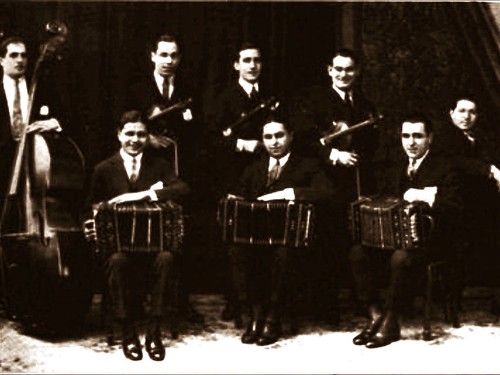
The Story Behind Orquesta Típica Victor aka OTV
From Todotango.com
When the officials of that record company had the idea of putting together an orchestra that would represent the corporation, they turned to a pianist classically trained, who had not yet played tango: Adolfo Carabelli.
This great artist studied with the best teachers of his time and when he was fifteen he was already playing concerts in the theaters of the city of Buenos Aires. When he was very young he went to Bologna, where he stayed until 1914. There he went to school and continued his musical studies. When the war broke up he returned to his country where he put together a small group of classical music: Trío Argentina.
Around that time he became acquainted with the pianist Lipoff, who accompanied the well-known dancer Anna Pavlova, and through him he was introduced to jazz, a genre that was beginning to get a wide acclaim.
His first orchestra was named River Jazz Band, later, when switching to the radio, the group bore his name, and the orchestra achieved an overwhelming success and was requested by all the nightclubs of the period. Eduardo Armani and Antonio Pugliese, among others, passed through its ranks.
He recorded his early records for the Electra label and later he is hired by the Victor company as musical advisor and responsible for the creation of a tango orchestra.
It was a seminal orchestra in tango, that never performed in public, but which left for us, during its long career, the indelible memory of its perfection and quality.
The first setting chosen by Carabelli, and that made its debut recording two tangos on November 9, 1925: “Olvido [b]”, by Ángel D'Agostino, and “Sarandí” by Juan Baüer, was the following: Luis Petrucelli, Nicolás Primiani and Ciriaco Ortiz (bandoneons); Manlio Francia, Agesilao Ferrazzano and Eugenio Romano (violins); Vicente Gorrese (piano) and Humberto Costanzo (double bass).
The composition of the orchestra changed very often, the musicians were continuously replaced, but they all were of an excellent level. So that so that some experts recognize, on certain recordings, the violin of Elvino Vardaro, for example.
Other important names that passed through the ranks of the orchestra were: Federico Scorticati, Carlos Marcucci and Pedro Laurenz (bandoneon players); Orlando Carabelli, brother of the leader, and Nerón Ferrazzano (double bass); Nicolás Di Masi, Antonio Buglione, Eduardo Armani and Eugenio Nobile (violins). Cayetano Puglisi, Alfredo De Franco and Aníbal Troilo were also included in the orchestra on some occasions.
Years later, and due to commercial reasons, the label thought that only one orchestra was not enough. For that reason a number of orchestras began to appear: Orquesta Victor Popular, the Orquesta Típica Los Provincianos led by Ciriaco Ortiz, the Orquesta Radio Victor Argentina led by Mario Maurano, the Orquesta Argentina Victor, the Orquesta Victor Internacional, the Cuarteto Victor lined up by Cayetano Puglisi, Antonio Rossi (violins), Ciriaco Ortiz and Francisco Pracánico (bandoneons) and the excellent Trío Victor, with the violinist Elvino Vardaro and the guitarists Oscar Alemán and Gastón Bueno Lobo.
The already mentioned quality of the musicians made the Orquesta Típica Victor one of the highest musical expressions of its period, and it would remain at the same level until the late thirties. And this is important to highlight, because other important orchestras, such as Julio De Caro, had lost their north.
Unfortunately later, because of a repertory that tried to fit into the commercial needs of the period, the quality of it declined, but neither its sound nor the capability of its members were of a poor level. Its vocalists, likewise, kept on being of a first rate level.
In 1936 the leadership of the orchestra is transferred to the bandoneonist Federico Scorticati, and its early recordings were the tangos “Cansancio” (by Federico Scorticati and Manuel Meaños) and “Amargura” (by Carlos Gardel and Alfredo Le Pera), sung by Héctor Palacios.
In 1943 the orchestra was led by the pianist Mario Maurano, and recorded the tangos “Nene caprichoso” and “Tranquilo viejo tranquilo” (both by Francisco Canaro and Ivo Pelay), with Ortega Del Cerro on vocals, on September 2.
The last recordings under the name Orquesta Típica Victor were made on May 9, 1944, and they were the waltzes “Uno que ha sido marino” (by Ulloa Díaz) and the popular “Sobre las olas” (by Juventino Rosas), both sung by the Jaime Moreno and Lito Bayardo duo.
According to Nicolás Lefcovich's discography, the recordings were 444, but to this number we would have to add many recordings coupled on discs that on the opposite face had renditions of varied interpreters.
Even though it was an orchestra that mainly played tango, it also recorded other beats, more than forty rancheras and a similar number of waltzes, around fifteen foxtrots and very few milongas. Also polkas, corridos, pasodobles, etc.
As for vocalists, they appeared only three years after its creation, after over a hundred instrumental numbers were recorded. And the first one was a violinist, Antonio Buglione (a total of four recordings), with the tango "Piba", on October 8, 1928.
He was followed by Roberto Díaz (27 recordings), Carlos Lafuente (37, the one who recorded most), Alberto Gómez (25), Ernesto Famá (17), Luis Díaz (14), Teófilo Ibáñez (9), Ortega Del Cerro (7), Juan Carlos Delson (7), Mario Corrales —later Mario Pomar — (6) and Charlo (4).
Through the ranks of the orchestra the following vocalists passed: Alberto Carol, Jaime Moreno, Lito Bayardo, Lita Morales, Eugenio Viñas, Ángel Vargas, José Bohr, Osvaldo Moreno, Vicente Crisera, Dorita Davis, Oscar Ugarte, Fernando Díaz, Héctor Palacios, Mariano Balcarce, El Príncipe Azul, Francisco Fiorentino, Armando Barbé (also with the name Armando Sentous), Samuel Aguayo, Hugo Gutiérrez, Jimmy People, Deo Costa, Alberto Barros, Raúl Lavalle, Augusto "Tito" Vila and Gino Forsini.
When in 1944 the label decided to put an end to its career, tango was so successful that it would not be an exaggeration to say that everyday a new orchestra was put together. Somehow, with the great orchestras of the forties: Troilo, D'Arienzo, Di Sarli, D'Agostino, Tanturi, Fresedo, Laurenz, among others, the need of having one's own orchestra has come to an end.
From Todotango.com
Subscribe to:
Posts (Atom)