
Showing posts with label Musicality. Show all posts
Showing posts with label Musicality. Show all posts
Monday, November 11, 2019
Ears + Heart + Feet: Talking About Tango Music :: Jessica Schilling
Jessica gave this presentation at the 2019 Albuquerque Tango Festival. This is a condensed "practice" version.
From the YouTube description: Let's talk about tango music! As dancers, knowing more about tango music's history and development can help us shine -- as well as make dancing a lot more fun. This talk from tango DJ Jessica Schilling goes over some of the history of tango music, what we can learn from the different eras of tango to help inform our dancing, and what we can bring with us into the milonga. It's a condensed version of a presentation given 9 November 2019 at the Albuquerque Tango Festival.
Big thanks to Pablo Stafforini for creating the wonderful "20 Tango Endings" video included in this talk!
Sent from my iPad


Wednesday, March 13, 2019
Wednesday, November 21, 2018
Musicality Part II :: How to get your musicality to flourish

Part II in my musicality the holy grail of tango series is primarily this: Listening to Tango Dance Music - A Beginner's Guide.
Scroll down for some of my original drivel-thought on the flourishing part.
Here's Part I Musicality The Holy Grail of Tango if you missed it.
You might call this one a prequel. Going back to basics. Or rather going to the original, the root/s, the foundations. The genesis of musicality.
The music.
Wow. That's some profound shit there Alex. He says. Self-deprecatingly. (grin)
Sidenote: I found this beginner's guide on TodoTango.com, excerpted from Michael Lavocah's "Tango Stories - Musical Secrets"
So, as I pointed out in Part I (parroting what Elizabeth said in her post), it's important to listen to a lot of tango music. The good stuff, not the bad shit. It's also important to have some background into what you are listening to. The structure and the elements and all that musicological jazz.
It's also important to think (hard) about what you are listening to. Sure, yes, just "listen" sometimes, letting the music wash over you and envelope your heart and soul, only engaging your brain by maybe throwing in some astral projection (see Part I). But sometimes do engage your brain, and think about the structure and elements Michael describes. And describe it very well does he. Not sure why I just dropped into Yoda-speak. (grin)
I would add a fifth element to acknowledge/be aware of/think about whilst listening. Another element beyond beat, rhythm, melody, and lyrics.
That fifth element would be emotion. First, the emotion "of" the music. Inside it. Emanating from the instruments, emanating from the musicians through their instruments. The vibrations sent forth across the air, making contact with your ear drums. Next, doing all the primordial things that the miraculous human body and brain does, all of the energetic electro chemical type stuff swirling around your heart and your soul and your being. Eliciting some sort of emotional response, hopefully. Your internal emotional response to the emotionally infused music that was just delivered unto you. You might ask ten different people to describe the emotion(s) "of" a particular song and get ten different answers. Then you might get different responses if you ask about the internal emotions of the listener, or rather their emotional responses. The stuff that wells up inside you when you listen to a really beautiful tango. Your favorite tango. The bubbles that form on the surface of your primordial ooze and then pop, manifesting into righteousness multitudinous itty-bitty thought bubble/clouds that we think when we're emotionally vibrationally energetically stimulated. Whilst dancing. Dancing tango. To good tango music. Dancing tango to good golden-age tango music. The warm and fuzzy shit.
Is there a song that makes you cry every time you listen to it? Or nearly every time? Or even some times? For me it's this one. I don't know why. I don't have any historical or experiential connection to the song. But it gets me nearly every time. It's just so fucking beautiful. And the magnitude of the beauty that the human animal is capable of creating. And the magnitude of the utter destruction of humanity itself, not to mention the destruction of the planet, unleashed by humanity itself. That's what gets me when I listen to this one. I think. Perhaps.
But I digress.
Hell, that one, perhaps, being the fifth, might even be the elusive quinta essencia. The Fifth Element. The Quintessence. Earth, Fire, Water, Air. Tango.
I've written about that before. https://alextangofuego.blogspot.com/2009/01/deep-tango-thoughts-golden-age.html
Okay, maybe the emotion of tango music isn't actually "THE" Quintessence of Tango.
But maybe it (the emotion of tango) just touches the surface of the concept (of the quintessence of tango).
Like a single candle illuminating a large dark room.
If you've read my blog for any length of time, you'll know that I tend to go round and round and digress all over the place and then gel it down to something in the end. That's what I love about extemporaneous writing disjointed bullshittery. Not knowing the point/conclusion/gist of what I'm writing until I get to the end, and I'm kinda sitting here pondering what I've just written. And then it comes to me. Voilà. I like that.
My point with this one, the point that I didn't realize until I got to the point of writing all the drivel above, is that for your musicality to flourish, there needs to be a direct connection between it and your emotions and the emotion(s) of the music. Think of it as a web of energetic interconnectivity/ed/ness.
IMHO.
Monday, November 19, 2018
Musicality :: The Holy Grail of Tango
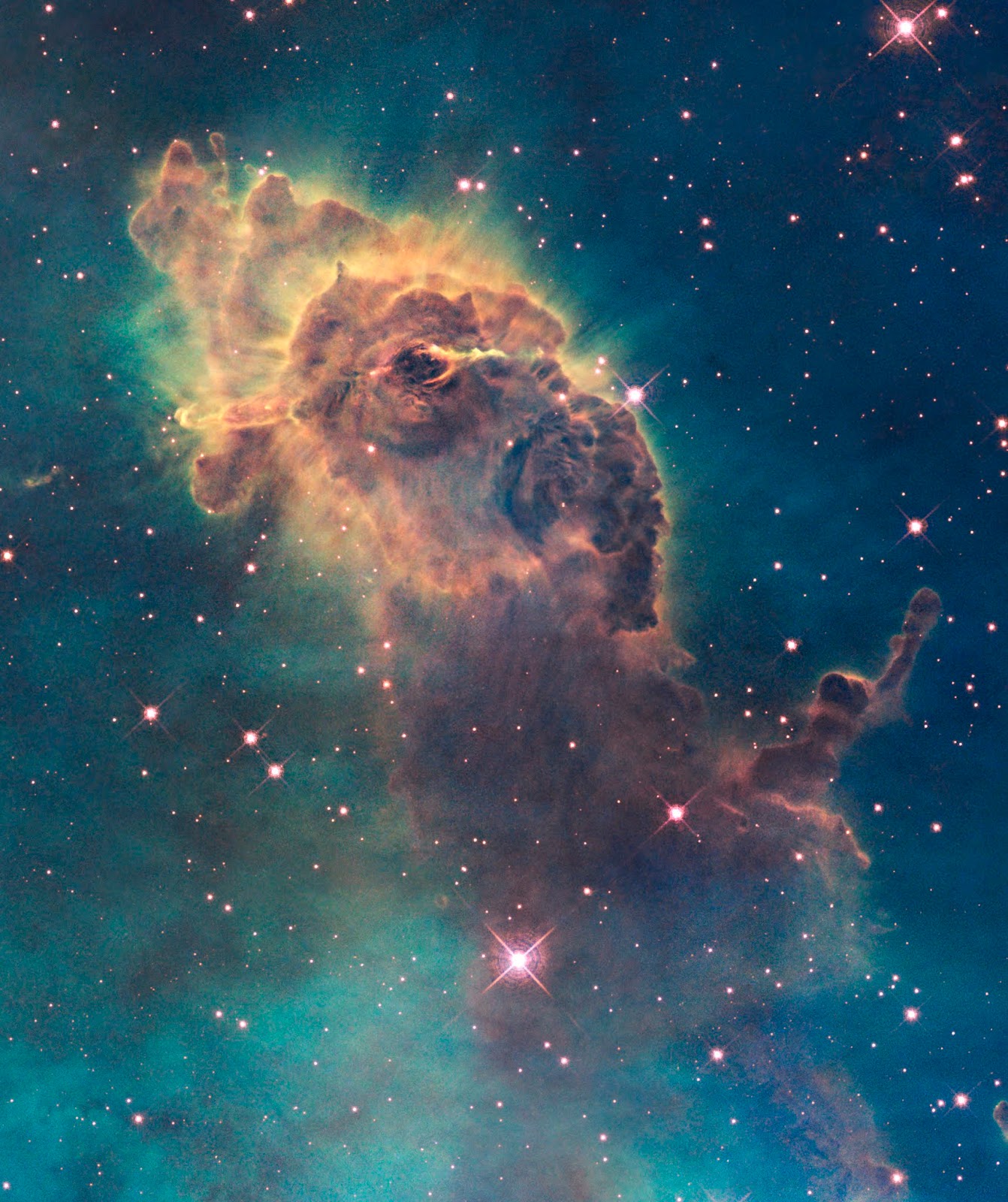
The Carina Nebula
So I just ran across this, thanks to my very first original tango teacher, Heather Morrow, high up in the Rocky Mountains in Aspen, Colorado. The link that is. The link at the very bottom of this post. The referenced post is courtesy of Elizabeth Wartluft out of Portland.
Nothing profound here (in her post), but it's a good start. I'll use this post (this here post) as the initial/starting post on a series looking into "musicality". The Holy Grail of Tango.
I like to believe my musicality is pretty good. I'm not sure how it happened though. I'll venture a guess that it's from Elizabeth's #1. I seem to recall a period, early in my tango years, that I decided I would only listen to tango music. That lasted about two years, if memory serves.
I think I've taken a few "musicality" classes at festivals in years gone by. I think I remember them being pretty nebulous. Maybe even arcane. Well hell yeah arcane! Now that I look up the definition. Nebulous AND arcane!!! (hence the nebula photo)
I'm not sure (tango) musicality can be "taught". You have to want it bad. You have to listen to a ton of good tango music. GOOD TANGO MUSIC. NOT THE SHIT THAT MOST DJ'S PLAY. Separating the GOOD SHIT from the BAD SHIT, the GOOD from the BAD and the UGLY SHIT, is a damn good exercise in musicality. If your community's DJ's are playing bad shit, it's likely their musicality sucks. It's likely there's not much good musicality being manifested by the general tango populace of the community. And that, my friends, is some sad shit. Bad tango music will ruin a tango community, and ruin it's dancers.
So listen to good tango music. Watch who you perceive to be good/musical dancers. Leaders, primarily I suppose. Leaders for leaders. Followers for followers.
Listen, watch. Listen, watch. Hyper-awareness whilst listening and watching. Feel the music.
Oh. Another thing I've done and I still do. I transport myself back to the 1940's. Maybe even all the way back to the 1930's. I transport myself back to a milonga, visualize a live orchestra playing, visualize a beautiful piece of architecture, a ballroom or whatever. Visualize the room, the dancers, the music, the cigarette smoke, the smells. I'm not sure you can visualize smells, but you get my drift. (grin) Visualize yourself dancing back then. In the middle of the zeitgeist that created tango. Astral projection is prolly the better word/s.
Oh yeah, and dance. Dance and practice, but to damn good tango music.
Listen, watch, feel, whilst hyper-awareness-isizing yourself. Listen, watch, feel, astrally project, dance.
Do all that shit and the "musicality" will come. It has to steep, absorb, infuse, assimilate...all the way down deep into your DNA. It will take months and years to get it hard-wired into your brain and hard-wired into your tango.
Oh, also - for a later post - we should talk about how much more musical you can be with songs you've heard before. Dancing to a live orchestra, especially to a song you're not familiar with, can be one of the most challenging, uh..."things" to your musicality-ish-ness. Again, a later post.
Anyway that's what I think.
What do y'all think?
https://www.elizabethwartlufttango.com/blog/2010/01/31/vals-and-argentine-tango-musicality-games-and-exercises
Thursday, June 14, 2018
"And the music?" "Oh, he doesn't let the music get in the way of his dancing!"
Shared on FB by Vania...
"And the music?" "Oh, he doesn't let the music get in the way of his dancing!" ~ Anonymous
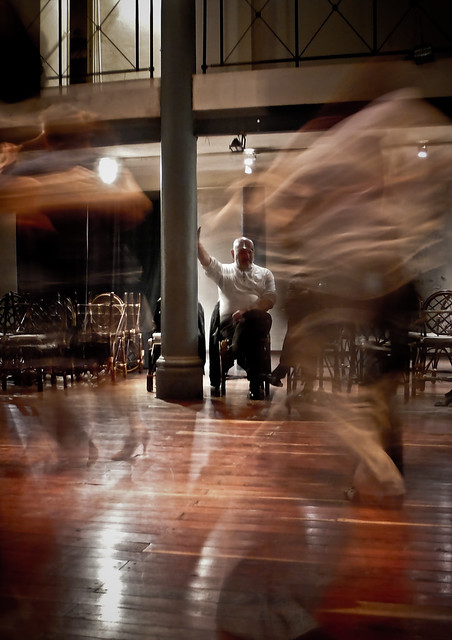 [One of my photos...]
"And the music?" "Oh, he doesn't let the music get in the way of his dancing!" ~ Anonymous
[One of my photos...]
Thursday, February 9, 2017
Listening to tango dance music - A beginner’s guide - By Michael Lavocah
By
Michael Lavocah
Adapted by the author from Tango Stories: Musical Secrets, 2nd edition, milonga press, 2014.
http://www.milongapress.com/books/tango-stories/english/
Listening to tango dance music - A beginner’s guide
hen listening to tango music for the first time, especially if our main experience of music has been modern pop music, it can be difficult to hear what is going on, and what we hear may well seem like a “wall of sound”. The good news is that listening to music is a faculty that we can develop. Attentive listening immediately changes our experience, making it richer, creating a relationship to the music. If you are a dancer, you dance what you hear, and so what you dance will immediately begin to change as well, without learning any new steps.
1. The four elements
Dance music can be thought of as comprising four elements: beat (compás), rhythm, melody, and lyrics. Lyrics are optional, although there are always feelings. The first step in developing our listening faculty is to learn to listen to these four elements. These form four listening skills, which for the dancer will map to four dancing skills —the skills of dancing to the beat, to the rhythm, to the melody, and to the lyrics—.
Beat and rhythm are not the same. By beat we mean the regular pulse of the music. Beat alone is not music, but it is the foundation of music. We walk on the beats, and so without beat there is no walking dance. Beat is a natural, physical phenomenon, like the beat of your heart, or the cadence of walking, or breathing. Some people think of themselves as having «no sense of rhythm», but the beat is there within us, waiting to be discovered.
Beat and rhythm are connected, and it’s hard to find a tango that is pure beat (i.e. with no rhythmic variation), but there is one: Juan D'Arienzo’s “Nueve de julio” —curiously, and significantly, the breakthrough track for the new D’Arienzo sound— that was created by the arrival of Rodolfo Biagi in 1935.
By rhythm, as distinct from beat, we mean the changing pattern of the beats. A classic example is the opening of “Milongueando en el cuarenta”, recorded by Aníbal Troilo in 1941, with its tumbling syncopation: 1-2-3, 1-2-3, 1-2-3, 1-2-3, 1-2, 1-2, 1.
Orquesta Troilo
The melody is what we sing to ourselves, or to others, when we recall a song: the tune. The more romantic orchestras prioritise the melody over the beat and the rhythm. This is something we hear developing in the later recordings of Di Sarli. For an earlier example, we can turn to Lucio Demare’s iconic 1942 recording of “Malena”, his own composition. The melodic line is vigorous and clear, and thus easy to follow.
Finally we have the lyrics – meaning. This element is hidden if we don’t speak Spanish. As an example, let’s take Ada Falcón’s 1940 recording of “Te quiero” (“I love you”) with the orchestra of Francisco Canaro. The opening lines run:
I love you!
As no-one has ever loved you,
and no-one ever will;
I adore you!
As one adores the woman
one has to love…
Hearing these words is sure to change your relationship to the song, and to arouse feelings, perhaps memories, which can then become enfolded into the music and expressed in your dancing.
The tango orchestras mix and prioritise these elements differently and this is one way to feel the orchestras and to distinguish them.
The beat
Beats are not all the same —they have their qualities—, and each orchestra has a different quality to its beat. A first attempt to discern and feel these qualities would be to classify them into polar opposites: hard or soft, strong or weak, sharp and choppy (staccato) or rounded and smooth (legato). D’Arienzo’s beat is staccato, a development that reaches its zenith with Biagi (e.g. the extreme beat of “Racing Club”); whilst Caló’s beat is smooth and soft (“Al compás del corazón (Late un corazón)”). Troilo is more sophisticated, moving between staccato and legato (“Milongueando en el cuarenta”, 1941).
This analysis breaks down when one starts listening to music from before the golden decade. The beats of Roberto Firpo (“La eterna milonga [b]”, 1929) or Juan Maglio (“Sábado ingles”, 1928) are strong, but also soft. In this period, most of the orchestras made a prominent use of the arrastre in their music. Now, what is the arrastre? It is when the beat, instead of being something instantaneous, is made longer, starting quietly and accelerating to a crescendo. In tango, this is described by the sound zhum (written: yum). This effect can be produced on all the instruments within the orchestra. In the bandoneon, it is produced by keying the note before opening the bellows, and then accelerating the opening to a sudden stop: listen for instance to the opening of “Melancólico”. In the strings, the bow is placed on the string before it is moved, and then accelerated. If you are not used to listening for this, it’s easiest to start with the double bass rather than the violins, for instance in the opening of Piazzolla’s “Buenos Aires hora cero”. From the point of view of walking, the most important of the string instruments is the double bass, because it’s the low notes which produce the beats upon which we walk. When going on to listen to the violins, the opening chord of Di Sarli’s “Retirao” provides an exaggerated example.
When the whole orchestra joins in, the effect can be dramatic. My favourite example is a recording by Osvaldo Fresedo’s sextet, “Mamá… cuco” (1927). This reveals another side to Fresedo, full of bite. The arrastre would not be so prominent again until Osvaldo Pugliese incorporated it into what he called la yum-ba: the repeated cell of two strong arrastres (‘yum’) on beats 1 and 3, separated by a less powerful chord on beats 2 and 4 (‘ba’), supported by the double bass powerfully striking the strings with the bow.
The qualities of the beat will affect the quality of the walk. Dancing to different orchestras is not principally about choosing different figures for different kinds of music, although we might: it is about manner. The different qualities of beat inspire different qualities of walking —different ways to place out feet upon the floor—. The arrastre in particular can have a big impact on the way the weight is transferred across the foot.
Rhythm and syncopation
The main rhythmic devices in tango are syncopations —beats falling in unexpected places—.
Let’s start with D’Arienzo. Principally, he uses the syncopa, tango’s classic syncopation – in Western terms, the behind-the-beat syncopation: listen for instance to the first syncopations in “Don Juan (El taita del barrio)” (1936). For a dancer, the staccato acceleration of the syncopa is strongly suggestive of a corte, a cut step. These syncopations often occur in bursts of three —useful information for the dancer—.
Listen closely, and you’ll hear that each syncopation is actually a double syncopation – a behind-the beat syncopation followed by a different one, a before-the-beat syncopation. This is normally much quieter, so we don’t notice it, but when equal prominence is given to both, the result can be disconcerting, as in the opening beats of D’Arienzo’s “Homero” (1937). You can also hear this combination at the opening of all three of Di Sarli’s recordings of “Organito de la tarde”.
Another classic syncopation is the 3-3-2 syncopation (counting 8 beats as 1-2-3, 1-2-3, 1-2). In tango’s golden age, this is found only in the more sophisticated orchestras. Strong examples are Pedro Laurenz’s “Arrabal” (1937) and Troilo’s “Comme il faut” (1938) —both of them electrifying recordings—.
An even more sophisticated and unique example, which we might consider derived from the 3-3-2, is the tumbling syncopation that Troilo employs at the opening of “Milongueando en el cuarenta” (1941). Counting it out, we find that it runs: 3-3-3-3-2-2-1.
The melody
Melody is constructed in phrases, just like human speech. Phrases can be short or long. In the very early days of tango, the days of the 2x4, phrases were always short: think for instance of “El choclo” —but this would soon change—. The example par excellence of the long phrase in tango music occurs in Francisco De Caro’s “Flores negras” (1927), one of the most beautiful melodies ever written in tango. It’s also an excellent example of counterpoint: listen carefully to the opening phrases, and underneath the nasal tones of Julio De Caro’s cornet violin one can hear the second violin playing a completely different tune.
The lyrics
It’s beyond the scope of this essay to talk about lyrics in any depth, but it’s worth noting that in the golden decade, sad lyrics were often given a very bright treatment by the dance orchestras —just think for instance of Troilo’s “Toda mi vida” (1941)—. This creates a bittersweet quality, which is perhaps no accident. If you want to appreciate this, there is no alternative but to learn Spanish.
Mixing the four elements
Generally speaking, dance orchestras lean towards a treatment that favours either the beat and the rhythm (D'Arienzo), or the melody (late Di Sarli). When both aspects are given space, the results are very satisfying: think for instance of Ricardo Tanturi with Enrique Campos, or Ángel D'Agostino with Ángel Vargas.
2. The instruments
Having looked briefly at the way the orchestras treat the elements of beat, rhythm and melody, we can go look at the way they use the instrumental forces at their disposal: the bandoneons, the violins, and the piano. How much prominence is each section given? In the case of the bandoneons and the violins, are individual players given solos? If they are, is there something characteristic about their playing which allows us to enjoy and to identify individual musicians?
The D'Arienzo orchestra always had a terrific bandoneon section, and many pieces culminate in a variación showcasing the ability of the whole group. A classic early example, with very clear phrasing, is the variación in “Paciencia” (1937). Listen closely and you may also hear the delightful changes in rhythm (from 4 beats per note to 3) that D’Arienzo often employs in his variaciones.
The Troilo orchestra has a completely different way of using the bandoneons. Rather than featuring the whole section, Troilo’s solo playing is given space. Troilo was famous for the feeling he put into his playing, and on many occasions he makes music just on a single note: the supreme example is his solo at the end of the milonga “Del tiempo guapo”. His rather more famous solos in “La tablada” (1942) and “La cumparsita” (1944) also use very few notes, but feel more economical and modest, with a subtle, introverted feeling.
Another way of using the bandoneon is shown by fellow bandoneonista Pedro Laurenz. His orchestra makes use of running variations, in which the bandoneon doesn’t pause for breath. The bandoneon is bisonic: each button produces two different notes according to whether the instrument is being opened or closed. It’s easier to play the instrument with power when opening, because, with the help of gravity, the instrument falls open across your knee. For this reason, many players mostly play in the opening direction, and then quickly close the instrument in order to return to that opening direction. Laurenz, on the other hand, just keeps going – listen to any of his orchestra’s recordings from 1940, such as “No me extraña”. This is virtuoso playing, requiring a total technical mastery of the instrument.
There are other bandoneon players whose sound we can identify. Osvaldo Ruggiero, Pugliese’s first bandoneon for 24 years, can be immediately identified by the piercing, sharp sounds he produces, for instance, in the 1944 recording of “Recuerdo” —the facility with which he dashes off the final variación makes it sound quite effortless—. One doesn’t realise how difficult it is until one hears it attempted by any other player.
Another bandoneonista with an individual sound is Minotto Di Cicco, Canaro’s first bandoneon for many years. Minotto was a real student of the instrument, producing chords with a wide spread of notes whilst always maintaining a very clean fingering. A good example of this can be found in “La muchachada del centro” from 1932.
The violins
The violin was a tango instrument from the very beginning, and there are a few orchestras which favoured the violins over the bandoneons. The classic example is the orchestra of Carlos Di Sarli. A useful listening example is the 1940 recording of the instrumental “El Pollo Ricardo”. Given the year of the recording (still in the aftermath of the D'Arienzo explosion) the playing is staccato and up-tempo, but the music is easily identified as Di Sarli from the piano playing. In the first chorus, the bandoneons are used to support the sharp attack in the string sections.
An even sharper attack can be heard from the violin of Raúl Kaplún, who joined Lucio Demare in 1942. This added strength to Demare’s lyrical sound, a combination you can hear from the opening notes of “Sorbos amargos”.
Another orchestra with a muscular violin sound, although with a denser texture, is Tanturi during his years with Campos on vocals. The classic example is “Oigo tu voz”, in which the violin opens the piece.
D'Arienzo’s violin rejects all these possibilities, and returns to the violin obligato of the guardia vieja: not really a melody, but a simple line, played low on the fourth string, which threads its way through the music. You can hear it for instance in the closing passage of his first (1937) recording of “La cumparsita” —or just about anywhere in his music—.
The piano
The use of the piano within the orchestra shows huge variation, perhaps more than with the other instruments. In some sense, it is the axis, the spine of the orchestra. Its role can be restricted to accompaniment, as in Tanturi (e.g. “Pocas palabras”), but the great orchestras did more with it. The piano often appears in the gaps between phrases, where it has different functions. Sometimes, especially in valses, it links the phrases together, e.g. Osmar Maderna’s piano for Miguel Caló in “Bajo un cielo de estrellas”. Sometimes it punctuates the phrases, as with Biagi in D'Arienzo’s orchestra, e.g. “El choclo”. D'Arienzo’s piano is usually heard quite high on the keyboard: the marcato of his bandoneons is so strong that his pianists, unusually, do not need to do much work in the bass notes.
Di Sarli’s piano is also easiest to notice in the spaces between phrases, where he places delicate, bell-like trills, but the real action is going on in his left-hand. A good example is his version of “La cachila”, and not just because it contains a rare piano solo. Di Sarli recorded this twice, in 1941 and 1952. The two versions are quite different in the piano; both are good, but Di Sarli’s growling left-hand is easier to appreciate in the second version.
Finally we come to tango’s most brilliant improvising pianist, Orlando Goñi, a man whose contribution to the Troilo orchestra has not really received the recognition it deserves. Naturally, he shines most in the instrumentals. “C.T.V.” gives you a good idea of what he is capable of: he roams all over the keyboard with great freedom. In the right hand, he can imitate and reflect the phrasing of Troilo, as in the opening notes of “La tablada”; in the left-hand (the bass notes), his legendary marcación bordoneada —striking of a chord as though rolling up through the bass strings of a guitar— provides a fluid and elastic foundation to the rhythmic drive of the orchestra that has never been equalled.
The double bass
The bass notes of the orchestra give the walking impulse, and these come from the left hand of the piano and the double bass, which had to work together in the orchestras: the double bass was usually positioned very close to the piano. Today we mostly listen to tango music on recordings, on which these notes are not as loud as they are in real life. In addition, the sound system in the average milonga does not reproduce these notes very well, so we need to make a special effort to train our ears to listen for them. Most pop music has some kind of bass drive; the tango of the golden age was simply the popular music of its day, albeit some of the most sophisticated pop music the world has ever known.
For the dancer, being aware of both the beat/rhythm and the melody, and being able to separate them in our ear, expands the range of music that we enjoy and gives us freedom. In tango music, the melody is often given a rhythmic treatment. It’s often impossible to separate them entirely, but learning to discriminate between the melody and the rhythm is one of the most important skills of all.
Adapted by the author from Tango Stories: Musical Secrets, 2nd edition, milonga press, 2014.
Michael Lavocah
Adapted by the author from Tango Stories: Musical Secrets, 2nd edition, milonga press, 2014.
http://www.milongapress.com/books/tango-stories/english/
Listening to tango dance music - A beginner’s guide
hen listening to tango music for the first time, especially if our main experience of music has been modern pop music, it can be difficult to hear what is going on, and what we hear may well seem like a “wall of sound”. The good news is that listening to music is a faculty that we can develop. Attentive listening immediately changes our experience, making it richer, creating a relationship to the music. If you are a dancer, you dance what you hear, and so what you dance will immediately begin to change as well, without learning any new steps.
1. The four elements
Dance music can be thought of as comprising four elements: beat (compás), rhythm, melody, and lyrics. Lyrics are optional, although there are always feelings. The first step in developing our listening faculty is to learn to listen to these four elements. These form four listening skills, which for the dancer will map to four dancing skills —the skills of dancing to the beat, to the rhythm, to the melody, and to the lyrics—.
Beat and rhythm are not the same. By beat we mean the regular pulse of the music. Beat alone is not music, but it is the foundation of music. We walk on the beats, and so without beat there is no walking dance. Beat is a natural, physical phenomenon, like the beat of your heart, or the cadence of walking, or breathing. Some people think of themselves as having «no sense of rhythm», but the beat is there within us, waiting to be discovered.
Beat and rhythm are connected, and it’s hard to find a tango that is pure beat (i.e. with no rhythmic variation), but there is one: Juan D'Arienzo’s “Nueve de julio” —curiously, and significantly, the breakthrough track for the new D’Arienzo sound— that was created by the arrival of Rodolfo Biagi in 1935.
By rhythm, as distinct from beat, we mean the changing pattern of the beats. A classic example is the opening of “Milongueando en el cuarenta”, recorded by Aníbal Troilo in 1941, with its tumbling syncopation: 1-2-3, 1-2-3, 1-2-3, 1-2-3, 1-2, 1-2, 1.
Orquesta Troilo
The melody is what we sing to ourselves, or to others, when we recall a song: the tune. The more romantic orchestras prioritise the melody over the beat and the rhythm. This is something we hear developing in the later recordings of Di Sarli. For an earlier example, we can turn to Lucio Demare’s iconic 1942 recording of “Malena”, his own composition. The melodic line is vigorous and clear, and thus easy to follow.
Finally we have the lyrics – meaning. This element is hidden if we don’t speak Spanish. As an example, let’s take Ada Falcón’s 1940 recording of “Te quiero” (“I love you”) with the orchestra of Francisco Canaro. The opening lines run:
I love you!
As no-one has ever loved you,
and no-one ever will;
I adore you!
As one adores the woman
one has to love…
Hearing these words is sure to change your relationship to the song, and to arouse feelings, perhaps memories, which can then become enfolded into the music and expressed in your dancing.
The tango orchestras mix and prioritise these elements differently and this is one way to feel the orchestras and to distinguish them.
The beat
Beats are not all the same —they have their qualities—, and each orchestra has a different quality to its beat. A first attempt to discern and feel these qualities would be to classify them into polar opposites: hard or soft, strong or weak, sharp and choppy (staccato) or rounded and smooth (legato). D’Arienzo’s beat is staccato, a development that reaches its zenith with Biagi (e.g. the extreme beat of “Racing Club”); whilst Caló’s beat is smooth and soft (“Al compás del corazón (Late un corazón)”). Troilo is more sophisticated, moving between staccato and legato (“Milongueando en el cuarenta”, 1941).
This analysis breaks down when one starts listening to music from before the golden decade. The beats of Roberto Firpo (“La eterna milonga [b]”, 1929) or Juan Maglio (“Sábado ingles”, 1928) are strong, but also soft. In this period, most of the orchestras made a prominent use of the arrastre in their music. Now, what is the arrastre? It is when the beat, instead of being something instantaneous, is made longer, starting quietly and accelerating to a crescendo. In tango, this is described by the sound zhum (written: yum). This effect can be produced on all the instruments within the orchestra. In the bandoneon, it is produced by keying the note before opening the bellows, and then accelerating the opening to a sudden stop: listen for instance to the opening of “Melancólico”. In the strings, the bow is placed on the string before it is moved, and then accelerated. If you are not used to listening for this, it’s easiest to start with the double bass rather than the violins, for instance in the opening of Piazzolla’s “Buenos Aires hora cero”. From the point of view of walking, the most important of the string instruments is the double bass, because it’s the low notes which produce the beats upon which we walk. When going on to listen to the violins, the opening chord of Di Sarli’s “Retirao” provides an exaggerated example.
When the whole orchestra joins in, the effect can be dramatic. My favourite example is a recording by Osvaldo Fresedo’s sextet, “Mamá… cuco” (1927). This reveals another side to Fresedo, full of bite. The arrastre would not be so prominent again until Osvaldo Pugliese incorporated it into what he called la yum-ba: the repeated cell of two strong arrastres (‘yum’) on beats 1 and 3, separated by a less powerful chord on beats 2 and 4 (‘ba’), supported by the double bass powerfully striking the strings with the bow.
The qualities of the beat will affect the quality of the walk. Dancing to different orchestras is not principally about choosing different figures for different kinds of music, although we might: it is about manner. The different qualities of beat inspire different qualities of walking —different ways to place out feet upon the floor—. The arrastre in particular can have a big impact on the way the weight is transferred across the foot.
Rhythm and syncopation
The main rhythmic devices in tango are syncopations —beats falling in unexpected places—.
Let’s start with D’Arienzo. Principally, he uses the syncopa, tango’s classic syncopation – in Western terms, the behind-the-beat syncopation: listen for instance to the first syncopations in “Don Juan (El taita del barrio)” (1936). For a dancer, the staccato acceleration of the syncopa is strongly suggestive of a corte, a cut step. These syncopations often occur in bursts of three —useful information for the dancer—.
Listen closely, and you’ll hear that each syncopation is actually a double syncopation – a behind-the beat syncopation followed by a different one, a before-the-beat syncopation. This is normally much quieter, so we don’t notice it, but when equal prominence is given to both, the result can be disconcerting, as in the opening beats of D’Arienzo’s “Homero” (1937). You can also hear this combination at the opening of all three of Di Sarli’s recordings of “Organito de la tarde”.
Another classic syncopation is the 3-3-2 syncopation (counting 8 beats as 1-2-3, 1-2-3, 1-2). In tango’s golden age, this is found only in the more sophisticated orchestras. Strong examples are Pedro Laurenz’s “Arrabal” (1937) and Troilo’s “Comme il faut” (1938) —both of them electrifying recordings—.
An even more sophisticated and unique example, which we might consider derived from the 3-3-2, is the tumbling syncopation that Troilo employs at the opening of “Milongueando en el cuarenta” (1941). Counting it out, we find that it runs: 3-3-3-3-2-2-1.
The melody
Melody is constructed in phrases, just like human speech. Phrases can be short or long. In the very early days of tango, the days of the 2x4, phrases were always short: think for instance of “El choclo” —but this would soon change—. The example par excellence of the long phrase in tango music occurs in Francisco De Caro’s “Flores negras” (1927), one of the most beautiful melodies ever written in tango. It’s also an excellent example of counterpoint: listen carefully to the opening phrases, and underneath the nasal tones of Julio De Caro’s cornet violin one can hear the second violin playing a completely different tune.
The lyrics
It’s beyond the scope of this essay to talk about lyrics in any depth, but it’s worth noting that in the golden decade, sad lyrics were often given a very bright treatment by the dance orchestras —just think for instance of Troilo’s “Toda mi vida” (1941)—. This creates a bittersweet quality, which is perhaps no accident. If you want to appreciate this, there is no alternative but to learn Spanish.
Mixing the four elements
Generally speaking, dance orchestras lean towards a treatment that favours either the beat and the rhythm (D'Arienzo), or the melody (late Di Sarli). When both aspects are given space, the results are very satisfying: think for instance of Ricardo Tanturi with Enrique Campos, or Ángel D'Agostino with Ángel Vargas.
2. The instruments
Having looked briefly at the way the orchestras treat the elements of beat, rhythm and melody, we can go look at the way they use the instrumental forces at their disposal: the bandoneons, the violins, and the piano. How much prominence is each section given? In the case of the bandoneons and the violins, are individual players given solos? If they are, is there something characteristic about their playing which allows us to enjoy and to identify individual musicians?
The D'Arienzo orchestra always had a terrific bandoneon section, and many pieces culminate in a variación showcasing the ability of the whole group. A classic early example, with very clear phrasing, is the variación in “Paciencia” (1937). Listen closely and you may also hear the delightful changes in rhythm (from 4 beats per note to 3) that D’Arienzo often employs in his variaciones.
The Troilo orchestra has a completely different way of using the bandoneons. Rather than featuring the whole section, Troilo’s solo playing is given space. Troilo was famous for the feeling he put into his playing, and on many occasions he makes music just on a single note: the supreme example is his solo at the end of the milonga “Del tiempo guapo”. His rather more famous solos in “La tablada” (1942) and “La cumparsita” (1944) also use very few notes, but feel more economical and modest, with a subtle, introverted feeling.
Another way of using the bandoneon is shown by fellow bandoneonista Pedro Laurenz. His orchestra makes use of running variations, in which the bandoneon doesn’t pause for breath. The bandoneon is bisonic: each button produces two different notes according to whether the instrument is being opened or closed. It’s easier to play the instrument with power when opening, because, with the help of gravity, the instrument falls open across your knee. For this reason, many players mostly play in the opening direction, and then quickly close the instrument in order to return to that opening direction. Laurenz, on the other hand, just keeps going – listen to any of his orchestra’s recordings from 1940, such as “No me extraña”. This is virtuoso playing, requiring a total technical mastery of the instrument.
There are other bandoneon players whose sound we can identify. Osvaldo Ruggiero, Pugliese’s first bandoneon for 24 years, can be immediately identified by the piercing, sharp sounds he produces, for instance, in the 1944 recording of “Recuerdo” —the facility with which he dashes off the final variación makes it sound quite effortless—. One doesn’t realise how difficult it is until one hears it attempted by any other player.
Another bandoneonista with an individual sound is Minotto Di Cicco, Canaro’s first bandoneon for many years. Minotto was a real student of the instrument, producing chords with a wide spread of notes whilst always maintaining a very clean fingering. A good example of this can be found in “La muchachada del centro” from 1932.
The violins
The violin was a tango instrument from the very beginning, and there are a few orchestras which favoured the violins over the bandoneons. The classic example is the orchestra of Carlos Di Sarli. A useful listening example is the 1940 recording of the instrumental “El Pollo Ricardo”. Given the year of the recording (still in the aftermath of the D'Arienzo explosion) the playing is staccato and up-tempo, but the music is easily identified as Di Sarli from the piano playing. In the first chorus, the bandoneons are used to support the sharp attack in the string sections.
An even sharper attack can be heard from the violin of Raúl Kaplún, who joined Lucio Demare in 1942. This added strength to Demare’s lyrical sound, a combination you can hear from the opening notes of “Sorbos amargos”.
Another orchestra with a muscular violin sound, although with a denser texture, is Tanturi during his years with Campos on vocals. The classic example is “Oigo tu voz”, in which the violin opens the piece.
D'Arienzo’s violin rejects all these possibilities, and returns to the violin obligato of the guardia vieja: not really a melody, but a simple line, played low on the fourth string, which threads its way through the music. You can hear it for instance in the closing passage of his first (1937) recording of “La cumparsita” —or just about anywhere in his music—.
The piano
The use of the piano within the orchestra shows huge variation, perhaps more than with the other instruments. In some sense, it is the axis, the spine of the orchestra. Its role can be restricted to accompaniment, as in Tanturi (e.g. “Pocas palabras”), but the great orchestras did more with it. The piano often appears in the gaps between phrases, where it has different functions. Sometimes, especially in valses, it links the phrases together, e.g. Osmar Maderna’s piano for Miguel Caló in “Bajo un cielo de estrellas”. Sometimes it punctuates the phrases, as with Biagi in D'Arienzo’s orchestra, e.g. “El choclo”. D'Arienzo’s piano is usually heard quite high on the keyboard: the marcato of his bandoneons is so strong that his pianists, unusually, do not need to do much work in the bass notes.
Di Sarli’s piano is also easiest to notice in the spaces between phrases, where he places delicate, bell-like trills, but the real action is going on in his left-hand. A good example is his version of “La cachila”, and not just because it contains a rare piano solo. Di Sarli recorded this twice, in 1941 and 1952. The two versions are quite different in the piano; both are good, but Di Sarli’s growling left-hand is easier to appreciate in the second version.
Finally we come to tango’s most brilliant improvising pianist, Orlando Goñi, a man whose contribution to the Troilo orchestra has not really received the recognition it deserves. Naturally, he shines most in the instrumentals. “C.T.V.” gives you a good idea of what he is capable of: he roams all over the keyboard with great freedom. In the right hand, he can imitate and reflect the phrasing of Troilo, as in the opening notes of “La tablada”; in the left-hand (the bass notes), his legendary marcación bordoneada —striking of a chord as though rolling up through the bass strings of a guitar— provides a fluid and elastic foundation to the rhythmic drive of the orchestra that has never been equalled.
The double bass
The bass notes of the orchestra give the walking impulse, and these come from the left hand of the piano and the double bass, which had to work together in the orchestras: the double bass was usually positioned very close to the piano. Today we mostly listen to tango music on recordings, on which these notes are not as loud as they are in real life. In addition, the sound system in the average milonga does not reproduce these notes very well, so we need to make a special effort to train our ears to listen for them. Most pop music has some kind of bass drive; the tango of the golden age was simply the popular music of its day, albeit some of the most sophisticated pop music the world has ever known.
For the dancer, being aware of both the beat/rhythm and the melody, and being able to separate them in our ear, expands the range of music that we enjoy and gives us freedom. In tango music, the melody is often given a rhythmic treatment. It’s often impossible to separate them entirely, but learning to discriminate between the melody and the rhythm is one of the most important skills of all.
Adapted by the author from Tango Stories: Musical Secrets, 2nd edition, milonga press, 2014.
Tuesday, May 11, 2010
Mala Junta Musicality
Cut and Paste :: http://www.youtube.com/watch?v=Xl_MVOQmWc0 [Embedding disabled]
Ezequiel y Sabrina :: CITA 2003 ...this one made me cry the first time I saw it...the way she throws herself into his arms at the end...a four second clip of mine...cuz I didn't want to infringe by posting the entire video...you would probably have to see the whole dance to have the same effect...
Ezequiel y Sabrina :: CITA 2002
One of the better pieces of musicality, if at times over the top, from Los Hermanos Macana. I remember watching this in amazement, and still do.
Okay yes, this one is stage tango...forgive me...it's for scientific/musicality purposes...
Monday, April 19, 2010
Musicality Resurrected Redux
Regurgitating an old post for a friend. Eleven [11] different couples dancing to Francisco Canaro's "Poema".
Make that 12. Here's Sebastian Arce y Mariana Montes.
From an old post...buried in the archives from just over a year ago...when I had two visitors a day...so there was zero commentary...maybe now we can get some discussion going...
Here are some examples of different musical interpretations, different musicality expressions, all danced to the song "Poema" by Francisco Canaro:
Jennifer Bratt y Ney Melo::
Geraldine Rojas y Javier Rodriguez::
Moira Castellano y Pablo Inza::
Mila y Korey::
Silvia y Tete::
Romina Tumini y Silvio Lavia::
Natacha Poberaj & Fabian Peralta::
Eugenia Parrilla y Mariano 'Chicho' Frúmboli::
Luna Palacios y Carlos Copello::
And one new one...
Homer y Cristina Ladas::
And one more...
Melina Sedo & Detlef Engel dance to Poema, a Tango by Francisco Canaro in Geneve, Switzerland. Occasion is the Milonga of Kap'Danse in April 2008.
Do you have a favorite? Comments? Observations? Epiphanies?
Make that 12. Here's Sebastian Arce y Mariana Montes.
From an old post...buried in the archives from just over a year ago...when I had two visitors a day...so there was zero commentary...maybe now we can get some discussion going...
Here are some examples of different musical interpretations, different musicality expressions, all danced to the song "Poema" by Francisco Canaro:
Jennifer Bratt y Ney Melo::
Geraldine Rojas y Javier Rodriguez::
Moira Castellano y Pablo Inza::
Mila y Korey::
Silvia y Tete::
Romina Tumini y Silvio Lavia::
Natacha Poberaj & Fabian Peralta::
Eugenia Parrilla y Mariano 'Chicho' Frúmboli::
Luna Palacios y Carlos Copello::
And one new one...
Homer y Cristina Ladas::
And one more...
Melina Sedo & Detlef Engel dance to Poema, a Tango by Francisco Canaro in Geneve, Switzerland. Occasion is the Milonga of Kap'Danse in April 2008.
Do you have a favorite? Comments? Observations? Epiphanies?
Friday, August 15, 2008
On the importance of the DJ :: In conclusion...
This was a comment that I left on the original (Part 1) post. It was so long, my afterthought is that it should have been a separate post...so here it is...
Thanks everyone for some great commentary!
Here are my final thoughts - especially based on Steve's latest post - and it goes to the more esoteric/abstract end of the subject.
Thought 1 ::
As observed by Steve, poor music selections/mixes can have a negative influence floorcraft and navigation.
Thought 2 ::
Poor music selections/mixes can have a negative influence on musicality, connection and emotion - and ultimately the overall dance/milonga "experience".
Thought 3 ::
Poor music selections/mixes can have a negative influence on the inexperienced or uninitiated tango dancer's music/al "taste", "knowledge", and "understanding" of said tango music.
Thought 4 ::
Based on the aforementioned three "thoughts", "pervasive" poor music selections/mixes can have a negative influence on the tango community as a whole, in the areas of connection, emotion, musicality, and floorcraft/navigation.
Conclusion ::
Ergo, in my view, the importance of the DJ is very high indeed, even if we may not consciously be aware of this factor in deciding to attend a milonga or not. It is only after we arrive at a milonga, and in general for the more experienced dancers, and to a higher degree for those who have been to Buenos Aires (per Steve's observation), that we are able to determine that the DJ may be sub-par, or at least playing sub-par music. A fact which may be imperceptible to less experienced dancers.
It's kinda like really good architecture/design/urban planning. Some buildings/rooms/spaces/neighborhoods/cities just "feel" good. They feel good and cool and right the moment you walk into them. It's an energy thing. You don't know why. You can't determine why or what it is about the place that makes it that way, even if you try.
And so it is with the tango DJ. If they are astute and doing a good job, the only thing anyone notices is lots of good connections/emotions, good dances and a great night at the milonga - they forget the DJ is even there.
Anyway, this is what I was thinking - and everyone knows I think too much.
Sorry for the long comment, it should have been a post, which I suppose I will do now...again, thanks for all the commentary, and all the reading if you made it this far!!!...
Thanks everyone for some great commentary!
Here are my final thoughts - especially based on Steve's latest post - and it goes to the more esoteric/abstract end of the subject.
Thought 1 ::
As observed by Steve, poor music selections/mixes can have a negative influence floorcraft and navigation.
Thought 2 ::
Poor music selections/mixes can have a negative influence on musicality, connection and emotion - and ultimately the overall dance/milonga "experience".
Thought 3 ::
Poor music selections/mixes can have a negative influence on the inexperienced or uninitiated tango dancer's music/al "taste", "knowledge", and "understanding" of said tango music.
Thought 4 ::
Based on the aforementioned three "thoughts", "pervasive" poor music selections/mixes can have a negative influence on the tango community as a whole, in the areas of connection, emotion, musicality, and floorcraft/navigation.
Conclusion ::
Ergo, in my view, the importance of the DJ is very high indeed, even if we may not consciously be aware of this factor in deciding to attend a milonga or not. It is only after we arrive at a milonga, and in general for the more experienced dancers, and to a higher degree for those who have been to Buenos Aires (per Steve's observation), that we are able to determine that the DJ may be sub-par, or at least playing sub-par music. A fact which may be imperceptible to less experienced dancers.
It's kinda like really good architecture/design/urban planning. Some buildings/rooms/spaces/neighborhoods/cities just "feel" good. They feel good and cool and right the moment you walk into them. It's an energy thing. You don't know why. You can't determine why or what it is about the place that makes it that way, even if you try.
And so it is with the tango DJ. If they are astute and doing a good job, the only thing anyone notices is lots of good connections/emotions, good dances and a great night at the milonga - they forget the DJ is even there.
Anyway, this is what I was thinking - and everyone knows I think too much.
Sorry for the long comment, it should have been a post, which I suppose I will do now...again, thanks for all the commentary, and all the reading if you made it this far!!!...
Tuesday, August 12, 2008
On the importance of the DJ...
From the Yahoo Group "TangoDJ"...a thread that just popped up...
The first post from Yura ::
Posted by: "Yura"
Mon Aug 11, 2008 2:13 pm (PDT)
Hi all,
I think that the imporantce of the DJ and her/his contribution to a milonga often highly exaggerated - and not least by the DJs themselves. The DJ would like to believe that people come to the milonga because they like the music which she or he plays, but this is not true. Rather, this is not completely true. People come to a particular milonga, because they like the room, the location is convenient for them to get to, they can eat well there, because the floor here is just slippery enough, and because a lot of good dancers come there. Nobody goes to a particular milonga only because this is the place where a particular DJ plays the music. Choosing between a milonga in a convenient location, with a long bar, good floor, moderate prices, and mediocre DJ, versus a milonga held in a place not entirely comfortable, attractive, or convenient, but with a very good DJ, I bet that all other things being equal, most people will choose the first milonga.
Various factors contribute to this choice, but there is one lesson from this is that among all the factors influencing the dancers' choice of a milonga, the DJ is far from being in first place. And I belive the DJ should remember this.
Many thanks to Kirill for his help in translation.
Yura
Reply posted by Andy ::
Posted by: "Andy"
Mon Aug 11, 2008 3:02 pm (PDT)
hi Yura,
I'm afraid you compare apples and oranges. The point is not to choose
between a good DJ and a bad floor or vice versa, but between 2 DJs at
otherwise similar circumstances.
It also depends how you define mediocre. The main border line is not
mediocre but "acceptable" and this is a individual choice. I don't' know
the name of all good DJ I had ever the pleasure to enjoy, but I
certainly remember the ones that I never want to hear again, doesn't
matter how gorgeous the place, the attendance, etc. are!
Actually the choice between two milongas running at the same time is a
sum of all criteria, like every choice in life. There are "knock out"
criteria and acceptable criteria. The choice is made by the weighted sum
of the criteria after excluding the knock out candidates. One doesn't
have to know anything about decision making theory, it happens
unconsciously. For me the long bar and the prices are absolutely
irrelevant, the floor a little bit, what counts is if one or better
three of my favourite dancers are there and a maximum one or two, better
zero kamikaze dancers attending ;-).
Andy
Reply from Tom ::
Posted by: "Tom"
Mon Aug 11, 2008 7:34 pm (PDT)
Sorry, I couldn't disagree more. Well, it isn't about the music, it is
about the emotions evoked by the music.
The DJ manages the energy of the dance and creates the psychological
experience for the attendees. A good DJ can make things work out okay,
a bad DJ can suck the life out of the party, and a great DJ? A great
DJ can create an extraordinary experience. It is an art, not an
analytical understanding.
The DJ is like the master of ceremonies, or in a new-age sense, the
ritual master, the keeper of the drum-circle, if you want to go new-
agey. Once you have experienced a milonga that takes you beyond
yourself, then maybe you understand. If you haven't, well many things
can get in the way: inexperience, bad mood, lack of "good" dancers,
missing your favorite dancers, non-musical crowd, a crowd that just
doesn't feel the music.
You are right that it works better when all the practical things are
in place, but a good DJ creates the psychological experience. This is
what the great DJs from the electro/trance-scene or even the disco-
scene have taught us.
Reply from Jake ::
Posted by: "Jake"
Mon Aug 11, 2008 7:41 pm (PDT)
Yuri Alekseev wrote:
> Choosing between a
> milonga in a convenient location, with a long bar, good floor,
> moderate prices, and mediocre DJ, versus a milonga held in a place
> not entirely comfortable, attractive, or convenient, but with a very
> good DJ, I bet that all other things being equal, most people will
> choose the first milonga.
>
"... all other things being equal"? We might as well propose that both
milongas are taking place in the middle of a power outage, and vote in
favor of whichever DJ can whistle.
"Most people" would, I imagine, have a better experience at /both/
milongas if no element was unnecessarily compromised but instead raised
to its optimum. Put the strong DJ in the strong venue: it's not very
complicated. Why follow a recipe for mediocrity, when there's an easy
chance for excellence?
I.e., there is no convincing reason to retain a mediocre DJ when you
could have an excellent one (or two), all other things /actually/ being
equal. Ego is in fact the only thing (to my knowledge; I omit the
possibility of malice) that could prompt one to decide otherwise.
Jake
And finally, a very lucid analogy from Plademan ::
Posted by: "plademan"
Mon Aug 11, 2008 10:27 pm (PDT)
Thank you Tom for your perspective.
I hope this analogy can provide a parallel perspective.
A good dancer dances steps, rhythms and melodies of the music.
A great dancer dances the emotions of the music.
A good DJ manages the energy and plays balanced tandas.
A great DJ plays emotionally connected tandas that pulls the dancers heart strings.
For me, it is always about the music, which always comes down to the DJ. I would dance on a street corner in the rain, hungry, thirsty, cold and tired if the music (DJ) were good/great. I have left many a milonga two to three hours before it ended because the music being played was crap.
The first poster, Yura, (whom I do not know) represents a great number of tango dancers who I believe don't "get" that tango is about the music first, the connection second, and everything else is not even a consideration.
Well, almost...
The first post from Yura ::
Posted by: "Yura"
Mon Aug 11, 2008 2:13 pm (PDT)
Hi all,
I think that the imporantce of the DJ and her/his contribution to a milonga often highly exaggerated - and not least by the DJs themselves. The DJ would like to believe that people come to the milonga because they like the music which she or he plays, but this is not true. Rather, this is not completely true. People come to a particular milonga, because they like the room, the location is convenient for them to get to, they can eat well there, because the floor here is just slippery enough, and because a lot of good dancers come there. Nobody goes to a particular milonga only because this is the place where a particular DJ plays the music. Choosing between a milonga in a convenient location, with a long bar, good floor, moderate prices, and mediocre DJ, versus a milonga held in a place not entirely comfortable, attractive, or convenient, but with a very good DJ, I bet that all other things being equal, most people will choose the first milonga.
Various factors contribute to this choice, but there is one lesson from this is that among all the factors influencing the dancers' choice of a milonga, the DJ is far from being in first place. And I belive the DJ should remember this.
Many thanks to Kirill for his help in translation.
Yura
Reply posted by Andy ::
Posted by: "Andy"
Mon Aug 11, 2008 3:02 pm (PDT)
hi Yura,
I'm afraid you compare apples and oranges. The point is not to choose
between a good DJ and a bad floor or vice versa, but between 2 DJs at
otherwise similar circumstances.
It also depends how you define mediocre. The main border line is not
mediocre but "acceptable" and this is a individual choice. I don't' know
the name of all good DJ I had ever the pleasure to enjoy, but I
certainly remember the ones that I never want to hear again, doesn't
matter how gorgeous the place, the attendance, etc. are!
Actually the choice between two milongas running at the same time is a
sum of all criteria, like every choice in life. There are "knock out"
criteria and acceptable criteria. The choice is made by the weighted sum
of the criteria after excluding the knock out candidates. One doesn't
have to know anything about decision making theory, it happens
unconsciously. For me the long bar and the prices are absolutely
irrelevant, the floor a little bit, what counts is if one or better
three of my favourite dancers are there and a maximum one or two, better
zero kamikaze dancers attending ;-).
Andy
Reply from Tom ::
Posted by: "Tom"
Mon Aug 11, 2008 7:34 pm (PDT)
Sorry, I couldn't disagree more. Well, it isn't about the music, it is
about the emotions evoked by the music.
The DJ manages the energy of the dance and creates the psychological
experience for the attendees. A good DJ can make things work out okay,
a bad DJ can suck the life out of the party, and a great DJ? A great
DJ can create an extraordinary experience. It is an art, not an
analytical understanding.
The DJ is like the master of ceremonies, or in a new-age sense, the
ritual master, the keeper of the drum-circle, if you want to go new-
agey. Once you have experienced a milonga that takes you beyond
yourself, then maybe you understand. If you haven't, well many things
can get in the way: inexperience, bad mood, lack of "good" dancers,
missing your favorite dancers, non-musical crowd, a crowd that just
doesn't feel the music.
You are right that it works better when all the practical things are
in place, but a good DJ creates the psychological experience. This is
what the great DJs from the electro/trance-scene or even the disco-
scene have taught us.
Reply from Jake ::
Posted by: "Jake"
Mon Aug 11, 2008 7:41 pm (PDT)
Yuri Alekseev wrote:
> Choosing between a
> milonga in a convenient location, with a long bar, good floor,
> moderate prices, and mediocre DJ, versus a milonga held in a place
> not entirely comfortable, attractive, or convenient, but with a very
> good DJ, I bet that all other things being equal, most people will
> choose the first milonga.
>
"... all other things being equal"? We might as well propose that both
milongas are taking place in the middle of a power outage, and vote in
favor of whichever DJ can whistle.
"Most people" would, I imagine, have a better experience at /both/
milongas if no element was unnecessarily compromised but instead raised
to its optimum. Put the strong DJ in the strong venue: it's not very
complicated. Why follow a recipe for mediocrity, when there's an easy
chance for excellence?
I.e., there is no convincing reason to retain a mediocre DJ when you
could have an excellent one (or two), all other things /actually/ being
equal. Ego is in fact the only thing (to my knowledge; I omit the
possibility of malice) that could prompt one to decide otherwise.
Jake
And finally, a very lucid analogy from Plademan ::
Posted by: "plademan"
Mon Aug 11, 2008 10:27 pm (PDT)
Thank you Tom for your perspective.
I hope this analogy can provide a parallel perspective.
A good dancer dances steps, rhythms and melodies of the music.
A great dancer dances the emotions of the music.
A good DJ manages the energy and plays balanced tandas.
A great DJ plays emotionally connected tandas that pulls the dancers heart strings.
For me, it is always about the music, which always comes down to the DJ. I would dance on a street corner in the rain, hungry, thirsty, cold and tired if the music (DJ) were good/great. I have left many a milonga two to three hours before it ended because the music being played was crap.
The first poster, Yura, (whom I do not know) represents a great number of tango dancers who I believe don't "get" that tango is about the music first, the connection second, and everything else is not even a consideration.
Well, almost...
Sunday, March 9, 2008
My musicality

Afternoon milongas are nice - everyone is bright-eyed and bushy-tailed - rested, fresh, energetic.
I noticed today that my musicality has taken on another layer - leading to the vocals. Subtle, but cool - as in "feels" cool. I've never noticed it before in my dance.
And, on top of that, I was doing it with a crushed spirit. More on that topic another time.
Subscribe to:
Posts (Atom)