
Showing posts with label Orquestas del Tango. Show all posts
Showing posts with label Orquestas del Tango. Show all posts
Tuesday, April 14, 2026


Sunday, December 4, 2022
Donato in 1942, part 1 of 4: Tu confidencia. A slow, sorrowful, ''odd'' type of Donato :: Lucas Antonisse
With this first song of a tanda, let's look at some of the defining features of Donato in 1942, when the orchestra slows down and sounds ''different'' but is still very much recognizable as Donato. INTRODUCTION TO THIS SERIES: https://www.youtube.com/watch?v=8A4zv... Link to full, uninterrupted song ''Tu confidencia'': https://www.youtube.com/watch?v=xAnuJ... (Link to the referred, more ''standard'' Donato song from a year earlier: https://www.youtube.com/watch?v=-RJ8i...)
Qué me has hecho del cariño
que te di con manos llenas,
que le das al corazón
y pagás con esta pena.
Confidencia que desangro,
volcada en amargo llanto,
saber que perdí el encanto
de no verte nunca más.
Sólo sé que el corazón
va llorando como un niño,
no comprende de razón,
sólo quiere tu cariño.
Vendaval que al azotar
el rosal de mis antojos,
ponen tristezas en mis ojos,
trayendo frío a mi corazón.
Cuando pasen muchos años,
cuando estés ya de regreso,
comprenderás que tus besos
me mintieron sin piedad.
Me mató tu confidencia
cuando un día, fríamente,
atormentaste mi mente
con un... no te quiero más.
Saturday, December 3, 2022
Wednesday, November 28, 2018
Tuesday, October 2, 2018
Monday, July 30, 2018
Orquesta Típica :: Tango or Death :: Documentary Film
Documentary film about Orquesta TípicaFernandez Fierro directed by Nicolas Entel. I read something about tango meets punk rock, or tango meets Metallica. I hadn't heard of them, nor this film, before this morning. Will have to watch...
Separate but related...the origins of the "orquesta típica" in tango...here
Documentary website here: http://www.orquestatipica.com/
Trailer here:
Full-length doc here, although search out and purchase it if it's available...on iTunes or wherever...
Separate but related...the origins of the "orquesta típica" in tango...here
Documentary website here: http://www.orquestatipica.com/
Trailer here:
Full-length doc here, although search out and purchase it if it's available...on iTunes or wherever...
Saturday, March 11, 2017
The Story Behind Orquesta Típica Victor aka OTV
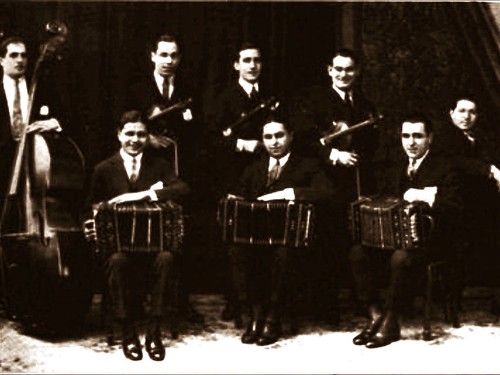
From Todotango.com
When the officials of that record company had the idea of putting together an orchestra that would represent the corporation, they turned to a pianist classically trained, who had not yet played tango: Adolfo Carabelli.
This great artist studied with the best teachers of his time and when he was fifteen he was already playing concerts in the theaters of the city of Buenos Aires. When he was very young he went to Bologna, where he stayed until 1914. There he went to school and continued his musical studies. When the war broke up he returned to his country where he put together a small group of classical music: Trío Argentina.
Around that time he became acquainted with the pianist Lipoff, who accompanied the well-known dancer Anna Pavlova, and through him he was introduced to jazz, a genre that was beginning to get a wide acclaim.
His first orchestra was named River Jazz Band, later, when switching to the radio, the group bore his name, and the orchestra achieved an overwhelming success and was requested by all the nightclubs of the period. Eduardo Armani and Antonio Pugliese, among others, passed through its ranks.
He recorded his early records for the Electra label and later he is hired by the Victor company as musical advisor and responsible for the creation of a tango orchestra.
It was a seminal orchestra in tango, that never performed in public, but which left for us, during its long career, the indelible memory of its perfection and quality.
The first setting chosen by Carabelli, and that made its debut recording two tangos on November 9, 1925: “Olvido [b]”, by Ángel D'Agostino, and “Sarandí” by Juan Baüer, was the following: Luis Petrucelli, Nicolás Primiani and Ciriaco Ortiz (bandoneons); Manlio Francia, Agesilao Ferrazzano and Eugenio Romano (violins); Vicente Gorrese (piano) and Humberto Costanzo (double bass).
The composition of the orchestra changed very often, the musicians were continuously replaced, but they all were of an excellent level. So that so that some experts recognize, on certain recordings, the violin of Elvino Vardaro, for example.
Other important names that passed through the ranks of the orchestra were: Federico Scorticati, Carlos Marcucci and Pedro Laurenz (bandoneon players); Orlando Carabelli, brother of the leader, and Nerón Ferrazzano (double bass); Nicolás Di Masi, Antonio Buglione, Eduardo Armani and Eugenio Nobile (violins). Cayetano Puglisi, Alfredo De Franco and Aníbal Troilo were also included in the orchestra on some occasions.
Years later, and due to commercial reasons, the label thought that only one orchestra was not enough. For that reason a number of orchestras began to appear: Orquesta Victor Popular, the Orquesta Típica Los Provincianos led by Ciriaco Ortiz, the Orquesta Radio Victor Argentina led by Mario Maurano, the Orquesta Argentina Victor, the Orquesta Victor Internacional, the Cuarteto Victor lined up by Cayetano Puglisi, Antonio Rossi (violins), Ciriaco Ortiz and Francisco Pracánico (bandoneons) and the excellent Trío Victor, with the violinist Elvino Vardaro and the guitarists Oscar Alemán and Gastón Bueno Lobo.
The already mentioned quality of the musicians made the Orquesta Típica Victor one of the highest musical expressions of its period, and it would remain at the same level until the late thirties. And this is important to highlight, because other important orchestras, such as Julio De Caro, had lost their north.
Unfortunately later, because of a repertory that tried to fit into the commercial needs of the period, the quality of it declined, but neither its sound nor the capability of its members were of a poor level. Its vocalists, likewise, kept on being of a first rate level.
In 1936 the leadership of the orchestra is transferred to the bandoneonist Federico Scorticati, and its early recordings were the tangos “Cansancio” (by Federico Scorticati and Manuel Meaños) and “Amargura” (by Carlos Gardel and Alfredo Le Pera), sung by Héctor Palacios.
In 1943 the orchestra was led by the pianist Mario Maurano, and recorded the tangos “Nene caprichoso” and “Tranquilo viejo tranquilo” (both by Francisco Canaro and Ivo Pelay), with Ortega Del Cerro on vocals, on September 2.
The last recordings under the name Orquesta Típica Victor were made on May 9, 1944, and they were the waltzes “Uno que ha sido marino” (by Ulloa Díaz) and the popular “Sobre las olas” (by Juventino Rosas), both sung by the Jaime Moreno and Lito Bayardo duo.
According to Nicolás Lefcovich's discography, the recordings were 444, but to this number we would have to add many recordings coupled on discs that on the opposite face had renditions of varied interpreters.
Even though it was an orchestra that mainly played tango, it also recorded other beats, more than forty rancheras and a similar number of waltzes, around fifteen foxtrots and very few milongas. Also polkas, corridos, pasodobles, etc.
As for vocalists, they appeared only three years after its creation, after over a hundred instrumental numbers were recorded. And the first one was a violinist, Antonio Buglione (a total of four recordings), with the tango "Piba", on October 8, 1928.
He was followed by Roberto Díaz (27 recordings), Carlos Lafuente (37, the one who recorded most), Alberto Gómez (25), Ernesto Famá (17), Luis Díaz (14), Teófilo Ibáñez (9), Ortega Del Cerro (7), Juan Carlos Delson (7), Mario Corrales —later Mario Pomar — (6) and Charlo (4).
Through the ranks of the orchestra the following vocalists passed: Alberto Carol, Jaime Moreno, Lito Bayardo, Lita Morales, Eugenio Viñas, Ángel Vargas, José Bohr, Osvaldo Moreno, Vicente Crisera, Dorita Davis, Oscar Ugarte, Fernando Díaz, Héctor Palacios, Mariano Balcarce, El Príncipe Azul, Francisco Fiorentino, Armando Barbé (also with the name Armando Sentous), Samuel Aguayo, Hugo Gutiérrez, Jimmy People, Deo Costa, Alberto Barros, Raúl Lavalle, Augusto "Tito" Vila and Gino Forsini.
When in 1944 the label decided to put an end to its career, tango was so successful that it would not be an exaggeration to say that everyday a new orchestra was put together. Somehow, with the great orchestras of the forties: Troilo, D'Arienzo, Di Sarli, D'Agostino, Tanturi, Fresedo, Laurenz, among others, the need of having one's own orchestra has come to an end.
From Todotango.com
Subscribe to:
Posts (Atom)