Tango music rapidly became a global phenomenon as early as the beginning of the twentieth century, with about 30% of gramophone records made between 1903 and 1910 devoted to it. Its popularity declined between the 1950s and the 1980s but has since risen to new heights. This Companion offers twenty chapters from varying perspectives around music, dance, poetry, and interdisciplinary studies, including numerous visual and audio illustrations in print and on the accompanying webpages. Its multidisciplinary approach demonstrates how different disciplines intersect through performative, historical, ethnographic, sociological, political, and anthropological perspectives. These thematic continuities illuminate diverse international perspectives and highlight how the art form flourished in Argentina, Uruguay and abroad, while tracing its international and cultural impact over the last century. This book is an innovative resource for scholars and students of tango music, particularly those seeking a diverse international perspective on the subject.
With this first song of a tanda, let's look at some of the defining features of Donato in 1942, when the orchestra slows down and sounds ''different'' but is still very much recognizable as Donato.
INTRODUCTION TO THIS SERIES: https://www.youtube.com/watch?v=8A4zv...
Link to full, uninterrupted song ''Tu confidencia'': https://www.youtube.com/watch?v=xAnuJ...
(Link to the referred, more ''standard'' Donato song from a year earlier: https://www.youtube.com/watch?v=-RJ8i...)
Qué me has hecho del cariño que te di con manos llenas, que le das al corazón y pagás con esta pena. Confidencia que desangro, volcada en amargo llanto, saber que perdí el encanto de no verte nunca más.
Sólo sé que el corazón va llorando como un niño, no comprende de razón, sólo quiere tu cariño. Vendaval que al azotar el rosal de mis antojos, ponen tristezas en mis ojos, trayendo frío a mi corazón.
Cuando pasen muchos años, cuando estés ya de regreso, comprenderás que tus besos me mintieron sin piedad. Me mató tu confidencia cuando un día, fríamente, atormentaste mi mente con un... no te quiero más.
Origins of Argentine Tango music: who actually created it and when? Here are the people and stories.
From ToTango.net - home of the acclaimed tango hits Remasters. http://ToTango.net
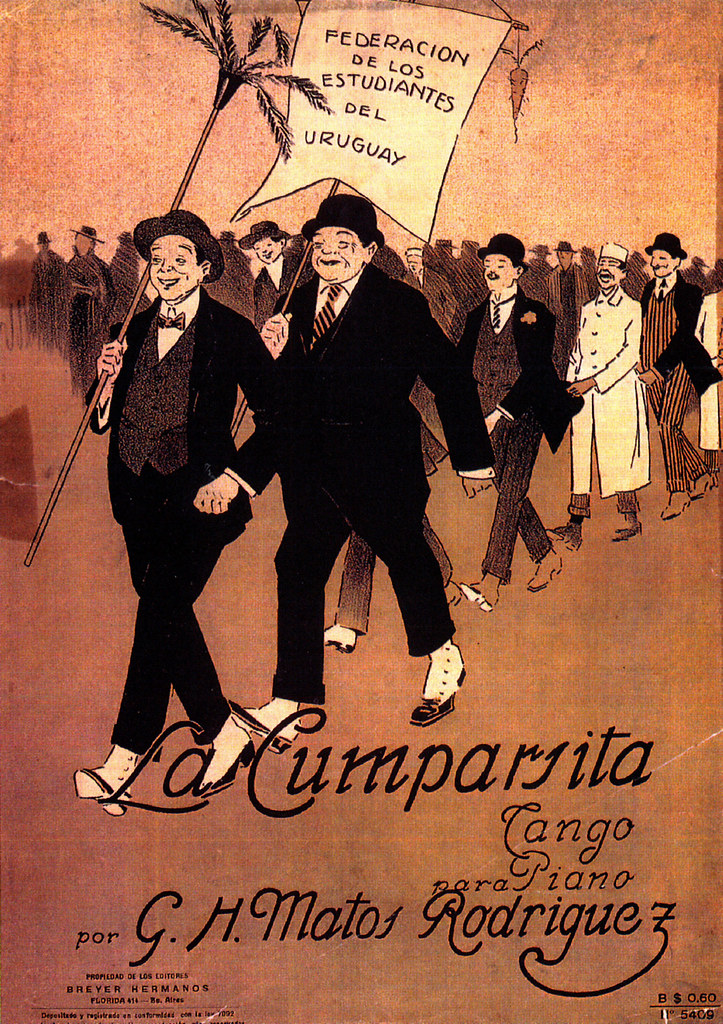
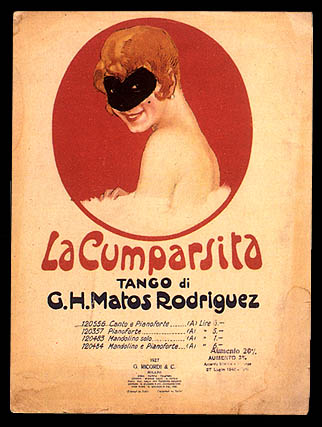
On the subject of why La Cumparsita is played as the last song at milongas:
This from Glen Royce on Facebook:
Alex: Ahhh- I thought the story was more well-known! :) Pugliese was a communist, and one night the police showed up at the milonga where his orquestra was playing, to bring him in, right when they were playing 'La Cumpa' ...my good tanguero friends down here in BA who are in their 70's and 80's say he WAS arrested, and so the milonga was finished- end of the night! (because the orquestra's director had been taken away...!) Anyway, feel free to read and visit the folllowing : ;)
"Once when Pugliese was playing La Cumparsita, the police entered the club he was performing in, and directed everything to stop as he was banned. The club owners said that they could not be interrupted whilst the orchestra was playing and the dancers was tangoing. On stage, Pugliese was told about this - so started playing La Cumparsita over and over again. The audience just kept on dancing! Eventually the police gave up and left. It was, perhaps, a world record in playing La Cumparsita?"
***Again, I have been told Pugliese DID get arrested and the milonga was finished for the night (no more director OR pianit...!) So that was the last song of the night! :)
Saturday, April 22, 2017
¿Por qué La Cumparsita es el último tango de la milonga? (Why is La Cumparsita the last tango of the milonga?)
Los milongueros asocian este tango inmortal con Juan D’Arienzo, El Rey del Compás, porque revolucionó todo el mercado con su grabación.
The milongueros associate this immortal tango with Juan D'Arienzo, El Rey del Compás, The King of the Beat, because he revolutionized the whole market with his recording.
Fue además el tema que más veces grabó, hasta en 7 oportunidades. En los años 1928 y 1929, con las voces de Carlos Dante y Raquel Notar, respectivamente, para el sello Electra, propiedad de su tío, Alfredo Améndola. Y luego para el sello Victor en otras cinco placas, en los años 1937, 1943, 1951, 1963 y 1971. La placa de 1951 tenía en la otra faz, la milonga de Pintín Castellanos La Puñalada, que también registró en cuatro ocasiones, y batió records de venta.
It was also the tango that he recorded the most times, up to 7 opportunities. In 1928 and 1929, with the voices of Carlos Dante and Raquel Notar, respectively, for the Electra label, owned by his uncle, Alfredo Améndola. And then for the Victor label on five other records, in 1937, 1943, 1951, 1963 and 1971. The record of 1951 had on the other side, the milonga of Pintín Castellanos La Puñalada, which also recorded four times, to became a sales blockbuster.
La versión de 1951 fue tan famosa, con más de un millón de discos vendidos sólo en Argentina, y más de doscientos mil en Japón, que el público deliraba al escucharla en sus presentaciones en vivo, entonces Juancito decide dejarla siempre para el final de sus shows, como la frutilla del postre.
The 1951 version was so famous, with more than one million albums sold only in Argentina, and more than two hundred thousand in Japan, that the audience raved when listening to it at their live performances, so Juancito decides to leave it always for the end of their Shows, as the icing on the cake.
Y fue así que se impuso como cierre de las milongas a partir de de los años cincuenta en todos los clubes de Buenos Aires. Y quedarse sin bailar este último tango significaba toda una frustración.
And so it was imposed as a closure of the milongas since the fifties in all clubs in Buenos Aires. And then, staying without dancing this last tango meant a whole frustration.
Los muchachos de entonces se reunían para escucharla y también se armaba toda una revolución en las milongas con este tema. Fulvio Salamanca, el pianista de D’Arienzo por 17 años, tuvo especial intervención en los arreglos de esta versión de 1951 y se nota su sabia mano en el resultado final. Una obra maestra y super milonguera.
The guys of the time met to listen to it at home, the streets, everywhere, and then a whole revolution was set up in the milongas with this tango. Fulvio Salamanca, the D'Arienzo pianist for 17 years, had an special intervention in the arrangements of this version of 1951 and it shows his wise hand in the final result. A super milonguera masterpiece.
A continuación La cumparsita por la orquesta de Juan D'Arienzo, en su versión del año 1951, quizás la más famosa de todas.
Next The cumparsita by the orchestra of Juan D'Arienzo, in its version of the year 1951, perhaps the most famous of all.
Presten atención al toque magistral del piano a cargo de Fulvio Salamanca, que le imprimió el clásico compás a la orquesta, una variación moderna y menos eléctrica, que la que le impusiera Rodolfo Biagi.
Pay attention to the masterful touch of the piano by Fulvio Salamanca, who impressed the classic compass to the orchestra, a modern and less electric variation, than that imposed by Rodolfo Biagi.
Escuchen a Enrique Alessio, primer bandoneón, en su famosa variación del segundo coro, magistral, sin palabras.
D'Arienzo, and his line of bandoneons
Junnissi, Lazzari and Alessio
Listen to Enrique Alessio, first bandoneon, in his famous variation of the second choir, masterful, without words.
No dejen de lado la melancolía del final, con el toque impecable del primer violín de la orquesta, Cayetano Puglisi.
Do not leave aside the melancholy of the end, with the impeccable touch of the first violin of the orchestra, Cayetano Puglisi.
Finalmente, la perfecta sincronización instrumental que en corto tiempo le diera a Juan D'Arienzo el acertado calificativo de El Rey del Compás.
Finally, the perfect instrumental synchronization that in a short time gave Juan D'Arienzo the correct qualifier of El Rey del Compás, the King of the Beat.
¡A disfrutar esta joya!
Enjoy this gem!
Here's my prior post:
La Cumparsita is the song that is traditionally the last song played at a milonga. It signals to everyone that this is the last song, and that the milonga has concluded. There was a time when I was on a mission to collect as many versions of the song as I could find. At this point, I have forty [40] distinct versions.
It was written by Gerardo Hernán Matos Rodríguez, an amateur pianist and architecture student, in late 1915 or early 1916 by all accounts. He was 17 years old when he wrote it. It's important to note that he was a student in Montevideo - so the song originated in Uruguay.
The song has a very interesting story behind it - with changed lyrics, new music arrangements, ownership and royalties lawsuits (four or five), and plenty of drama over the years. It's often billed as "the most famous tango in the world". Astor Piazzolla called it "the most frighteningly poor thing in this world" in reference to the original score by Matos Rodríguez and its simple melody.
Here are a couple of links to good, in depth treatments of the song and its history:
Note that both of these sites contain a wealth of information about tango music and all things tango.
Alberto Paz' www.planet-tango.com includes a lyrics translation of the re-written version. Alberto's site is well known for his lyrics translations, and also includes a wealth of information about tango.
This 1930 version, with the original lyrics sung by the opera singer Tito Schipa, is my personal favorite.
Lastly, here's a "mashup" of many versions over 26 years...
Bleary-eyed early breezy morning facebook perusal...Mari posted this gem (below)...Malena, by Hugo Díaz, a version of which I can't find in the discographies. It appears to be on Hugo Díaz Antología Volumen 2, based on the album cover of the YT video, but Malena is not one of the 14 tracks on that album. If anyone knows the true source of this version, please post a comment.
(Note that the best version of Malena for all time is our own Glover John Gill's piano solo on his album "Solo Tango"...but that's just me...here's a review by Valorie Hart on El Firulete. Glover plays live here in Austin two or three times a month. We're very lucky. Very.)
So, I'm browsing and searching and google-ing and blundering around... blurry bleary sleepy coffee-less eyes...google...wiki...tango dj sources...amazon dot com....youtube...and discover that there was a documentary film on Hugo Díaz' life released in 2005. It was directed by Alejandro Larrán and written by Larrán and Luis Cruz. There's not much info about it on imdb, nor much about Larrán.
[Glover Gill by Laura Burlton, Houston Photographer]
We're extremely lucky to have our very own Tango composer and performer (piano, accordion) here in Austin (and Houston). Not to mention the other artists who complete the Tosca Tango Orchestra - Tosca String Quartet. They have been called "an exquisite ensemble of estrogen-driven musicality".
I love the challenge of dancing to them live. There's something about dancing to a live orchestra that tests, piques, energizes, electrifies, a leader's listening/musicality/interpretation/improvisation on the fly and to the hilt. Something wonderful. Truly an example of letting it go in your ears, filter through you heart and soul, and manifest itself in those four feet on the pista.
I've posted this video before, an "invitation" to the first annual Houston Tango Festival, produced by the local dancers of the Houston Tango community. HouTango is a great bunch of folks who I almost never see, nor dance with nearly enough. The song is "Mi Otra Mitad de Naranja" from the soundtrack for the film "Waking Life":
I just did a one-click download of it on Amazon.com. Or you can "Gift" it to someone. Click here. I'm not sure if the actual CD is still available. It looks like some used ones might be available.
My other recommendation is Glover's "Solo Tango". The entire CD is great, but I would recommend that you buy it solely for the "Malena" track. For me, it rivals - no it bests - by a great margin, Lucio Demare's Malena piano solo. Evidence: I'm clicking through my various versions of Malena, trying to find the one other piano solo in my collection. I find Demare's, listen a bit, and then click on Glover's in passing before I come back here. The hairs on the back of my neck immediately stand up. Good enough indicator for me.
And, it's extremely danceable.
You can buy Solo Tango through PayPal directly on Glover's website - and there are several other CD's there as well. Also note that there is sheet music for sale as well.
My only connection to Glover is that I know him, not well, but well enough to know he's a "good guy" and a very talented artist. Extremely talented, and he shares that talent with the local tango community with great humility - and shares it frequently. He is the tango dancer's composer/performer, and we're unbelievably blessed to have him in our lives.
That, and apparently his mom and my mom knew each other - growing up in the same San Antonio neighborhood back in the day.
Small world. I'll bet those teenage girls woulda never guessed their future sons would be connected out there in the great wide infinite - some 65 years later - connected by El Tango.
Once again, National Tango Day (Argentina, and globally), December 11, has come and gone without fanfare, at least with regard to this humble blogger. Not just yesterday, but last year as well - not a peep. I just couldn't pull anything out of my proverbial fedora, couldn't come up with anything of any value myself. I Googled around, feebly, looking for an official website, announcement, press release, something, anything to post to mark the day.
But nothing. Nothing came. I pondered this day for a week or so, my computer calendar popping up with a reminder each day, but still nothing.
There is the "Global Milonga" event that uses December 11 - ostensibly in celebration of the National Tango Day or Day of Tango or Dia del Tango - but their mission appears to be more globally oriented, calling attention to the environment, "celebrating Tango's ability to unite and transform" - with this year's theme being to planting trees in the ravaged and struggling country of Haiti.
A good and noble cause, but not what I was looking for.
We had planned to go to a milonga last night, after a very small dinner party with a close friend. I figgered that would be my own little celebration, my own private acknowledgment of the day, to dance a little tango with my love in my arms in honor of this love my tango. But it was not meant to be. Chopin played on a grand piano, with a glass of vino tinto trumps tango. Every time.
So, this morning, booting myself up on Facebook, I was pleased when I read Alberto Paz' piece honoring the day. I couldn't have even come close to anything like this, and Alberto was gracious enough to allow me to re-post it here in its entirety.
I love the natural and innate flow of the Universe, of tango, of this blog, of my life. Everything always seems to come together, falling into place as it was meant to, as it wants to, as it has to. Natural and without force, guided by love and friends and friendship and good, well intentioned energy. The world is as it should be. Mostly. But that, my friends, is the subject of another post, and as usual, I am digressing.
Based out of my childhood home of New Orleans, Louisiana, Alberto is well known for his Planet Tango website and greatly appreciated for his tango lyrics translations, now at Letras de Tango. He's also coming back strong after a serious health scare. We were all worried about him, and the word is he's feeling much better and feeling strong enough to dance again. I'll speak for all of us and extend well wishes to him (and to Valorie) in his continued recovery. They have both been to hell and back - a big Texas hug from me.
So, without further ado, and thanks again Alberto, and take good care of that ticker...
When The Tango Became Music Posted by Alberto Paz on Sunday, December 12, 2010 at 12:21am
Nearing the end of the first thirty years of the twentieth century, every orchestra sounded more or less the same way as if the original sound born out of many sounds had become a long road to musical boredom. Along the way had traveled the heroic itinerant trios that perched on the corners of tough neighborhoods, the artistic innovation that brought the incorporation of the bandoneon, and the legendary quartets.
To be fair, every ensemble had a leader and everyone attempted to add a bit of his own personal touch, but in general, the styles of the orchestras were so similar that it was hard to tell apart the works of Vicente Greco, Juan Maglio Pacho, Roberto Firpo, Francisco Canaro or Augusto Berto.
Julio De Caro, whose birthday on December 11 contributed to the designation of the date as National Day of Tango in Buenos Aires, broke ranks with the traditional style and led a genuine opening into renovation, a revolution that saved the tango from oblivion. Yet, De Caro did not discard what others had done before. His typical sextet gave new life to some of the greatest creations of Eduardo Arolas and Agustin Bardi.
They amalgamated into a genial coexistence with the new found beauty of the romantic melodies emanating from the creative muse of Juan Carlos Cobian, Osvaldo Fresedo, and Enrique Delfino.
During the early days of the twentieth century very few people stayed in school beyond the third grade and illiteracy in Buenos Aires was very high. Thus the music of the tangos of that period suited very well the simply minds of the audiences. When mandatory public school was established, the popular culture grew up and the music of the tanguitos of Arolas began to be insufficient for the larger intellectual capacity of the new audiences.
This generational change of guard led the Argentine Tango to a musical evolution that paralleled the cultural evolution of the porteño. The sounds of a changing Tango continued to be Tango, much in the same way that an educated porteño continued being a porteño.
History has appointed Julio De Caro, the supreme priest of the major renovation vanguard that took place in the mid 1920’s. The word vanguard had been used mostly in military lingo to identify what is up front, at the leading edge of the battlefield. With the stellar appearance of Julio De Caro, the history of the Tango was divided in two major hemispheres, the pre and post De Caro era. At the helm of the renovation, the sexteto tipico lead by Julio De Caro paved the way for the vanguardistas who continued to advance, faithful to their commitment to always be ahead of the rest.
The concepts and style which have become known as integral parts of the Decarean school, have constituted a standard by which all instrumental renovation of the Tango has been measured, both in terms of authenticity and naturalness. In very simple terms, the Decarean concept was to embellish the melody of the Tango.
In his memoirs, Julio De Caro remembers the time when, as a third violin for one of Cobian’s recording sessions, he found a section of one of the Tangos to be very poor. With no time to write a new arrangement, De Caro decided to add a counterpoint with the intention of embellishing the melody. This addition had very good acceptance but as Cobian found out about the daring modification that De Caro had done, he admonished him reminding him about who was the boss.
This reprimand in lieu of a praise was enough for 24 year-old De Caro to leave the Cobian sextet. He took with him bandoneon players Pedro Maffia and Luis Petrucelli, called upon his brother Francisco to play the piano, drafted Leopoldo Thompson (the inventor of the canyengue sound effect) to play the bass and brought yet another brother, Emilio as a second violin.
Historian Luis Adolfo Sierra has written perhaps one of the most celebrated hyperbole about the De Caro tendencies, “the harmonic accompaniment of the piano, the phrasing and variations of the bandoneons, the counterpoint of the violin knitting melodies of pleasant contrast with the central theme, plus the piano and bandoneon solos expressed with a harmonic and sonorous richness never heard before then, are some of the most valuable contributions that those real innovators introduced in the execution of the Tango.”
Jose Gobello says that what it is most recognizable of the De Caro sextet, is the intention to synthesize the insolence with the romanticism, the rusticity of the outskirts with the refinement from the conservatories. While Julio was best represented by the cheeky twist in (listen to Mala Junta), his brother Francisco embodied the romantic flair of (listen to Flores Negras).
Thanks to Julio De Caro the destiny of the Tango was also in the music, not just in the dance or the singing.
I'm sitting here this morning, coffee and D'Agostino, reading a thread on a tango DJ list about dancers not knowing tango music. This is one instance where I'm talking knowledge versus knowing. There is a difference, but I talk about it elsewhere in this blog.
The writer, Joe Grohens, talks about how the vast majority of tango dancers don't really know tango music. They don't listen to it in their day-to-day lives, most likely because they don't own any. He posits that the only time most dancers hear tango music is at the milongas.
As a result, they hear it a few hours a week at best, but don't really know much about it. They don't know the orchestras, the song titles, or the names of the singers. They don't know the stories behind the songs, they don't know the history of the orchestras and the players. They don't know about the various recording companies and record labels during that time. I'm not suggesting that all dancers go to this depth. Some do, some don't, most are somewhere in the middle.
This was me six years ago. Not only did I know nothing of tango music, I didn't even know how to find any if I wanted to buy some. I had my one starter CD that our teacher burned for us to listen to outside of class.
Not only did I know nothing of the music, but I didn't like it. Yes, Alex the tango-purist-bordering-on-fundamentalist-milonguero-jihadist did not, at one time, in the beginning, even like tango music. I also didn't like the (men's) shoes, and took some cool Pumas to the cobbler to have the rubber soles ground off and leathers glued on. But that is another story. For another time.
I had a pretty good collection of interesting music on my computer & iPod, so I sifted and listened and listened and sifted to find songs with a four beat that my partner and I could practice to. Any songs. Borderline tango-danceable. Crap, really, as I think back on it.
I didn't "get" tango music. I couldn't find the beat. It was as if I couldn't...didn't hear the music when I was dancing. I was deaf, dumb and blind to the music - a fatal condition in tango.
Not just fatal as in a death-blow, but fatal as in squashed like a beetle on the pavement. Note that I didn't mean to squish him and I apologized to him after I took his innocent life. Ashes to ashes and dust to dust and covered him up with a bootkick of caliche.
I convinced myself I was a rhythmic retard. And I quit. Dropped tango cold turkey from my life. For six months.
When I came back to tango, I had six months of tangosmosis on my side. I somehow knew that I would have to wrap my head around this music. Wrap my head and my heart around it. And my soul. In that next year I figured out that it would take nothing less than absolute and total immersion in tango. I was determined to "get" this dance and its music. I had dis/misplaced dreams of mastering tango. I know better now. One never masters "El Tango". Anyway....
So I started doing the research on the internet. Quizzing my teachers and long-time dancers. Copping and copying CD's whenever and wherever I could. I ordered some CD's from Buenos Aires. I had people pick some up for me there and tote 'em back to the mountains. I saved up my money and bought tons of CD's when I went to BsAs. I searched the "World Music" sections of record stores every chance I got. I discovered some at the iTunes store.
I ended up with some garbage, some duplications of songs, but mostly good stuff. It was worth the effort. I have quite a collection now. For the past three or four years, I've been more selective in my acquisitions. I check the orchestra discographies online and do a little research to find the CD with the best (or my favorite) version of the song with the best sound quality.
Luckily, during that time in Aspen, I was in a position to do this "total immersion" approach. For three years. I didn't have a life. Tango was my life. I think there was a year in there that I listened, literally, to nothing but tango music. There were favorite songs that I would listen to over and over for hours thanks to the repeat setting on the iPod. Even when the iPod was off, the song was still playing in my head. Try it some time. Brainwashing by tango.
Another of my "total immersion" techniques was this - whilst I was dancing (and other times, too) I would transport myself, along with my partner, using pure-D abstract visualization, back to a milonga in Buenos Aires. Back to that time where an orchestra might have been playing live. I would visualize the milonga, the room, the decor, the other dancers, the clouds of cigarette smoke, the smells. I would transport us in my mind back to the 1930's or 1940's - reveling in the zeitgeist of that time. Imagining what it must have been like. Try it some time. It still works for me, sometimes inducing some strange and interesting feelings, for lack of a better word this early in the morning.
So that's how I came to love tango music. And I do love it. The good stuff. The real stuff. The Golden Age stuff. The Guardia Vieja stuff. "Old school" tango the youngsters call it now. Authentic. Vintage. Reclaimed. Historic. Whatever.
I realize the total immersion approach is not practical, and maybe not even healthy. There is a zone between that and zero. The productive middle ground. All it takes is one CD, or two, or five. You might get bit and collect 20 or 200. Find, buy, beg, borrow (but don't steal) or otherwise acquire some good Golden Age tango - from 1925 through 1955. Afterthought: Buy, buy, buy the music whenever you can. It's the right thing to do. Pony up your hard earned greenbacks - it makes the music that much more valuable to you.
And listen to it. Really listen. Hear it.
With a little knowledge of the music, you will be on the path to knowing tango.
Knowing versus knowledge.
And there is a difference.
Have a great weekend y'all. I'm back into carpintero mode. Closer to closing in the addition. Tango music wafting through the woods. Sawing and fitting and nailing and dancing tango and designing in my head.
La Cumparsita is the song that is traditionally the last song played at a milonga. It signals to everyone that this is the last song, and that the milonga has concluded. There was a time when I was on a mission to collect as many versions of the song as I could find. At this point, I have forty [40] distinct versions.
It was written by Gerardo Hernán Matos Rodríguez, an amateur pianist and architecture student, in late 1915 or early 1916 by all accounts. He was 17 years old when he wrote it. It's important to note that he was a student in Montevideo - so the song originated in Uruguay.
The song has a very interesting story behind it - with changed lyrics, new music arrangements, ownership and royalties lawsuits (four or five), and plenty of drama over the years. It's often billed as "the most famous tango in the world". Astor Piazzolla called it "the most frighteningly poor thing in this world" in reference to the original score by Matos Rodríguez and its simple melody.
Here are a couple of links to good, in depth treatments of the song and its history:
Note that both of these sites contain a wealth of information about tango music and all things tango.
Alberto Paz' www.planet-tango.com includes a lyrics translation of the re-written version. Alberto's site is well known for his lyrics translations, and also includes a wealth of information about tango.
This 1930 version, with the original lyrics sung by the opera singer Tito Schipa, is my personal favorite.
Lastly, here's a "mashup" of many versions over 26 years...
Here is an instrumental version of the song "Vida Mia" by Osvaldo Fresedo, featuring Dizzy Gillespie on trumpet. It was written in 1933 - music by Osvaldo, lyrics by his brother Emilio Fresdedo.
According to the details of this video (of photographs) on YouTube, they played together at the Night Club Rendezvous Porteño in 1956. From the looks of the photograph, there is audio recording equipment on a table - I'm not sure if this is the recording they made that night. Does anyone know?
This version of Vida Mia has been one of my favorite songs for some time now. I gather that Fresedo is something of an acquired taste.
There were five recordings with five different singers over the years - 1933/Roberto Ray, 1934/Tito Shipa, 1944/Oscar Serpa, 1945/Pedro Vargas, and 1952/Héctor Pacheco. I'm not sure which one this is below.
Boy I'd sure like to get my hands on the Tito Shipa version. I've got the original La Cumparsita, before it was re-arranged by Francisco Canaro, with Tito Shipa singing. That one may actually be my all time #1 favorite tango song.
Here are the lyrics: Siempre igual es el camino que ilumina y dora el sol... Si parece que el destino mas lo alarga para mi dolor.
Y este verde suelo, donde crece el cardo lejos toca el cielo cerca de mi amor... Y de cuando en cuando un nido para que lo envidie yo.
Vida mia, lejos mas te quiero. Vida mia, piensa en mi regreso. Se que el oro no tendra tus besos, y es por eso que te quiero mas. Vida mia, hasta apuro el aliento acercando el momento de acariciar felicidad. Sos mi vida y quisiera llevarte a mi lado prendida y asi ahogar mi soledad.
Ya parece que la huella va perdiendo su color y saliendo las estrellas dan al cielo todo su esplendor. Y de poco a poco luces que titilan dan severo tono mientras huye el sol. De esas luces que yo veo ella una la encendio.
And here is a translation by Ruddy Zelaya: Always the same is the road that illuminates and gilds the sun... It seems as if destiny extends it even more for my pain.
And this green ground, where the thistle grows afar touches the sky near my love... And from time to time a nest so that I may envy it.
Life of mine, from afar I love you more. Life of mine, think about my return. I know that gold will not have your kisses, and that is why I love you even more. Life of mine, I even hurry up my breath shortening the moment for caressing happiness. You are my life and I wish to carry you fastened to my side and thus drown my solitude.
It seems already that the track is losing its color and the appearing stars give the sky all of its splendor. And little by little lights that flicker give a somber tone while the sun flees. Of those lights I see she lit up one.
There is some dialog going on right now on the Tango DJ group about "We need new danceable music!" and "If you must play alternative..."
Reading the various posts, I was reminded of something I posted to El Tango back in January of this year, more or less on topic with the Tango DJ topics. It's about the crucial elements that make Golden Age Tango sound the way it does, and why it is so difficult/impossible for contemporary orchestras/musicians/groups to reproduce that sound we all love so much.
I've been wondering lately what it is that makes so many people "not" love the sounds of Golden Age Tango - perhaps the subject of another post.
As the first paragraph states, I was simply recapping others' posts, and expanding on the subject a bit...that's what the names are about...
Here it is:
To Pat's question about crucial elements that may be required to achieve the character and quality of Golden Age tango sound...recapping prior posts to help gel my own understanding...note that I am not a musician, nor have any special technical knowledge...I just know what sounds good, what moves me, and what doesn't sound good...
Critical Elements :: Interesting points made by posters [paraphrasing]
1] Zeitgeist - World/Social Context :: The time period during which the music was played...[Ron] 'Inflected' by world events and social mores of the time ... this cannot be reproduced...ever...
2] Space/Suspense :: Golden Age orchestras/musicians deliberately or unconsciously allowed for space, suspense, suspension, openness in the arrangements...versus modern orchestras/musicians (in general) not recognizing this, and hurrying the music, just as many/most dancers hurry their dance... [Tom]
3] Orchestra Dynamics :: The smaller size of orchestras today versus in the Golden Age, the larger size of orchestras and the increased number of violins and bandoneons provided a richness and depth to the sound...[Christopher, Myk] Inexperienced musicians without sufficient practice time and not enough emphasis on ensemble playing...[Christopher]
4] Subconscious Awareness :: The fact that the human mind 'knows' that this is no longer the Golden Age, and may impact how we 'hear' Golden Age vs. Modern Age tango... [Bruno] Were the listeners of the Golden Age as moved by the music then, as we are today? Who knows?
5] The Fifth Element :: Whether you ascribe to Ilene's 'magic' quality, an intangible that simply cannot be reproduced, or believe that there may be some other quintessential element, possibly metaphysical energy, which takes this 'magic' quality, and pulls in the Zeitgeist of that time. Add to the mix the emotional energy of the composers, orchestra leaders, and individual musicians - more musicians, more energy. Finally, top it off with the emotional energy of the dancers and listeners they were composing and playing for at that time. Let's just call it 'energy'. This had to be a profound influence, in my view.
I doubt that the sound and emotion of that music, from that time, can ever be reproduced. More importantly, why? Why even attempt to reproduce it? Not that Pat suggested this in the originating post, but there does seem to be a gentle undercurrent of a desire to somehow reproduce the sound. It's interesting to discuss and ponder, which I'm sure we all have, and will continue to do.
My feeling is to leave it alone. I'm not saying not to discuss or ponder it, but to let the music be what it is. Let the musicians of today create their own music - free in their own creative juices. They say "Imitation is the sincerest form of flattery", but I think in this case, it is not. There is something very beautiful about spontaneous, unhindered, free flowing creativity. Let ColorTango be, and sound like, ColorTango. Let the others be and sound like themselves. When a painter today is commissioned for a work, hopefully the patron doesn't say "make it look like a Matisse..." - the patron wants the artist to create a uniquely individual, one-of-a-kind, work of art.
One of my favorite tango quotes is by Jorge Luis Borges. He said "The tango can be debated...but it still encloses, as does all which is truthful, a secret."
Let's keep that magic, that energy, that secret...let's keep it secret...
Or, you may ascribe to the philosophy that tango is "just a dance..."
Ilene also added a comment after my post about the recording technology of the time. No doubt that played a role as well - as compared to the digital recording technology in use today. There is good, skillful, highly crafted digital recording going on today, resulting in very rich sounding recordings and then there is the not-so-good.
My buddy Rigoberto [so named for anonymity] sent me the video below of La Cumparsita/D'Arienzo last night. I've seen it before, and thought that I had actually posted it in the past. I also remember posting the one of Adrian Guida. I was not able to sift through and find them, though. There was a period several months ago that I was posting stuff without tagging it. I'll have to go back and fix that. Orphans.
Anyway, there is something about live tango that stirs the soul. Something about transporting yourself back to the day when it was all live - or at least there might have been special events, like there are now, where a live orquestra was on stage.
Many people don't like to dance to a live orquestra, as the individual musicians sometimes don't mesh into one contiguous rhythym. I have had the pleasure of dancing to Extasis in Denver, and also Orquestra Color Tango at the Buenos Aires Social Club, where I developed a crush on their pianista. I'll lead off with them in the video line-up.
Thanks to Rigoberto for the subject of this post. Do a little searching on YouTube - there is an amazing amount of stuff out there. I've included some links at the bottom.
Oh, my point is that if you ever get the chance to see a live event/orquestra/duo/trio/quartet/quintet/whatever performance, or dance at one, definitely, most definitely, go for it.
Orquestra Color Tango :: Malena
Orquestra del Rey del Company y Juan D'Aienzo :: La Cumparsita A live (TV) version of la orquestra del Rey del Compas, led by Juan D'Arienzo. Note that this YouTube user/channel, has 837 videos of live performances of the Singers, Golden Age Tango Orquestras, Bandoneonistas, and modern day Orquestras as well. There are also interviews, film clips and TV show clips. Hugo, in NYC, has done a remarkable job collecting and cataloging a wealth of historical footage. We owe guys like this a huge debt of gratitude.
The following is one of my favorites for the passion of the singer...sheesh man, the hair is standing on end all the way up and down my neck and back just listening to this now... Osvaldo Pugliese :: Adrian Guida :: Y No Puedo Olvidarte
Extasis Tango :: Denver Tango Festival :: Mercury Cafe Thanks go to miles/tangobliss for the video...
Javier Ponce :: Malena
Ashes in Order :: August Hoerr :: Shane Perlowin :: Asheville, NC :: Anaphora Tango Ashes in Order is Shane Perlowin on guitar and August Hoerr on accordion. They are based in Asheville, North Carolina. This piece, entitled Anaphora Tango, was composed by August. August is the son of tango friends here.
And no post on this subject would be complete without mention of the esteemed and exalted Mr. Glover Gill and Glover Tango (and sometimes the Tosca String Quartet). Glover is a composer, pianist and accordionist.
This first one is "Mi Otra Mitad de Naranja", composed by Glover and performed by the Tosca String Quartet. More of a nuevo piece. The video is by tangohous/Mikas.
Glover Gill :: Mi Otra Mitad de Naranja [partial]
The second one I wanted to post I couldn't find. It's Glover's piano solo of the song "Malena". He is an amazing pianist, tattoos and all. His solo of Malena is even better than Lucio Demare's. Look for Glover's CD titled "Solo Tango". It's a good one. Get it!
Happy Wednesday to all. Oh, I almost forgot about the links...here ya go...
My Favorites on my YouTube Channel "ZGman" [Disregard the non-tango stuff, especially the rooftop rough sex/porno]
HAranguiz [Hugo in NYC] - Most extensive collection...
The fuckers at YouTube are cracking down. One link I was going to leave you is "Elvio07". It appears they have suspended his channel.
ElCachafaz08 It appears this might be Elvio07's new channel.
Here's a good playlist embed from Oleh/OneTangoSpring...no live orchestra footage, but a good catalog of 23 different tango orquestras...
Keep searching on your own...there's tons of stuff out there...
This was a comment that I left on the original (Part 1) post. It was so long, my afterthought is that it should have been a separate post...so here it is...
Thanks everyone for some great commentary!
Here are my final thoughts - especially based on Steve's latest post - and it goes to the more esoteric/abstract end of the subject.
Thought 1 ::
As observed by Steve, poor music selections/mixes can have a negative influence floorcraft and navigation.
Thought 2 ::
Poor music selections/mixes can have a negative influence on musicality, connection and emotion - and ultimately the overall dance/milonga "experience".
Thought 3 ::
Poor music selections/mixes can have a negative influence on the inexperienced or uninitiated tango dancer's music/al "taste", "knowledge", and "understanding" of said tango music.
Thought 4 ::
Based on the aforementioned three "thoughts", "pervasive" poor music selections/mixes can have a negative influence on the tango community as a whole, in the areas of connection, emotion, musicality, and floorcraft/navigation.
Conclusion ::
Ergo, in my view, the importance of the DJ is very high indeed, even if we may not consciously be aware of this factor in deciding to attend a milonga or not. It is only after we arrive at a milonga, and in general for the more experienced dancers, and to a higher degree for those who have been to Buenos Aires (per Steve's observation), that we are able to determine that the DJ may be sub-par, or at least playing sub-par music. A fact which may be imperceptible to less experienced dancers.
It's kinda like really good architecture/design/urban planning. Some buildings/rooms/spaces/neighborhoods/cities just "feel" good. They feel good and cool and right the moment you walk into them. It's an energy thing. You don't know why. You can't determine why or what it is about the place that makes it that way, even if you try.
And so it is with the tango DJ. If they are astute and doing a good job, the only thing anyone notices is lots of good connections/emotions, good dances and a great night at the milonga - they forget the DJ is even there.
Anyway, this is what I was thinking - and everyone knows I think too much.
Sorry for the long comment, it should have been a post, which I suppose I will do now...again, thanks for all the commentary, and all the reading if you made it this far!!!...