Follow the money. Here's a good start to R&D (reading and downloading [into one's brain]) on the subject of "more on the shrinking of bears ears national monument by the supreme piece of shit donald trump"
Scroll down below the video for the links...the WaPo article is obviously superb...by Juliet Eilperin
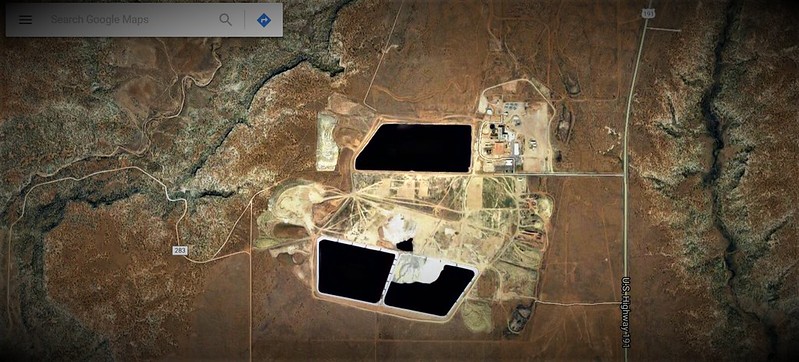
Across the Colorado Plateau, irresponsibly operated uranium mills have devastated landscapes and communities including Moab and Monticello, Utah. The Trust is currently working to prevent another chapter of this toxic legacy from occurring at White Mesa. Located just three miles from the Ute Mountain Ute Tribe’s White Mesa community on Highway 191, between Bluff and Blanding, the White Mesa Uranium Mill processes uranium from mines across the Colorado Plateau as well as radioactive waste imported from toxic sites across North America.
The White Mesa Uranium Mill is the United States' only operating conventional uranium mill, but it's owned and operated by Energy Fuels Inc., a Canadian corporation.
I don't get luxury brands...I get it, but I don't get it...especially when they throw charitable "work" into their mix of products and spokesmodels and beautiful it people and vapid imagery/illusions/delusions to sell/boost sales/bring attention to a new Dior fragrance...not that charity/philanthropy/giving are a negative, ever...but sometimes it seems a little bit tainted, somehow...I dunno...oblivious narcissistic conspicuous consumerism...pick your brand...
Last year at Thanksgiving, my daughter treated the two of us to a trip to Paris. It was a really nice. Particularly excellent. And very nice to re-live the trip through photos and videos.
BETTE'S BUTTERMILK PANCAKES
INGREDIENTS:
-- 2 cups all-purpose flour
-- 2 tablespoons sugar
-- 2 teaspoons baking powder
-- 1 teaspoon baking soda
-- 1/2 teaspoon salt
-- 2 eggs
-- 2 cups buttermilk
-- 1/2 cup milk
-- 1/4 cup unsalted butter, melted
-- Choice of berries, sliced bananas, raisins or chopped toasted nuts (optional)
-- Oil for griddle
INSTRUCTIONS: Combine the flour, sugar, baking powder, baking soda and salt in a large bowl.
Lightly beat the eggs with the buttermilk, milk and melted butter.
Just before you are ready to make the pancakes, add the liquid ingredients to the dry ingredients all at once, stirring just long enough to blend. The batter should be slightly lumpy.
If you want to add fruit or nuts, stir them in now, or you may sprinkle them on the pancakes while they are on the griddle.
Heat a lightly oiled griddle or heavy skillet over medium-high heat (375 degrees on an electric griddle).
Pour 1/4 cup batter per pancake onto the griddle or skillet, spacing the pancakes apart so they do not run together. When bubbles appear on the surface of the pancakes and the undersides are lightly browned, turn and cook for about 2 minutes longer, until lightly browned on the bottom.
Serve immediately on warmed plates with the topping of your choice. Serves 4 (yields about 24 four-inch pancakes.)
PER SERVING: 445 calories, 15 g protein, 58 g carbohydrate, 17 g fat (9 g saturated), 145 mg cholesterol, 816 mg sodium, 1 g fiber.
"The point of marriage is not to create a quick commonality by tearing down all boundaries; on the contrary, a good marriage is one in which each partner appoints the other to be the guardian of his solitude, and thus they show each other the greatest possible trust. A merging of two people is an impossibility, and where it seems to exist, it is a hemming-in, a mutual consent that robs one party or both parties of their fullest freedom and development. But once the realization is accepted that even between the closest people infinite distances exist, a marvelous living side-by-side can grow up for them, if they succeed in loving the expanse between them, which gives them the possibility of always seeing each other as a whole and before an immense sky."
Democratic presidential candidate Sen. Bernie Sanders of Vermont inspired millions of loyal supporters, some of whom chose not to support Hillary Clinton in the general election in 2016.
Sandy Huffaker/AP
Fully 12 percent of people who voted for Sen. Bernie Sanders, I-Vt., in the 2016 Democratic presidential primaries voted for President Trump in the general election. That is according to the data from the Cooperative Congressional Election Study — a massive election survey of around 50,000 people. (For perspective, a run-of-the-mill survey measuring Trump's job approval right now has a sample of 800 to 1,500.)
Political science professor Brian Schaffner of University of Massachusetts, Amherst tweeted the data on Wednesday.
Schaffner's numbers show that after a bitter Democratic primary, more than 1 in 10 of those who voted in the primaries for the very progressive Sanders ended up voting for the Republican in the general election, rather than for the Democratic candidate, Hillary Clinton.
What drove those voters to Trump? Schaffner dug into that, as well. What it wasn't was trade, an issue where Sanders was closer to Trump's philosophy than Clinton's. At least, the issue of trade didn't seem to have that much of an impact.
For those suggesting this is about trade, note that opposition to TPP is not dramatically different among defectors. 8/n pic.twitter.com/Fu0GhL58bU
— Brian Schaffner (@b_schaffner)
Party seems to have had something to do with it — Sanders-Trump voters were much less likely than Sanders-Clinton or Sanders-third party voters to have been Democrats. Likewise, approval of President Barack Obama appears to be related — Sanders-Trump voters approved of Obama much less than other Sanders primary voters.
It is also the case that the defectors are not fans of Obama, as this chart shows. 7/n pic.twitter.com/HjictmLnnT
— Brian Schaffner (@b_schaffner)
And then there is race. Nearly half of Sanders-Trump voters disagree with the idea that "white people have advantages."
But there does appear to be a racial component to this, as defectors are much more likely to disagree that whites are advantaged in US 9/n pic.twitter.com/zcoHm9APNf
— Brian Schaffner (@b_schaffner)
This tracks with broader observations about election 2016 — for example, as I wrote last week, in general, the larger a state's general-election Trump vote, the less likely its residents are to perceive a lot of discrimination in the world, according to data from the Public Religion Research Institute. And another postelection study — co-authored by Schaffner — found a "relatively strong indication that racism and sexism were more important in 2016 than they had been in previous elections."
Caveats, caveats, caveats
To answer the question that many Clinton supporters may be asking: By this data, yes — there are enough of those Sanders-Trump voters who could have potentially swung the election toward Clinton and away from Trump.
Specifically, if the Sanders-Trump voters in Michigan, Wisconsin and Pennsylvania had voted for Clinton, or even stayed home on Election Day, those states would have swung to Clinton, and she would have won 46 more electoral votes, putting her at 278 — enough to win, in other words.
But then, it's not as simple as that. First off, this counterfactual world in which these voters didn't vote for Trump rests on a few ifs. If the Sanders-Trump voters in these three states had defected and if nothing else had happened to somehow take electoral votes from Clinton elsewhere and if this survey is correct ... then yes, Clinton would have won. (Some would also argue that if Clinton had campaigned more in the so-called "blue wall" states, she also could have picked up more votes.)
A more important caveat, perhaps, is that other statistics suggest that this level of "defection" isn't all that out of the ordinary. Believing that all those Sanders voters somehow should have been expected to not vote for Trump may be to misunderstand how primary voters behave.
For example, Schaffner tells NPR that around 12 percent of Republican primary voters (including 34 percent of Ohio Gov. John Kasich voters and 11 percent of Florida Sen. Marco Rubio voters) ended up voting for Clinton. And according to one 2008 study, around 25 percent of Clinton primary voters in that election ended up voting for Sen. John McCain, R-Ariz., in the general. (In addition, the data showed 13 percent of McCain primary voters ended up voting for Obama, and 9 percent of Obama voters ended up voting for McCain — perhaps signaling something that swayed voters between primaries and the general election, or some amount of error in the data, or both.)
All of that said, one other figure that stuck out to Schaffner: Compared with those numbers above, Clinton 2016 voters were remarkably loyal — "I found basically no Clinton primary voters who voted for Trump," he told NPR in an email.
When will it end?
Data like this might seem like yet another step in what will be an endless 2016 election relitigation. And it's true that there is bound to be plenty more in the coming months and years — particularly as Clinton releases her memoir on the campaign next month.
All of the unusual factors in election 2016 — the first female major-party candidate, the first major-party candidate with no military or elected-office experience — combined with the election's surprises — that there were actually a number of Obama voters who went for Trump, that the far-better-funded candidate lost, that the Republicans essentially torched the playbook they wrote after they lost in 2012 — mean that there are plenty of questions to answer in coming years.
Nuevo videoclip de 7 de enero, tango de Javier Arias que registramos en nuestro ultimo disco "Tu lado acústico" con la aparición estelar de: Roxana Suarez/Sebastián Achaval, Inés Muzzopappa/Fernando Galera y Rocio Lequio/Bruno Tombari.
On the subject of why La Cumparsita is played as the last song at milongas:
This from Glen Royce on Facebook:
Alex: Ahhh- I thought the story was more well-known! :) Pugliese was a communist, and one night the police showed up at the milonga where his orquestra was playing, to bring him in, right when they were playing 'La Cumpa' ...my good tanguero friends down here in BA who are in their 70's and 80's say he WAS arrested, and so the milonga was finished- end of the night! (because the orquestra's director had been taken away...!) Anyway, feel free to read and visit the folllowing : ;)
"Once when Pugliese was playing La Cumparsita, the police entered the club he was performing in, and directed everything to stop as he was banned. The club owners said that they could not be interrupted whilst the orchestra was playing and the dancers was tangoing. On stage, Pugliese was told about this - so started playing La Cumparsita over and over again. The audience just kept on dancing! Eventually the police gave up and left. It was, perhaps, a world record in playing La Cumparsita?"
***Again, I have been told Pugliese DID get arrested and the milonga was finished for the night (no more director OR pianit...!) So that was the last song of the night! :)
Saturday, April 22, 2017
¿Por qué La Cumparsita es el último tango de la milonga? (Why is La Cumparsita the last tango of the milonga?)
Los milongueros asocian este tango inmortal con Juan D’Arienzo, El Rey del Compás, porque revolucionó todo el mercado con su grabación.
The milongueros associate this immortal tango with Juan D'Arienzo, El Rey del Compás, The King of the Beat, because he revolutionized the whole market with his recording.
Fue además el tema que más veces grabó, hasta en 7 oportunidades. En los años 1928 y 1929, con las voces de Carlos Dante y Raquel Notar, respectivamente, para el sello Electra, propiedad de su tío, Alfredo Améndola. Y luego para el sello Victor en otras cinco placas, en los años 1937, 1943, 1951, 1963 y 1971. La placa de 1951 tenía en la otra faz, la milonga de Pintín Castellanos La Puñalada, que también registró en cuatro ocasiones, y batió records de venta.
It was also the tango that he recorded the most times, up to 7 opportunities. In 1928 and 1929, with the voices of Carlos Dante and Raquel Notar, respectively, for the Electra label, owned by his uncle, Alfredo Améndola. And then for the Victor label on five other records, in 1937, 1943, 1951, 1963 and 1971. The record of 1951 had on the other side, the milonga of Pintín Castellanos La Puñalada, which also recorded four times, to became a sales blockbuster.
La versión de 1951 fue tan famosa, con más de un millón de discos vendidos sólo en Argentina, y más de doscientos mil en Japón, que el público deliraba al escucharla en sus presentaciones en vivo, entonces Juancito decide dejarla siempre para el final de sus shows, como la frutilla del postre.
The 1951 version was so famous, with more than one million albums sold only in Argentina, and more than two hundred thousand in Japan, that the audience raved when listening to it at their live performances, so Juancito decides to leave it always for the end of their Shows, as the icing on the cake.
Y fue así que se impuso como cierre de las milongas a partir de de los años cincuenta en todos los clubes de Buenos Aires. Y quedarse sin bailar este último tango significaba toda una frustración.
And so it was imposed as a closure of the milongas since the fifties in all clubs in Buenos Aires. And then, staying without dancing this last tango meant a whole frustration.
Los muchachos de entonces se reunían para escucharla y también se armaba toda una revolución en las milongas con este tema. Fulvio Salamanca, el pianista de D’Arienzo por 17 años, tuvo especial intervención en los arreglos de esta versión de 1951 y se nota su sabia mano en el resultado final. Una obra maestra y super milonguera.
The guys of the time met to listen to it at home, the streets, everywhere, and then a whole revolution was set up in the milongas with this tango. Fulvio Salamanca, the D'Arienzo pianist for 17 years, had an special intervention in the arrangements of this version of 1951 and it shows his wise hand in the final result. A super milonguera masterpiece.
A continuación La cumparsita por la orquesta de Juan D'Arienzo, en su versión del año 1951, quizás la más famosa de todas.
Next The cumparsita by the orchestra of Juan D'Arienzo, in its version of the year 1951, perhaps the most famous of all.
Presten atención al toque magistral del piano a cargo de Fulvio Salamanca, que le imprimió el clásico compás a la orquesta, una variación moderna y menos eléctrica, que la que le impusiera Rodolfo Biagi.
Pay attention to the masterful touch of the piano by Fulvio Salamanca, who impressed the classic compass to the orchestra, a modern and less electric variation, than that imposed by Rodolfo Biagi.
Escuchen a Enrique Alessio, primer bandoneón, en su famosa variación del segundo coro, magistral, sin palabras.
D'Arienzo, and his line of bandoneons
Junnissi, Lazzari and Alessio
Listen to Enrique Alessio, first bandoneon, in his famous variation of the second choir, masterful, without words.
No dejen de lado la melancolía del final, con el toque impecable del primer violín de la orquesta, Cayetano Puglisi.
Do not leave aside the melancholy of the end, with the impeccable touch of the first violin of the orchestra, Cayetano Puglisi.
Finalmente, la perfecta sincronización instrumental que en corto tiempo le diera a Juan D'Arienzo el acertado calificativo de El Rey del Compás.
Finally, the perfect instrumental synchronization that in a short time gave Juan D'Arienzo the correct qualifier of El Rey del Compás, the King of the Beat.
¡A disfrutar esta joya!
Enjoy this gem!
Here's my prior post:
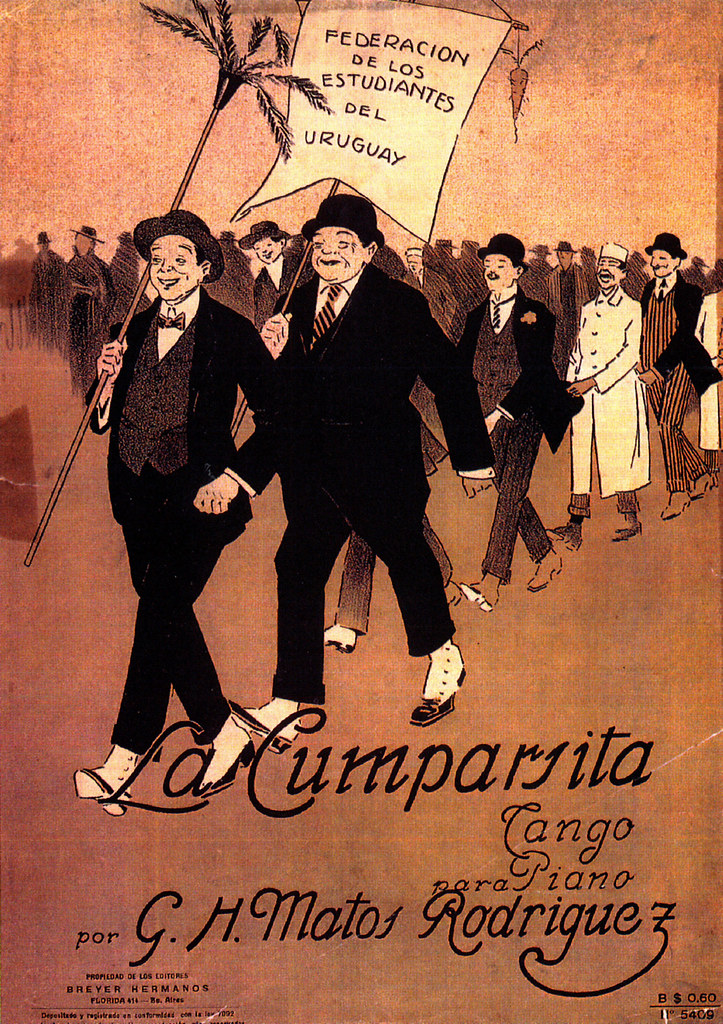
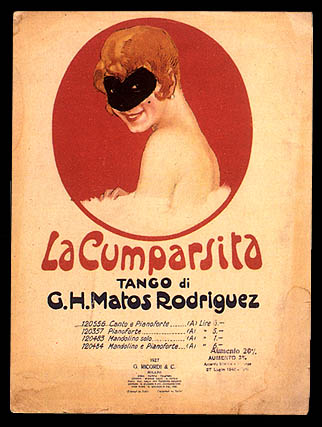
La Cumparsita is the song that is traditionally the last song played at a milonga. It signals to everyone that this is the last song, and that the milonga has concluded. There was a time when I was on a mission to collect as many versions of the song as I could find. At this point, I have forty [40] distinct versions.
It was written by Gerardo Hernán Matos Rodríguez, an amateur pianist and architecture student, in late 1915 or early 1916 by all accounts. He was 17 years old when he wrote it. It's important to note that he was a student in Montevideo - so the song originated in Uruguay.
The song has a very interesting story behind it - with changed lyrics, new music arrangements, ownership and royalties lawsuits (four or five), and plenty of drama over the years. It's often billed as "the most famous tango in the world". Astor Piazzolla called it "the most frighteningly poor thing in this world" in reference to the original score by Matos Rodríguez and its simple melody.
Here are a couple of links to good, in depth treatments of the song and its history:
Note that both of these sites contain a wealth of information about tango music and all things tango.
Alberto Paz' www.planet-tango.com includes a lyrics translation of the re-written version. Alberto's site is well known for his lyrics translations, and also includes a wealth of information about tango.
This 1930 version, with the original lyrics sung by the opera singer Tito Schipa, is my personal favorite.
Lastly, here's a "mashup" of many versions over 26 years...