Friday, January 22, 2016

Can Another Body Be Seen as an Extension of Your Own? Tango makes it into Scientific American

kind of illusion

Scientific America/Mind

Can Another Body Be Seen as an Extension of Your Own?

Surprising results show the fluidity of the "body schema"

By Julie Sedivy on January 12, 2016

The relationship between a person’s notion of self-hood and the openness of their body schema to another human being hints that perhaps it’s no coincidence that tango, which takes entanglement to sublime heights, originated in a culture that orients toward interdependence.

They want $500 for me to post an excerpt for up to 12 months.

Fuck that noise.

Here is the link.

http://www.scientificamerican.com/article/can-another-body-be-seen-as-an-extension-of-your-own/

Thursday, January 21, 2016

Tango Voice :: Understanding Argentine Tango :: Tango in North America vs. in Buenos Aires

https://tangovoice.wordpress.com/2016/01/07/understanding-argentine-tango-with-the-assistance-of-milongueros-its-not-just-another-ballroom-dance/#comments

Excerpt: (the complete post is a fairly long one...be sure to click the link above to read it in its entirety...)

"In looking out across the dance floor at many events advertised as ‘milongas’ in North America, it is apparent that the character of the dancing while tango music is playing is very different from the tango dancing in a typical milonga in Buenos Aires [Tango de Salon: The Tango of the Milonga (Part II of ‘Tango Styles, Genres and Individual Expression’)]. What one often sees among dancers in the North American event is a collection of step patterns, with names most dancers using them could recite, such as ‘sandwich’, ‘lustrada’, ‘boleo’, ‘gancho’, ‘sacada’, ‘arrastre’, ‘volcada’. (A categorization of tango into named steps is given in ‘Figures of Argentine Tango’.) Among the men who have acquired a collection of movements, there is often a display consisting of a nearly continuous and sometimes predictable sequence of step patterns, often without regard to the progression of the line of dance; complexity in the physics of movement appears to be favored over the highly improvised linking of small movements (often those lacking a codified name) that utilize only the space needed to progress in the circulating ronda. Many women appear to be focused on performing embellishments, finding as many opportunities as possible to use them, often without regard to whether or not the man has provided time and space for their execution, and without regard to the space between them and other dancers on the floor (Women’s Adornments for Tango Social Dancing). Tango dancing at North American milongas often appears to be a performing art (with questionable artistic properties), directed by the brain, not a social and emotional interchange between partners, directed by the music. Often absent in dancing to tango music in North American milongas is an embrace between man and woman, i.e., chest-to-chest contact maintained through the dance or, if there is any embrace at all, it is broken apart for the performance of conspicuous step patterns. Also absent is a close connection of movement with the music, even when the dance-facilitating classic tango music from the Golden Age is played for dancing. For the dancers who more or less are connected to the music (i.e., moving in conjunction with the primary beat), they are not exploring the intricacies of music by taking into account syncopations, as well as pauses associated with musical phrasing. It often appears as though the music is only a background for executing patterns, not a framework for structuring the dance. In the most extreme cases, the music played for dancing at these events advertised as ‘milongas’ (sometimes ‘alternative milongas’) is not tango music designed for dancing tango (i.e., classic tango music)."

In Stranger's Arms :: Tango book

http://instrangersarms.com/

Wednesday, July 8, 2015

Gonna manifest myself some new reality

P1090175-1

File under 4 am epiphanies...ever have something you know to be true? Nagging at you for years...too many years...behind the veil...but there, telling you, asking you notice. Shouting at you to notice. Well, for me, it rang like a big-ass bell really loudly just a bit ago. I'm doing the wrong thing. I've been doing the wrong thing for 37 years. Yes, I love it. Yes, I'm very good at it. But I've felt in a corner of my soul that it's not what I was meant to do, not what I want to do - "Do", or "DO" in this life. I've been getting the signal(s) over the years, and have largely ignored them. I hear, and notice, and ponder, and roll it around in my hands and look closely at it - very aware and lucid and alert. But I still ignore those signs where the rubber meets the road. I "knew" what I wanted to do, and what I didn't want to do, in this life - way back when I was 16 or 17. At the ripe age of 18, I got sidetracked. I have a history of taking paths I don't really want to take. Not want I truly madly deeply full of love and bliss "want" to do. I travel down those paths for far too long. Water under the bridge. Lost opportunities for some fucking richness in this life. No regrets, though, right?. There is still plenty of time. Time to change. Time to manifest some new reality.

Sunday, June 7, 2015

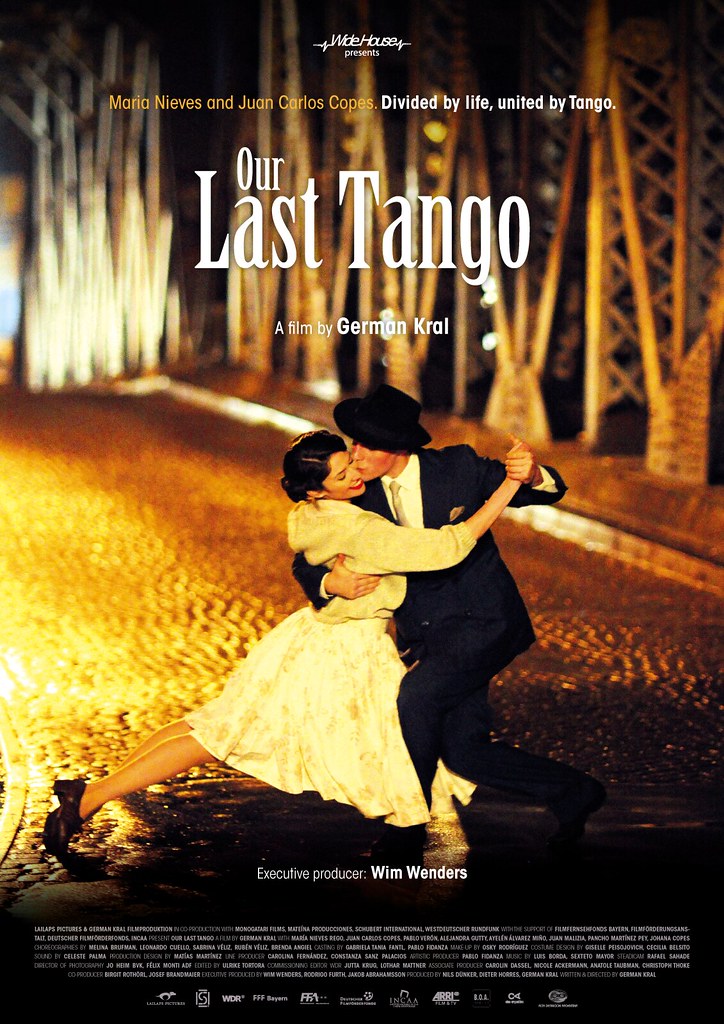
Our Last Tango :: A Film by German Kral

OurLastTango_Recto_V17


Our Last Tango
Un Tango Mas (original title)


A film by German Kral

"Our Last Tango“ is above all a love story. A story of love between the two most famous dancers in tango’s history. And the story of their tremendous love of tango.

María Nieves Rego (80) and Juan Carlos Copes (83) met when they were 14 and 17, and they danced together for nearly fifty years. In all those years they loved and hated each other and went through several painful separations but always got back together. No other man danced like Juan and no other woman danced like María!

Eventually, he left her for good for a woman 20 years younger with whom he fathered two children.

Now, at the end of their lives, Juan and María are willing to open up about their love, their hatred, and their passion.

In "Our Last Tango“ Juan and María tell their story to a group of young tango dancers and choreographers from Buenos Aires, who transform the most beautiful, moving and dramatic moments of Juan and Maria’s lives into incredible tango-choreographies. These beautifully-shot choreographies compliment the soul-searching interviews and documentary moments of the film to make this an unforgettable journey into the heart of the tango.

As of June 2015, Wide House Films is looking for a distributor in the U.S.

- See more at: http://widehouse.org/film/our-last-tango/#sthash.GACwigUD.dpuf

Saturday, June 6, 2015

Oldie but Goodie Tango Film

Anyone know any of the details behind this video, uh film clip, rather? Besides the fact that it stars Tobey McGuire's grandfather (right in the beginning)?

Een kijkje in het verleden. De Tango van toen!

Posted by Centaur Cheiron Salon on Wednesday, May 14, 2014

Sunday, May 24, 2015

Saturday, May 16, 2015

On the subject of partner rotation in classes...

On the subject of PARTNER ROTATION IN CLASSES...a woman recently invited me to take a class with her for an upcoming workshop, because she said, the last workshop she took there was a reluctance (refusal?) amongst attendees to rotate, and the teacher didn't impress upon them the benefits nor actually insist on rotation.

It's really a disservice to both leader and follower not to insist on partner rotation (in a fun, non-off-putting way). In my experience, there are nuances in both roles that manifest with different partners that are critical to learning proper vocabulary and "grammar".

Not to mention the psychological and social aspects - ice breaking, meeting new people, community building, getting people out of their comfort zone, and last but not least, letting those new to tango know that tango is a social dance, to be danced with multiple partners, not just their spouse or significant other or practice partner or preferred partner.

If leaders can't effectively lead whatever is being taught with every follower in the room, then they aren't really leading it, and worse, they haven't learned the lead as truly/madly/deeply as they could have.

Lastly, kind and compassionate mutual feedback/constructive criticism - in the spirit of giving/helping/learning - between lead and follow is hugely critical. I want followers to tell me what they are getting/feeling from/with my lead, obviously only in a class/practica setting, as well as give me feedback if my left arm is too far forward/back/too high, if my right arm is too tight, if I'm not opening up and giving room in the molinete, etc and all of the multitudinous nuances of the embrace, etc. I do my best to adjust to each follower - I call it equilibration - but you never really know without feedback. The key being kind/compassionate/constructive.

And obviously this goes both ways - leader feedback to the follower(s) - I've written this from a leader's perspective.

And also, this comes from a former non-rotation/rotator who learned the error of his ways very early on.

Anyway, just thought I would put this out there...

Anyone have any examples of wording/approach/games, etc to facilitate rotation...?

Sent from my iPad

Thursday, May 14, 2015

NPR FRESH AIR

?? Stapleton...
Album/Traveler...
Country Blues Fusion

More Of You/Song
Whiskey And You/Song

Note to self


Sent from my iPhone

AlexTangoFuego

Richard Rothstein Research Associate

UC Berkley NPR Fresh Air Racist Housing Policy

Sent from my iPhone

AlexTangoFuego